
TIFF Part I: Sweat and the Scene

I attended my inaugural TIFF in 2012. Silver Linings Playbook at Roy Thomson Hall with my best friend, a Tim Hortons Double Double in hand. I couldn’t believe Jennifer Lawrence’s face—too young to be playing her widowed, crumbling character but making up for it with her verve—was being projected in a place typically reserved for the symphony. I felt grown up and giddy.
Since then, I have gone to as many iterations of the annual film festival as possible, and the feeling remains. Toronto becomes a Disney World version of itself—everyone is shiny and happy! Something is always happening! Crowds within crowds! Streetcar diversions, Escalade parades! Midnight Madness!
But, when the sun inevitably rises, attendees open their eyes to a number of longstanding issues. As an institution, TIFF has been the subject of public scrutiny over the last few years due to its sponsorship woes and rising, inaccessible ticket prices, calling its unofficial title of “The People’s Festival” into question. The criticism is certainly warranted, though a comparable arts spectacle has yet to be seen in this city. With dozens of festivals and arts organizations having shuttered over the last six years, there is considerable urgency to sustain this multi-day cultural gathering which attracts people from all over the world, eager to see what awaits them in Toronto.
The criticism is certainly warranted, though a comparable arts spectacle has yet to be seen in this city.
This year boasts 293 titles across seven venues, a Nongshim instant ramen pop-up with a confounding line that seemed to snake around the block every time I passed it, Criterion’s takeover of the new brick-and-mortar Cinema Cellar space, and an interactive truck advertisement for Verity whose mysterious innards haunted me.

More compelling than the festivities, however, are the films. Sunburn, Filipino-Canadian director Serville Poblete’s feature, is warm and fuzzy, as much an ode to the city as it is an ode to sweat. I mean this in a visceral sense: the film’s temperatures (a heatwave and baked pavements à la Do the Right Thing) and textures (a forehead pimple that will delight some and disgust most) are striking.
Urban dirt and drippage function as supporting actors to Sunburn’s excellent, Toronto-based leads: Joshua Obra, Dashawn Blackwood, Arianna Shannon and Milan Deng. The cast play young adults at the edge of the rest of their lives, wandering and searching through St. James Town, one of the city’s most culturally diverse and apartment-complex-dense slices, during a confronting summer blackout that forces them outside. The scenery neither glamorizes nor disparages the high-rise community Poblete grew up in, and the subjects and themes are not groundbreaking, but the actors’ subtlety and ease invigorate a familiar story: will they stay, or will they leave? And then, who will they become?
There is a careful clumsiness to these characters: they overthink a text to a crush, harbour dreams of moving far away, express skepticism about sunscreen, instigate splashy fights with kids half their age. There is a lightness in Poblete’s gracious and goofy dialogue: “Hey, you got any dreams?” a pre-teen kid asks a friend, who replies in detail about his dream from the night prior. Sunburn does not attempt to reinvent coming-of-age as we know it, but its dedication to tenderness for nostalgic faces and places secures its place in the genre’s canon.
Alexandra Pechman presents coming-of-age differently in Magazine. In this time capsule of 2011 à la last year’s Mile End Kicks (Chandler Levack), Lily McInerny (Bonjour Tristesse, Palm Trees and Power Lines) stars as Nora, a naive but measured college grad who lands her dream internship at the prestigious New York literary magazine, Platen. The publication is fictional, but viewers may note that Platen plays in a literary softball league with n+1.
Nora is bright-eyed and bushy-tailed in her Peter Pan collars and A-line skirts, showing up to the airy converted-warehouse office to review submissions with her fellow interns on a communal sofa. She says she wants to be a poet, though this is mentioned offhand and not explored much further. Like the other interns, she is gunning for a permanent position at the magazine. She quickly falls into a situationship with an Abercrombie-catalogue-handsome editor, Thomas (Joshuah Melnick), who refuses to make any promises romantically or professionally. Editor-in-chief Mickey (Jake Lacy) advises Nora to “always know when to leave the party.”

The internship is unpaid, and it seems the only way anyone manages to work there is by inheriting a trust fund or receiving an academic award. Nora falls into the latter group, where she and the literati gossip about the rich kids of the scene as well as their own literary aspirations. The film is astute in its portrayal of bookish, big-city cults (Toronto included)—the who’s who at parties, the abysmal entry-level salaries, the endless job competition, the men allergic to commitment.
It is a pleasant surprise when you realize that most people at these events are less aloof than you think they will be.
However, the dialogue between characters comes across as stiff. Perhaps the writing is an attempt to represent what at times can feel like a cold, unwelcoming scene, but it manifests as a stilted script with flat characters whose desires seem unbelievable, conveyed in their detached airs. Iris Apatow, meanwhile, makes the most of a bit role as a quirky nepo baby whose outfits (and habit of name-dropping) become more outlandish as the movie progresses. From the American Apparel-heavy costuming to the historically accurate soundtrack (Sky Ferreira, Beach House, The Strokes), it’s clear that the characters who inhabit this world are supposed to have “taste.” I found myself wishing for more robust interiority rather than monotonous party small talk.
As a friend remarked to me after a humbling interaction at a festival party (she wore jorts and a hoodie, I wore jeans, and we were subsequently approached by a friendly stranger who said he was drawn to our “casual vibe”), it is a pleasant surprise when you realize that most people at these events are less aloof than you think they will be. Or maybe it’s just a TIFF thing.
On the animated front, Tangles—a Canadian-American production based on Vancouver-born Sarah Leavitt’s eponymous, deeply personal graphic novel—left an impression. Since its premiere at Cannes in May, fellow Vancouverite director Leah Nelson’s adaptation has drawn considerable buzz for how it paints a delicate yet bold depiction of Alzheimer’s disease through the lens of experimental illustration, ‘90s suburbia, and Jewish family bonds.
The characters’ voices are all deeply familiar. Julia Louis-Dreyfus plays Midge, the spritely Leavitt family matriarch, opposite Abbi Jacobson as her queer, activist-turned-illustrator daughter Sarah; the parallels to Jacobson’s role in the dark animated Netflix series, Long Story Short, are hard to miss. Bryan Cranston harkens back to his Malcolm in the Middle Hal(cyon) days as the clueless but well-meaning father. Seth Rogen appears briefly in a supporting part as Sarah’s sister Hannah’s (Beanie Feldstein) boyfriend, which elicited laughter in the screening, if only because his laugh, so distinct as to resemble a Canadian birdsong, brought some levity to an otherwise heartbreaking story.
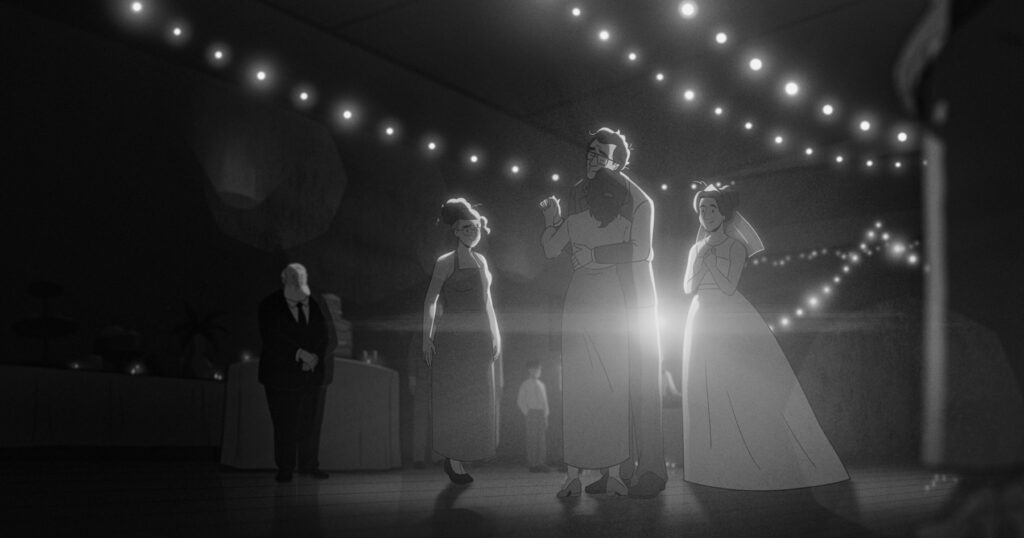
Watching Midge deteriorate while Sarah becomes increasingly torn between her hyper-independence and her desire to care for her mother, it never feels heavy-handed or saccharine. To be sure, this is an entry into the ever-growing canon of adult cartoons, resembling a hybrid of Persepolis and It’s Such a Beautiful Day for how it addresses loneliness, identity, and relationships.
I saw the film in IMAX, which was… strange. Spliced childhood flashbacks, like Sarah’s fear of monsters in the bedroom and her unease around her identity, are juxtaposed with playful elements, like the fantastical plane journeys Sarah takes between California and Maine, where, as a bit, the flight attendant announces her neuroses over the intercom. These scenes were stirring, if a bit overpowering in surround sound and curved display.
It’s certainly a tearjerker (sniffles soundtracked the final act of the film); an argument that animation can be one of the most powerful mediums to explore memory.
Carol Nguyen is another Canadian filmmaker with a tender approach to family illness. I knew the basics going into Still Night, Burning House, Nguyen’s debut feature-length documentary loosely focused on the investigation of her uncle’s tragic death and how it severed her connection with the paternal side of her family. Nguyen’s precision is magnificent: she conducts research in medical documents and photographs to piece together the events before the event, and complements it with striking cinematography on the streets of Ho Chi Minh City, where her father remarks that a bubble tea spot stands where their ancestral home used to be.
These uncanny moments are oddly comforting rather than unnerving. The interviewed family members take some time to warm up to the camera, but there is a consistent sense of familiarity, an unspoken knowing that radiates between them (and the viewer), particularly given so much about Nguyen’s uncle’s struggles with schizophrenia are left unsaid.
There is poetry to be found in movies, and such is the case with Still Night. To make sense of death, to process grief, it can be easier to sift the emotions through a lyrical funnel, experimenting with form through fragments. Through pauses. Their silence lingers like the smoke rising at the Vietnamese cemeteries, where Nguyen’s family sends off their departed with a burning ritual.
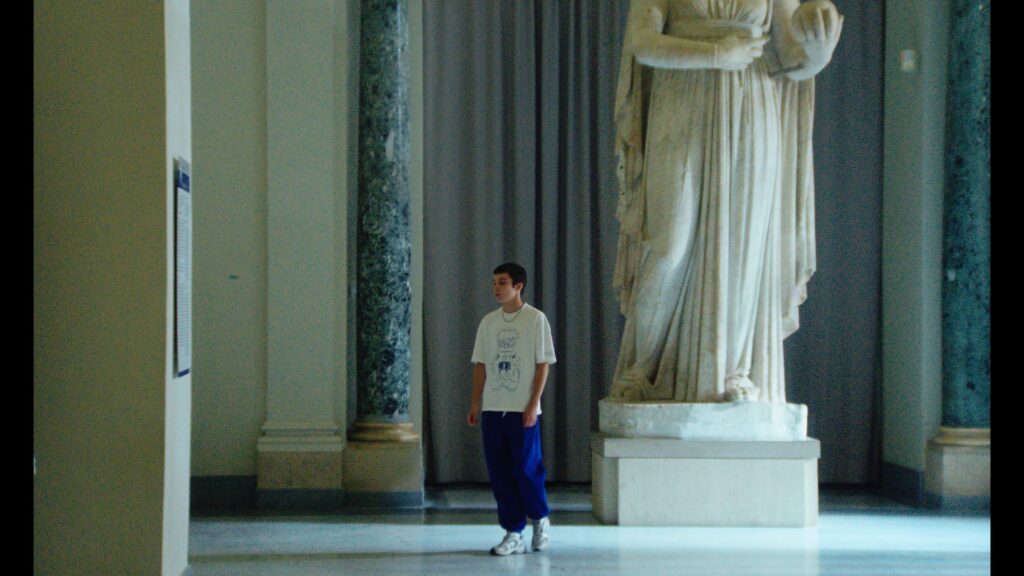
This time, it felt like a field trip. When in Toronto, and particularly when at TIFF, winding lines are par for the course, but this year, memories of school outings to museums and conservatories flooded back to me. Volunteers in Scotiabank Theatre, where most of the press screenings took place, held up signs with cinema numbers while manning their corresponding queues, leading press and market attendees into their screenings in single-file lines. I stood up straighter when we moved from the stanchions to the theatre and felt ridiculous. It all compounded upon watching La Gradiva, a French film set on a school trip to Pompeii. In it, some students act out for attention, others long to be invisible. The gradual unravelling of these characters creates a thrilling slow burn.
One scene, in which the students and their teacher are analyzing a fresco, was grating. This is a compliment. Mercier (Antonia Buresi) is pushing the teens to really go deep, pick apart the visuals and uncover a philosophy around the imagery that relates to eroticism, desire, and each other. Toni (Colas Quignard) is too cool for all of this, joking around with his best friend and crush James (Mitia Capellier-Audat) and taking the brunt of Mercier’s frustration, even when it’s a peer instigating. It felt long in the way that being a kid feels endless, and profoundly discomfiting, like trying to impress someone despite knowing it will never work.
Director Marine Atlan said she was inspired by a Wilhelm Jensen short story, one of Freud’s favourites by the same name. She’s orchestrated an ecosystem that at once feels contemporary and ancient. She builds tension so gradually by arranging teenagers among ruins and having them decide whether they will destroy each other or repair something within themselves. I won’t spoil it for you; either way, it’s devastating. But how beautiful to understand that everything that was once new decays in the end.
Movie theatre etiquette is in crisis. I wondered how TIFF audiences would fare, considering recent cinema sightings of sockless feet propped up on seat backs as if they were La-Z-Boys, and countless Tommy Texters lighting the rows. I checked myself for a moment. Am I simply jealous that people are truly being themselves in the cinema? Would I feel less agitated and maybe even free if I also ignored social norms and decorum for the sake of comfort?
This is a question that was answered, in a few different ways, upon watching Jesse Eisenberg’s The Debut. The film is a clear successor to Eisenberg’s previous work, exploring alienation, reinvention, and obsession. The lead role was supposedly written for Julianne Moore and Julianne Moore only. No small wonder: Moore is exceptional, playing the agreeable housewife who liberates herself from the shackles of complacency and domestic labour to realize dreams of participating in community theatre. Paul Giamatti delivers a thrilling performance as her exacting director, while Moore in particular is exceptional, liberating herself from the shackles of complacency and cooking dinner to realize dreams of participating in community theatre.
Movie theatre etiquette is in crisis. I wondered how TIFF audiences would fare, considering recent cinema sightings of sockless feet propped up on seat backs as if they were La-Z-Boys, and countless Tommy Texters lighting the rows.
I was surprised by how frequently I laughed, and was further delighted when everyone in the packed theatre applauded rapturously following a particular scene between Moore and Giamatti. Moore’s Mona only gets her part in the play by process of elimination (Serena Chery, played by Bernadette Peters, backs out), and then runs so far with the role that she turns into a nightmare, becoming foreign to her family and friends, yet oddly familiar to herself.
Many have made apt comparisons between this work and the seminal The Simpsons episode, “A Streetcar Named Marge,” though Miranda July’s All Fours also comes to mind. In both, the protagonists decide that they have had enough of playing by the rules and ignoring their impulses, thus leading to an indulgent journey of self-discovery, decorum be damned.
The joy found in the private resonance of other people’s absurd public behaviour. The pleasure found in a room full of strangers experiencing shades of that same darkness.
Hannah Ziegler is a writer from Toronto. Her work has appeared in AnOther, Nylon, and i-D. She writes about fan culture in her newsletter, Fan Mail.