
An Education in East Jerusalem
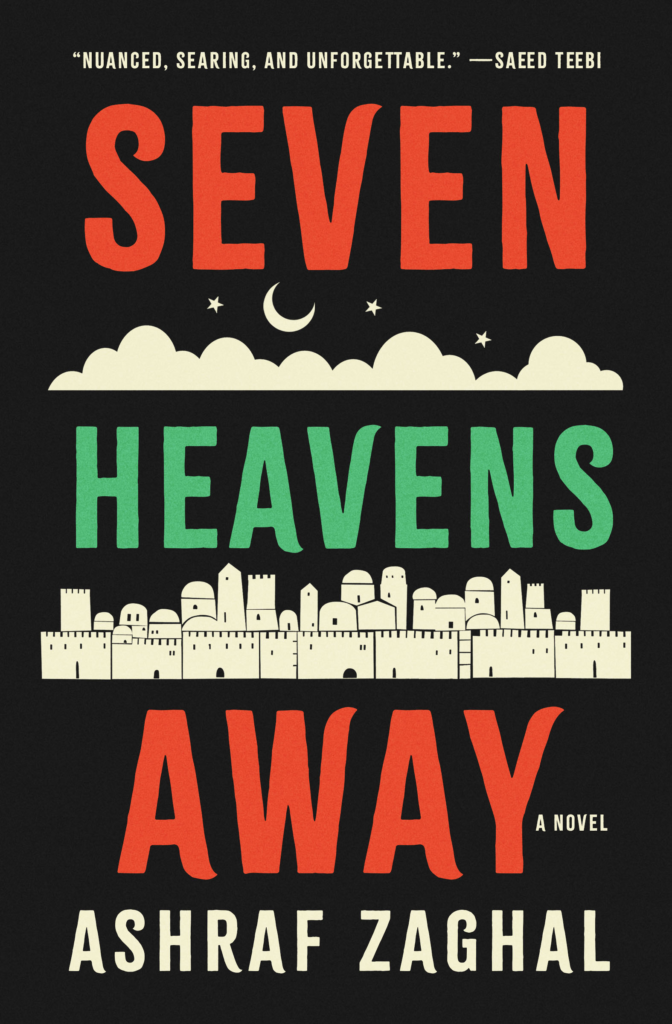
Seven Heavens Away: A Novel
By Ashraf Zaghal
House of Anansi, 328 pp., $26.99 (paper)
February 3, 2026
In my fourth grade class, we recently explored literary devices such as metaphor and hyperbole in our unit on poetry. “It’s raining cats and dogs” was much more difficult to explain, while “my homework took a thousand years to complete” made total sense. “Did your homework really take a thousand years?” I asked my 8 and 9 year old colleagues, with half a smile, and was met with laughter and “nooooooo!” in response.
“But it felt like it!” they said.
“How else can I explain that feeling?” I asked.
“You have to really emphasize it,” they’d tell me, pointing to their own chests and then pushing their hands outwards, telling me that words need oomf.
They make me a better writer. Their literary advice is almost synonymous with “show, don’t tell” and other adages you might hear in an MFA classroom. We call our classes “workshops” and they take them more seriously than you can imagine. These 9-year-olds are doing criticism: they’re asking why we use some phrases, where they come from, how we can communicate feelings beyond everyday, conversational language.
When poetry resists linearity, I find that no one understands or holds more closely to non-linear thinking than young people. I think children are the most reliable keepers of time. Maybe it’s my own teaching philosophy showing, but I feel that it is human nature to resist constructs such as time. When we’re small, our emotions are much more base, much more expansive, more immediate. It’s why our 10 minute recess feels like 45 seconds, and why nursery-aged children have many memories and stories to tell you about “when they were bigger once.”
That’s how Ashraf Zaghal’s debut novel Seven Heavens Away (House of Anansi) pulls in its reader. The novel opens with Palestinian teenager Aziz, on a plane to Toronto from Tel Aviv; from the sky, he considers that Jerusalem (Al-Quds) is really only a 45 minute drive from Tel Aviv: “I knew some who could make it in twenty minutes / Some who could not make it in twenty days.” It’s Aziz’s youth, I believe, that allows him to distill these varying interpretations of time—poetically, yes, but also incredibly concretely.
It is within this tragedy—compounded by the tragedies and indignities of occupation—that Aziz is expected to form and sharpen his political beliefs.
For most of the book, we’re set in the fall of 2015, a period known as the “Knife Intifada.” There were numerous uprisings by young people in Palestine, and in the same period, more than 200 Palestinians were killed at the hands of the IDF. The novel expertly weaves Aziz’s perspective as a young Palestinian boy in East Jerusalem with this reality: torn between the advice of two teachers, Aziz navigates his coming-of-age, education, forbidden crushes, the wills of his parents, and at the beginning of the novel, the sudden martyrdom of one his best friends, Hassan. And just like any other young person, he is guided by the wisdom of others while trying to let his own take shape.
Time is both relative and universal. Throughout the novel, I kept asking myself: what is the relationship between distance and time? How far away—in time or in space—must you be for the resonance of an event to hold more or less?
Aziz experiences time as simultaneously very fast and very slow, as children so often do. We the readers are given cues on time early on in the book. We know where Aziz is, and that time moves quickly for him as he traverses busy spaces: on buses mixed with the settler and Palestinian populations, grabbing lunch from street vendors with his friends, pausing only for the adhan, the call to prayer. We also are made aware of how the broader community moves through time, living tenuously and surviving the occupation, where the theft of time—through incarceration, border checkpoints, and more—marks the everyday. Though he is a touch older than them, and living under different kinds of pressures, I see and hear Aziz in so many of my students: when tragedy strikes early on in the book and “the world rearrange[s] itself into before and after,” Zaghal depicts the experience of time and memory (both long-term and short-term) that are experienced differently by youth than adults.
It is within this tragedy—compounded by the tragedies and indignities of occupation—and in grief and anger, that Aziz is expected to form and sharpen his political beliefs. Sheikh Abu-Hassan, a respected patriarch in their community, becomes more present in his life after the killing of his son, his guidance emphasizing a moral-steadfastness, patience, and dignity. Aziz’s friend, Mustafa, alternately embodies grief and resentment in the wake of this loss. Both boys receive mentorship and guidance from Abu-Hassan, though they differ in how they honour Hassan, and react to the violence visited upon them. It’s key that the Sheikh is Hassan’s father, thereby representing generational desires in which children are a form of wishcasting: they represent what is wanted by, and what is possible for, a people.
There are often struggles between these wishes, and what appear to be immovable binaries between Aziz and Mustafa: to meet violence with violence, or instead with apathy, or some form of patience, as well as confrontations with archetypes of the “terrorist” versus the “good” Palestinian. These are binaries presented so often that undoing them becomes a fight unto itself, or “the burden of pedagogy,” as writer and poet Mohammed el-Kurd names it in his book Perfect Victims: And the Politics of Appeal (2025). In the novel, Zaghal presents a challenge to these neat divides, and honours feelings of exhaustion, depletion, and agony alongside desires for justice, knowing full well that even the mildest attempt to imagine a Palestine free of occupation and settler violence is discredited and met with calls for annihilation. There is no “good” nor “fair” occupier, no way for the occupied to appeal to them.
As tensions following Hassan’s death escalate, and their corner of the city becomes ever more fragile, Aziz’s mother considers removing him from their home. She’s anxious, worried for her son and his future in the way mothers are. She prefers he stay close to traditional beliefs, and when he develops a friendship that further challenges said beliefs, Zaghal presents and challenges another set of oppositions: personal relationships versus political identity, or self-discovery versus familial and communal expectations. To settle these binaries (and the novel’s conflict as a whole) among adolescents is key. It is children, after all, who have continued to suffer in numbers in Palestine, and in Gaza, the median age of the population is approximately 20. Not only do children destabilize our understanding of linear time through their perspectives, their very presence presages a future.
Teachers are stewards of this possibility, making sense of the world for their students, so often transmitting the narratives that help shape their pupils’ understanding of and approach to their surroundings. Much like Abu-Hassan, Aziz is also counselled by Ustadh (teacher) Salim, his instructor in physics. Salim represents hard science and the tangible, yet he also encourages curiosity and critical thinking. Abu-Hassan, on the other hand, emphasizes spiritual discipline, obedience, and inherited knowledge. The tension between “ask why” and “accept what has been taught” is weighty, not just for Aziz, but for his two teachers as well. Both men are doing the best they can amidst unyielding violence that forces them to witness children and their students become martyrs, while they attempt to find new answers for how to move forward. Their responsibility is to advocate for a vision of what home could look like in the years to come, and to imagine what role Aziz and other young people will play in the Palestine of tomorrow.
Almost two-thirds into the novel, Aziz and Mustafa have a heated back and forth. Emotionally, they’re all over the place. There are accusations: Aziz’s crush on a girl who could teach him Hebrew is cast as a betrayal, and Mustafa coughs between retorts, evidence of his time incarcerated lingering in each breath. The boys’ conversation drips with grief as they miss their martyred friend, and, as Aziz calls them, “the old days.” It is here that they allow themselves to begin questioning their beloved Sheikh, compromising the perfect light in which he has been painted for much of the novel. Mustafa yearns for a father like him, but Aziz warns not to place him on a pedestal, naming his faults, and suggesting that perhaps his outward political stance and internal motivations may not be as congruent or noble as they seem. The boys debate whether they even need Abu-Hassan’s lectures anymore.
There are also other teachers, of course, beyond Salim and Abu-Hassan, such as Aziz’s mother or even Mustafa, each providing their own forms of knowledge, such as survival and pragmatism. But what is so strikingly represented in the novel’s two primary educators is how they live in the tensions between their institutions and their ethics, functioning as moral and political intermediaries. Perhaps the most important foils in the story, these two men parallel one another in their respective environments—the school and the mosque, the street corner and the home—with Aziz in between them. They both push and pull him towards and away from a collective identity, framing major events for him and the other youth taken under their wings.

“How do you know something?” is a question that comes up in my classroom. Education, at any time, in any place, is not just a means to acquire knowledge, but a lens through which one sees themselves and others, and a battleground for ideological influence. The source of knowledge is rarely as objective as we might wish for it to be. The novel encourages us to consider what education—broadly conceived—might be, as well as what it does and how. Any act of consciousness-raising is not neutral, and each teacher in Zaghal’s novel has their own desires for the kind of world for which they are hoping to prepare Aziz and the other children. Salim’s pedagogy is more secular and within reach—education as a means of ascension, of refuge, as safe in its scientific method and measurable results. His methods contrast those of Abu-Hassan, who speaks “as if every word carried the weight of history,” and who emphasizes spiritual and embodied knowledge dependent on the collective.
There are lessons, Aziz notes early on in the book, for which no classroom has prepared him and his friends. Science is for asking questions, he’s reminded by Salim, and I am then taken back to every question asked of me by my own students: “Why do we have to know this?” “Will this be something we need for grade five?” I laugh, sometimes teasing them about math skills that are so foundational they will follow them until high school. And then it’s “noooooo” again, and a pregnant pause: “How old… when will… how old will you be when we’re in high school… or university… or college?” I ask them to do the math, and when fingers are counted and sums added in their heads, the result is disbelief. How dare I not stay the same age, frozen in time for them? I sometimes wonder the same thing. What they are really asking is, “How far away from me will you be?” “Not far,” I want to tell them, always.
It’s this brilliant strain, between time and space, known intuitively to my little ones, that Zaghal ultimately unravels so well. The novel closes just as it opens, considering time and distance once again, as Aziz contends with what home will look and feel like for him going forward. Physically, the novel ends with him home, but it’s clear his journey is just beginning, as he carries his learnings with him, including his realisations of which to take with him and how. With age will perhaps come more discernment, and with time, liberation and a sense of belonging that outlasts any colonial clock, border, or rule.
Furqan Mohamed is a writer, educator, and arts worker from Toronto. Her writing has appeared in Maisonneuve, FASHION, The Local, and C Mag. She served as Guest Curator for the 2025 Mayworks Festival of Working People & the Arts, exploring fear, bodies, work, and labour justice. She currently hosts and curates Who’s Afraid?, a literary series dedicated to exploring the feared, haunted, alien, foreign, and more. Furqan is occupied by poetry, culture, knowledge-sharing, and abolition. She will be telling her kids about you.