
Petra Collins’ Dream Worlds
Petra Collins: STAR
By Petra Collins
Rizzoli, 176 pp., $60 (hardcover)
April 14, 2026
In the essay “Famous Strangers,” Rachel Kushner details her relations with celebrities: most of the meetings are unremarkable at best, disappointing at worst. “You can encounter a celebrity but you cannot know one, because the very status of celebrity is born of image and of distance—of unknowability,” she writes. It’s a sentiment that might ring true for Torontonians who saw actor Jacob Elordi passing by on Bloor Street in 2024, blending in but sticking out, his star power at odds with the Bulk Barn in the background. Kushner describes the particular uncanniness of being confronted by a figure you have, consciously or not, studied through a screen—one that will almost certainly not reciprocate the recognition, nor will they match the avatar into which they have been made.
Looking through Petra Collins’ early photographs conjures a similar experience born through that distant familiarity. The Toronto-born artist’s work originated with soft-focus photos of her friends gathered in local parks, smoking in bedrooms, perched on bathroom sinks—the stuff of teen myth-making. If you used the social blogging site Tumblr in the early-mid 2010s, you probably saw her sister’s boyfriend Fox on his last day of high school, an image that went viral. Or if you used to peruse the now defunct website of Rookie magazine, you certainly became acquainted with her recurring photo albums of teen witches and school dances, which established a dreamy visual aesthetic that would dominate digital culture for years to come.
Collins’ nightmarish cinematic universe employs theatricality to depict the latent horror of a young woman’s rise to fame.
This early 2010s period was the concurrent peak of both Tumblr and Rookie, two of the most influential sites where teens, especially young girls, developed their personal tastes and online identities. It was a time when images of typical teenage bedrooms carried the same weight as paparazzi shots of high-profile pop-stars. A cohesion materialized when scrolling past stills from Sofia Coppola’s The Virgin Suicides (1999), Lana Del Rey music videos, and Collins’ photos: they all embraced despondence as the ultimate generative affect. Much like the blogs on which they lived, Collins’ photographs were held together by a loose narrative of yearning, femininity, and grief for a youth that was not yet over. The subjects served as something of a portal—aspirational and aloof enough to be saved on a moodboard, yet relatable enough to project oneself onto. Her photos helped create and inform an emergent self, much like all of these images collaging a blog and establishing a digital persona: assemble the right photographs on your page, rack up some followers, and you too could become something of an internet celebrity.
While Rookie shuttered in 2018 and Tumblr has long been replaced by a mix of Instagram, TikTok, and Substack, Collins’ captivating style has endured. After making music videos with pop-stars like Olivia Rodrigo and Selena Gomez, and advertisements for Miu Miu and Coach, her latest project, a photobook called STAR (Rizzoli), harkens back to her halcyon days. It also hints at what’s to come, with a debut feature film on the horizon.
“STAR explores identity, authenticity, the mental and emotional toll of being watched, and how stories shift and distort when they’re told from the outside,” Collins describes in the book’s introduction. “I went back to the way I shot when I first began taking photographs. There’s something honest in that early instinct, quiet, imperfect, intuitive, that I wanted to return to. This book lives in the space between the real and the imagined.”
The visual tale, which spans a considerable 176 pages, envisions a group of girls as fictionalized pop-stars and obsessive fans, navigating the turbulent terrain of both identities. STAR marks a shift in Collins’ oeuvre—after years of her personal mythmaking being absorbed into mass culture (the HBO original series Euphoria somewhat infamously filched her penchant for fever-dream lighting and glitter), this work is as much a cautionary tale against the perils of fame as it is a comment on Collins’ own celebrity.

Collins’ stratospheric rise is not unlike that of a pop-star. She had already become a fixture on the Toronto arts scene as a teen, setting up a retrospective for the notorious avant-garde American filmmaker Richard Kern at the age of 17, as well as founding The Ardorous, an international female artist collective. There was a short stint as a student at OCAD, where she became a muse to photographer Ryan McGinley after he saw one of her shows. “She’s kind of Warholian: somebody who curates and is also an artist and a model,” McGinley told the New Yorker in 2016. It wasn’t long until, like so many other Toronto artists, she made the pilgrimage to New York City and then Los Angeles, where she currently resides. Her impish visual identity has now been translated into a clothing line with SSENSE and she has appeared in campaigns for luxury labels like Jean Paul Gaultier and Gucci (for whom she has also walked the runway at Milan Fashion Week). Scroll through her Instagram and TikTok comments, and they are filled with devoted followers asking her to direct their favourite pop-star’s next music video, or even their lives.
I discovered Collins’ work in Rookie, around 2012. Like many other 15-year-olds, I was beginning to uncover media that came to feel like another limb: The Virgin Suicides, Twin Peaks, The Craft, Freaks and Geeks, and My So-Called Life all packaged teenagehood as something to covet and aestheticize. I thrifted flannels, varsity jackets, crushed velvet dresses. I took photos of my friends in the park and posted them online. I created hyper-specific playlists that made every walk feel like a movie. I knew that all of this world-building was an appropriation of the realities of adolescence I’d seen on TV, but I thought I was doing something important and mysterious, even as thousands of other girls were doing the same things. I did not want to be famous, but I think I wanted to be seen. Emulating teenage stories outside my own experience was a way to fulfill this desire.
This is, in short, the experience of being a fan. Performing devotion, performing a persona. Collins’ photos were so compelling, in part, because there was a cool distance between subject and viewer. At a surface level, her images are intimate—teens sprawled on grass, leggy and self-assured, the back of a girl’s neck, the intention of her bra strap peeking out. But the haze hides something. In images of Collins’ figures taking selfies and texting at parties, we get the sense that the subjects’ real worlds are actually contained in their phones. In critic Mark Fisher’s words, here the personal is not political, but impersonal. “It’s miserable for anyone at all to be themselves (still more, to be forced to sell themselves),” he wrote in Ghosts of My Life: Writings on Depression, Hauntology, and Lost Futures. “Culture, and the analysis of culture, is valuable insofar as it allows an escape from ourselves.” As a matter of fact, Collins has said that these images were not at all aligned with her own teen experience. “I wanted to be a teenager so badly,” she told Highsnobiety in 2020. “What I was capturing, I guess, was half of my angst and then half of this nostalgia for something that never happened.”
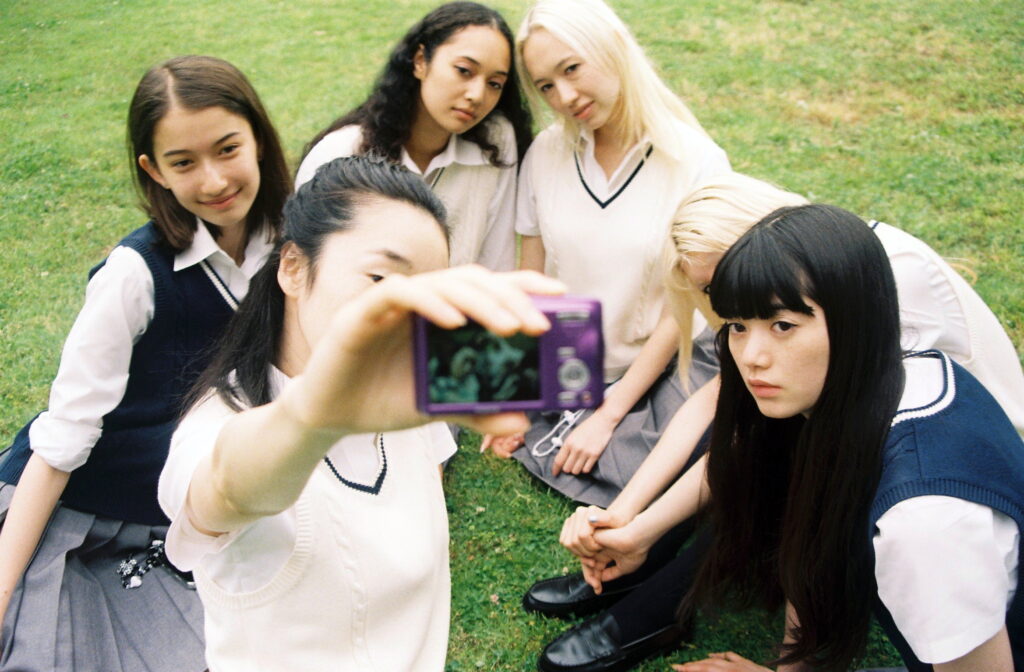
While phones are notably absent from STAR, there is a selfie scene, taken with a compact digital camera. It is a quintessential Collins arrangement: six young women in schoolgirl uniforms sit in a circle on a field, tight smiles and a hint of boredom in their eyes. Collins’ story tells us that they are a teen girl group called Siren8. They have joined forces with solo artist Ashley, who was plucked from obscurity at her school talent show and thrust into the spotlight. There is a darkness underneath their pageantry—or perhaps it is the stiffness and discomfort that comes with being watched. We see it in the clutching of one girl’s hands and the tilt of another’s head.
Collins’ photos were so compelling, in part, because there was a cool distance between subject and viewer.
“I made the book so that when you read it, you don’t know who the author is, really,” Collins explained in an interview with Climax Books. “It could be the star, it could be a fan in their bedroom, or it could be a stalker. It’s sort of this God image of what the girls are.”
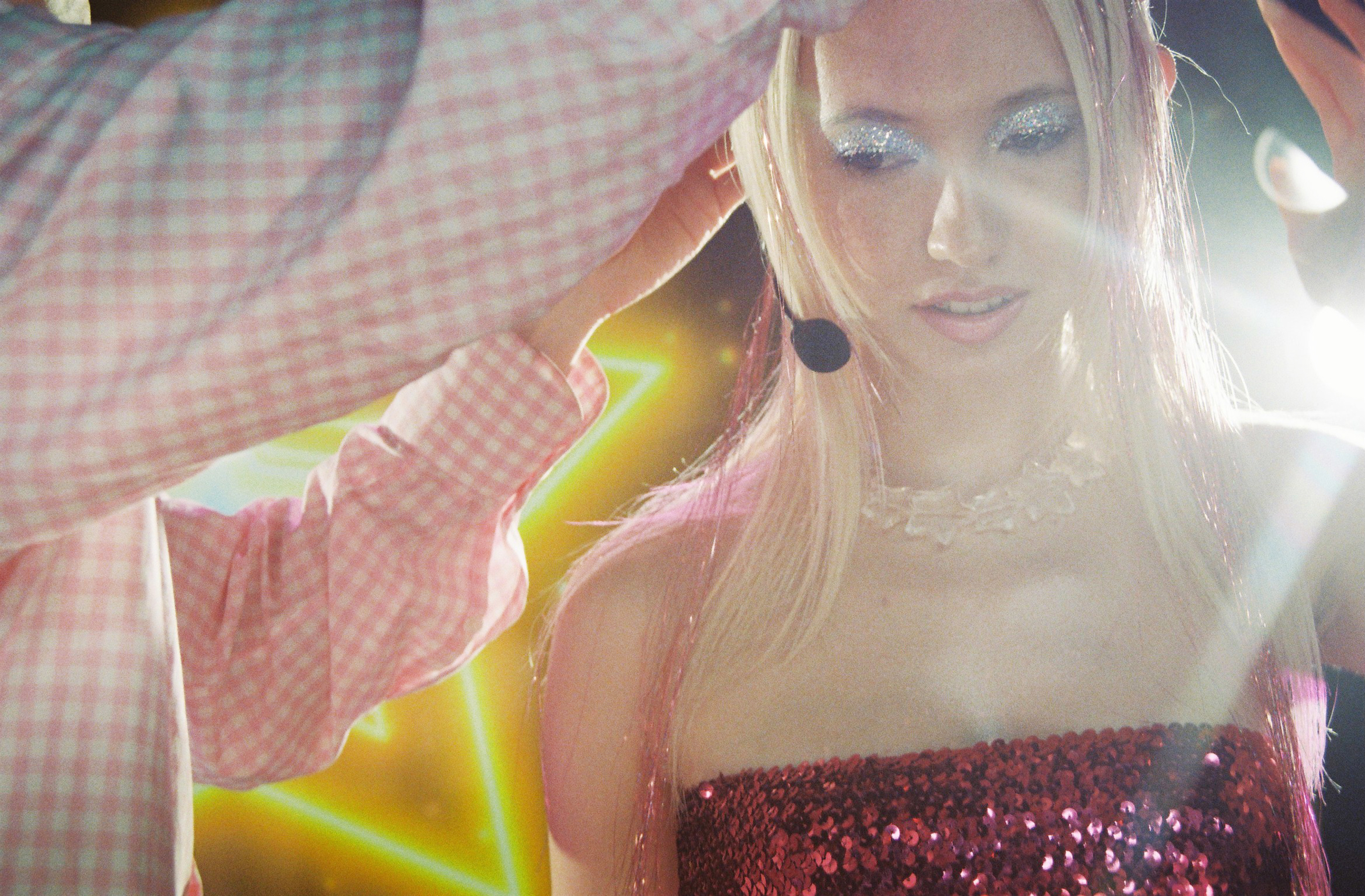
One of the very first images in the book is not a traditional photograph, but fan art of Ashley in a ruled notebook. We see her rendering (drawn by the character of b, an obsessive fan turned stalker) next to a Hannah Montana-esque glossy close-up primed to be postered on bedroom walls. Her eyelids are covered in silver glitter, and her hair is streaked with pink tinsel. She gazes at something or someone out of the corner of her eye. We know that this polished ideal is doomed: b has placed gashes on her Ashley drawing’s shoulders, while the accompanying handwritten note confesses, “I wish things hadn’t gone the way they did.”
It’s clear that b’s love, devotion, and obsession are driven by some sort of morbid fantasy—she wants to have what Ashley has, so much so that her desire becomes shaded with violence. “The power of the glamorous resides in their supposed happiness,” John Berger wrote in Ways of Seeing. “It is this which explains the absent, unfocused look of so many glamour images. They look out over the looks of envy which sustain them.”
There is no question here that the images are highly staged, styled, and scripted. But they are also perhaps the most honest ones Collins has produced in years. It would be too obvious and overplayed to depict the brutality of celebrity exactly as it was in the aughts—the unforgiving paparazzi flashes reflecting through Bentley windshields, a zoom lens revealing an incriminating set-up on a balcony. Instead, Collins’ nightmarish cinematic universe employs theatricality to depict the latent horror of a young woman’s rise to fame.
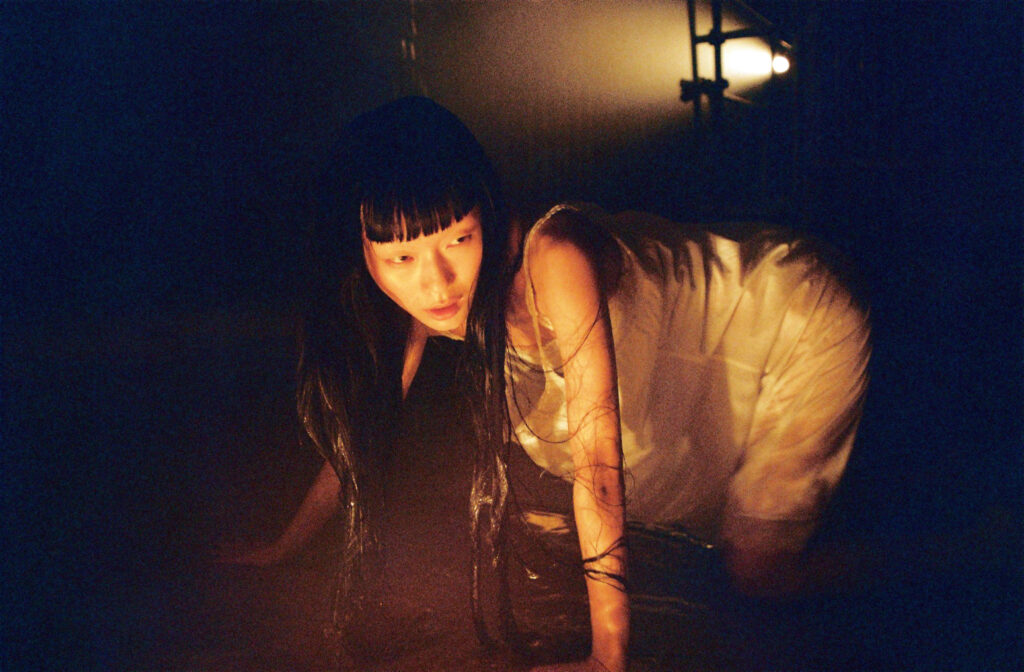
Much like pop stardom is inherently referential (let’s not forget when Madonna called Lady Gaga’s music “reductive”), the images in STAR pay tribute to films like Death Proof (2007), Audition (1999), Kill Bill (2003), Perfect Blue (1999), and The Virgin Suicides—the common thread among them being the dangerous and volatile nature of obsession. In The Virgin Suicides specifically—a consistent inspiration for Collins—we are guided into the Lisbon sisters’ universe through the literal lens of their fans, i.e. teenage boys who live across the street and spy on them through binoculars. Most of us can place ourselves in the boys’ shoes, lusting after someone or something that feels far away, even if they are technically close enough to touch. It’s more appealing (and alluring) to romanticize the girls—enigmatic and mythic in their cotton dresses, inaccessible behind closed doors.
To idolize someone is to attempt to enmesh yourself in their story. In this way, literary scholar H. Porter Abbott raises questions about narrative as inherently participatory: “Are stories … at the mercy of the reader and how diligently he or she reads?” Likewise, whether a celebrity has control of their story beyond its genesis is up for debate—if history, and these photos by Collins, have revealed anything, it’s that the viewers are ultimately the ones wielding the power. With STAR, we are left to cobble together clues and flesh out dynamics between characters through cryptic imagery, assigning meaning to glances and tracking trails of blood. It’s detective work that superfans know all too well, and a job that most of them would never give up, relishing the puzzle more than its ultimate assembly.
Memories of a car crash will tend to eclipse the stretches of road that preceded it. Britney Spears’ public downfall comes to mind: no doubt the image that is burned into the collective consciousness is the one of her shaving her head in 2007, or else her wielding an umbrella like a crowbar against a paparazzo’s car shortly thereafter. Much has been said about the photos, her well-being, her social media presence, and her attempt at setting the record straight with her 2023 memoir, The Woman in Me. But these photos will outlive anything else said about those nights. Some may argue that these images depict a woman attempting to regain control of a life that was not her own. Some say it was simply a well-documented breakdown, illuminating the deteriorating state of her mental health. What is undeniable is the way that these images have been repurposed and recontextualized alongside the internet’s evolution. On Tumblr (where else?), it was not uncommon to scroll by edits of these photos in a glitter frame, or with a “literally me” caption, claiming a likeness to Britney’s burnout and anguish. For $3.99, you can buy a sticker of her with a shaved head on eBay and put it on your laptop. Years after the fact, we have been projecting ourselves onto the star, moulding her to fit our own imagined worlds. Aestheticizing the pictures shifted the narrative around an objectively distressing story. Similarly, I can’t help but think that without Collins’ purple and pink glow surrounding the cast members of Euphoria, the show would be nearly unwatchable with its relentless trauma and exploitation on full display.
STAR acknowledges how quickly fame’s sparkling facade can dissolve into destruction. In one scene, Ashley is found in a field, assisted by two nurses who lead her to a shiny, white hospital. She is in a pink medical gown, lost. We’ve seen this look before—glazed eyes, there but not really there. The person we think we know so well seems to have forgotten who they are. In a dream-like sequence, Ashley is also an accomplice to a man’s murder, making for one of the most striking photos in the book: b clutches a freshly dissected human heart in her hands, while her roadkill (the man) lies in the background, on a desolate strip of highway. She is self-possessed, a foil to Ashley’s fugue state. B later emerges on stage in sequins, effectively replacing her idol. But much as in Satoshi Kan’s Perfect Blue, whose protagonist’s identity is dismantled as her star rises, we as viewers are left to parse what is real and what is imagined in Collins’ photos.
We will never truly know Collins’ subjects—both the real celebrities and the ones she has made up—even though her dream-like worlds have come to feel like second homes. It’s not because of intimacy that her photos resonate; conversely, the magic is in their gauzy remove. It’s this wide open space that affords fantasy, an unlimited projection of desire. As long as she keeps us at arm’s length, Petra Collins will always have fans.
Hannah Ziegler is a writer from Toronto. Her work has appeared in AnOther, Nylon, and i-D. She writes about fan culture in her newsletter, Fan Mail.