
Save the Pupfish
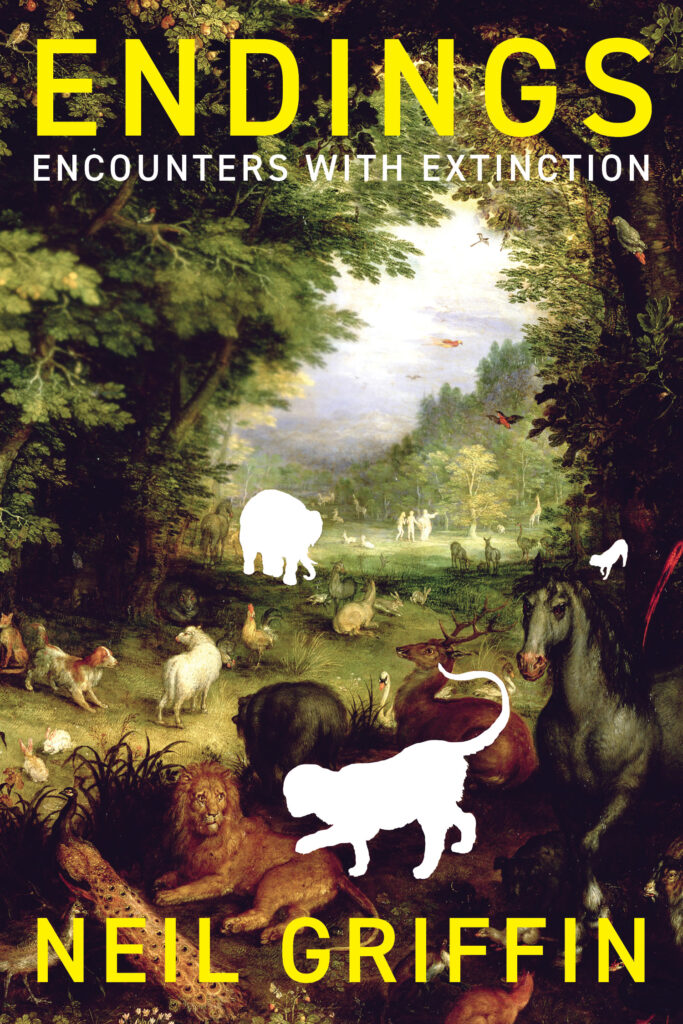
This essay is excerpted from Endings: Encounters with Extinction by Neil Griffin, published by House of Anansi on September 22, 2026.
It is impossible now to imagine a world without the knowledge of extinction. Even an evangelical who insists the Earth is only 6,000 years old, or a titan of industry with a paycheque (and a conscience) dependent on a selective understanding of ecology, is unlikely to deny the reality that species can disappear from the face of the Earth. Some might question the magnitude or deny extinction’s relevance—surely profit overrides concerns as paltry as material existence—or they may argue that all things, death and life together, are manifestations of some ultimate, unknowable plan. (A well-thought-out plan, you’d hope, though evidence suggests otherwise.) But it’s rare to hear anyone outright deny extinction. Extinction is knowledge that, once known, cannot be unknown—only mediated.
That hasn’t always, or even often, been the case in human history. Extinction as a process is as old as life on Earth, but extinction as accepted knowledge in the scientific West dates only to the 1800s. Before that, to suggest that a species, perhaps even humans, might be erased from existence was radically subversive. The science of extinction is younger than the invention of the bicycle.
The man who codified extinction as a scientific fact was Georges Cuvier, a scientist and bureaucrat working in post-revolutionary France. Like many scientists, Cuvier was an obsessive collector. Throughout the late 1700s and early 1800s, his work was focused on the creation of a complete encyclopedia of animal life, a multi-volume work called Le Règne Animal (The Animal Kingdom). From his office at the National Museum of Natural History in Paris, Cuvier solicited animal specimens from around the world. He wrote letters to soldiers and colonists, priests and merchants, asking them to capture whatever they could find, from the smallest insect to the largest mammal, and ship them to him, COD.
That species can be eradicated ought not to be a regularity of life, like taxes or flat tires, but should be considered a grave crime against the past, the present, and the future.
They responded in droves, and soon his office was stacked with crates of wildlife in various stages of preservation and decomposition. The smell must have been horrendous. Cuvier’s rooms at the museum looked out over the Seine, and to offset the smell he pried open his windows. The mingled sweet and sour pierce of decay swept out into the Parisian summer, descending on the heads of promeneurs as they strolled along the riverbanks. Liberté, égalité, and formaldehyde were thick in the air.
Along with recently deceased wildlife, Cuvier collected fossils, particularly of strange, elephant-like creatures from across northern Europe and the newly independent United States of America. It was Cuvier who first recognized and named the woolly mammoth and the mastodon, and it was Cuvier who first suggested that they were not, in fact, African elephants who’d been transported to the Arctic for a laugh but were instead wholly different species. Species that were now, he wrote for the first time, lost, annihilated, or wiped out. In other words: extinct.
Cuvier presented his theory of extinction in an 1812 work with the catchy title The Preliminary Discourse. It is one of the titanic, paradigm-shifting works of Western science, belonging in the pantheon with Darwin’s Origin of Species, Galileo’s Dialogue, and Newton’s Principia Mathematica. Unfortunately, Cuvier was a miserable prose stylist, and even The Preliminary Discourse—his most lucid work—is a difficult read. (Darwin, it’s reported, once dropped out of a geology course to avoid reading Cuvier.) In Discourse, Cuvier marshals a remarkable breadth and depth of evidence—biological, geological, oceanographic—to argue that the world has undergone at least four significant catastrophes, moments that rearranged the shape of life on Earth. Life, he argues, is fragile, finite, and always at risk of being blown away.
Incidentally, for all his hard work, Cuvier missed something. (It happens to the best of us.) The first concrete mention of extinction in scientific literature actually appeared in 1770, 42 years before Cuvier’s Discourse. It came in a letter sent to another French scientist, the Comte de Buffon. Buffon, during his reading and writing, had become fascinated with a plump, flightless bird, living on the small island of Mauritius in the Indian Ocean. We know it as the dodo, although it has had many names. Buffon found the available information about the dodo to be infuriatingly vague, contradictory, and unreliable. He wrote to the tiny Dutch colony ensconced on the island asking for clarification and, if possible, some specimens. A hospital clerk named Morel replied. The birds, Morel wrote, no longer existed. They were lost forever.

Extinction should still be a radical idea. It ought to shake the very foundations of our often complacent approach to existence. Instead, extinction is banal. It surrounds us every day, in headlines and news tickers and social media feeds, but only as another thing to scroll through or pass by. I find this strange. Any given species on Earth, from the smallest mite on the eyelashes of a rat to the sublime, cathedral-like redwoods of California (really, we should refer to cathedrals as being “redwood-like”; the trees, after all, were here first), is the result of hundreds of millions of years of evolution. Every living species is a survivor against almost impossible odds. That species can be—that species are being—eradicated ought not to be a regularity of life, like taxes or flat tires, but should be considered a grave crime against the past, the present, and the future.
But what of de-extinction, perennially in the news? Scientists clone a woolly mammoth; click this YouTube link to hear a dire wolf; soon Irish elk steaks will be available at a butcher near you.
De-extinction—scientific resurrection—offers one of life’s most tantalizing propositions: a do-over. Load your last save, begin again with all the knowledge that you have now. If we could only bring back the Pinta giant tortoise, we’d do it right this time.
The final passing of the last living member of a species is without a doubt a poignant moment, a locus of emotion. But ecologically it’s less important than the point where the total population of the species dipped below the minimal viable population (MVP). The MVP is the estimated number of living animals needed to keep a population alive over generations, through the challenges and catastrophes of existence: natural disasters, genetic mishaps, demographic change. While the number varies from species to species, for vertebrates in general, ecologists estimate the MVP to be 3,700 individuals.
That’s not quite as romantic as hearing the last Kaua‘i ‘ō‘ō sing its mating song into an eternal silence and mourning the voiceless woods. (This is probably why Mary Shelley called her novel The Last Man, and not The Last Minimally Viable Population.) But I think it’s important to be clear about the science.
De-extinction may resurrect an individual animal of an extinct species. And I will be the first in line at a zoo or nature park in Brisbane or Colorado or Madrid to view the thylacine (brought to you by Shell) or the dodo (property of Meta). But one or two living individuals is a far cry from herds of mammoths wandering through Irkutsk, or million-strong flocks of passenger pigeons grounding flights out of Pittsburgh International.
Make no mistake: on an ecological scale, extinction is permanent.
In Nevada’s Amargosa Desert, just east of Death Valley, there is a hole in the Earth. It leads to a cave system filled with hot-tub-temperature water and descends to a depth whose reaches have never been fully mapped. Members of the United States Geological Survey have described it as a “skylight” to a subterranean realm—some evidence suggests it may be linked to Mexican cave systems over 3,000 kilometres away. It is called, with a little melodrama and some sloppy punctuation, Devils Hole, and is home to a species of fish that exists nowhere else on Earth.
The Devils Hole pupfish is an innocuous creature. It is a small fish, growing to only a few centimetres long, but with an outsized charisma. Scales a rippling night-sky blue and pale green fins rimmed in black. You could imagine it at home in a dentist’s office aquarium, if you wanted for some reason to do that, except for one hitch: the Devils Hole pupfish is probably the rarest species of fish on Earth, with less than two hundred individuals, all of them living in Devils Hole. (A low but stable population, spitting in the face of MVP science. Ecology is complicated and strange, and abhors a scientific law.)
The water level must be maintained to preserve the existence of an economically inconsequential, virtually anonymous, little blue fish.
Since the discovery of the pupfish in the 1930s, their existence has been under constant threat. Local developers wanted to fill in the hole, to pave over it for real estate. Ranchers wanted to drain it for the water. In the late 1960s, a newspaper editor in a nearby town threatened to dump pesticide into the hole and kill them all. The county commissioner at the time, Robert Rudd, sold bumper stickers that read “Kill the Pupfish.”
Instead of an existential crime, extinction is usually accepted either as an inevitability of progress—the ranch needs its water, the suburbs must grow—or as something impossible to prevent. Conservation’s oldest problem: what can I, an individual, do against the arrayed forces of international global capital? And anyhow, extinction is inevitable.
We all go the way of the dodo eventually—or the dinosaurs, or really any of the other 99 per cent of life in Earth’s biological history that has already gone extinct. But I don’t think that’s what we mean when we think about extinction being inevitable. I doubt that we’ve all become detached philosophers, conceiving of species death as a metaphysical eventuality. I have met some scientists who think like that, but I suspect they’ve forgotten how to be human: statistical code chugs through their arteries, and in place of a heart they have a spreadsheet. More likely, inevitability is a psychic defence. If I believe an outcome is beyond my ability to alter, then I do not have to wrestle with the possibility of failure, with the chance of anguish or loss or defeat.
It’s rope-a-dope with despair. I may never win, but I’ll also never lose.
In 1952, President Harry Truman used a piece of American legislation called the Antiquities Act to create the Death Valley National Monument. The act was created by Theodore Roosevelt, the first conservation-minded U.S. president, and allows for the unilateral, executive protection of land deemed culturally, historically, or ecologically important. The Death Valley National Monument included Devils Hole under its aegis, ensuring a baseline of protection for the endangered pupfish. In 1968, the State of Nevada attempted to undermine the federal legislation, granting permission to the Cappaert ranching family to drain water from Devils Hole. The United States government sued the Cappaerts, and in 1975 the Supreme Court heard the case that would determine the fate of the Devils Hole pupfish. It was fish versus man, preservation versus progress. Who would have bet on the fish?
But conservationists had an ace in the hole. The most senior justice on the court was William O. Douglas, a Franklin Roosevelt appointee, dedicated outdoorsman, and environmental lawyer. Douglas had grown up fishing and hunting in the forests around Yakima, Washington, and brought a love of the wild with him to the capital. He was very nearly FDR’s running mate in the 1944 presidential election, but for some chicanery at the Democratic Convention. FDR favoured Douglas, but the people around him favoured Truman—a man they deemed more pliable. Presidents in those days did not pick their own vice-presidential candidates, so Truman won, eventually becoming president when FDR died in office.
Ecology is complicated and strange, and abhors a scientific law.
Imagine, briefly, a different post-war America. On Franklin Delano Roosevelt’s death, President William Douglas is inaugurated. He is a man who loves conservation and the wild—he has no patience for suburbs or interstate highways and he dreams of a world where every person has the right of communion with wild places, not the right of conquest over them. How different might our current world be?
But the world’s loss was the pupfish’s gain. It was just the sort of case Douglas was looking for: an opportunity to reaffirm the federal government’s land rights over an uppity state, a chance to legislate water rights in the dry West, and a moment to make an argument for a vision of a still-wild country. The State of Nevada, representing the Cappaert family, drowned themselves in a semantic argument. The Death Valley National Monument protects only the surface of the land, Nevada’s lawyers said, but subsurface water—such as the Devils Hole cave system—lies deeper than Washington is allowed to reach. Ranchers should be able to draw from the water if they are drawing from deeper subsurface water. Call it the legislative argument for longer hoses. If the pupfish went extinct because the water level lowered, well, that was hardly the ranchers’ fault. Maybe the fish should’ve moved with the lowering water levels.
It doesn’t read to me like a strong argument. Nor to the Supreme Court. The Court’s argument was built on the dusty bones of all legislation in the North American West: water rights. Nevada was incorrect, they said in their decision. In areas of national importance, subsurface water belongs to the federal government. If we want to be starry-eyed and a little naive, it belongs to a democratic whole.
What is remarkable is the end of their final decision, where all arguing over water fell away and the justices stated plainly: the water level must be maintained to preserve the existence of an economically inconsequential, virtually anonymous, little blue fish.
And so, the Devils Hole pupfish is not extinct. The newspaper editor who threatened to dump pesticide in the water was briefly held in jail. The anti-pupfish county commissioner lost his re-election campaign. And the Cappaert family sold their ranch and moved on.
Today, the pupfish’s population is monitored year-round. In 2013 the species faced extinction again, dropping to only 35 individuals, before rebounding to 263 in 2022. You can buy “Save the Pupfish” coffee mugs and bumper stickers from local gift shops. I have one on my laptop, and people sometimes regret asking me about it.
Even when it appears likely, extinction need not be inevitable.
Neil Griffin is a writer and naturalist from Calgary, Alberta. Raised on the prairies and trained as a wildlife biologist, for over a decade he tracked the disappearing and the dead of our world, from Canada’s boreal forests to the Amazon basin, from Ethiopia’s Afar desert to the Virunga Mountains of Rwanda, before giving up the glitz and glamour of tropical fieldwork for the financial stability of freelance writing. He holds an MFA from the University of Victoria, where he is an instructor in the Department of Writing.