
Becoming a Gen-Z Novelist
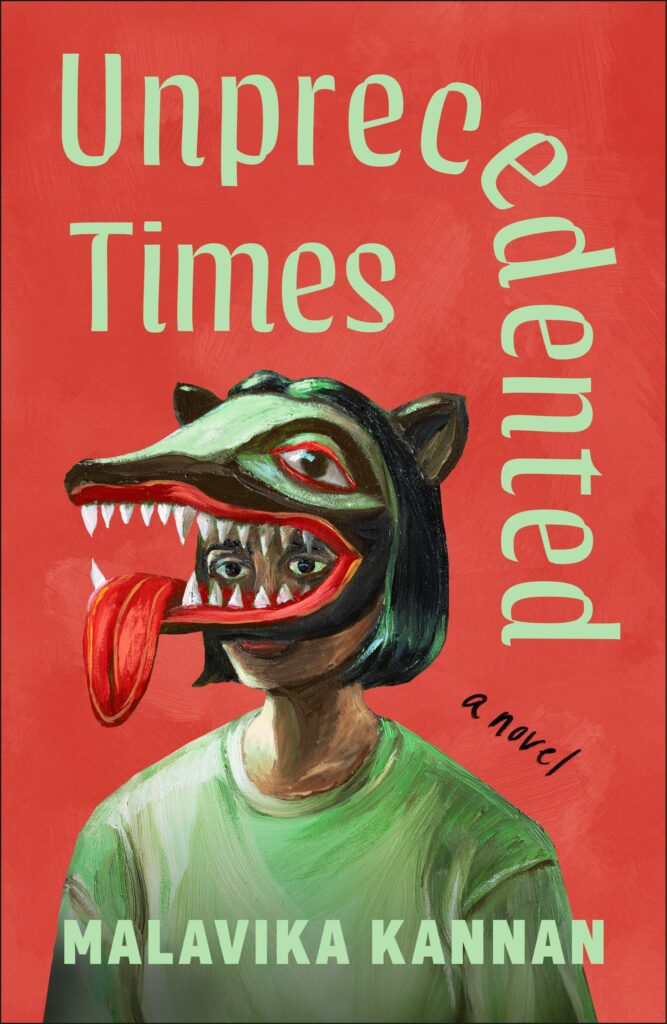
Unprecedented Times: A Novel
By Malavika Kannan
Henry Holt and Co., 352 pp., $25.99 (paperback)
August 18, 2026
In my first year of university I took a class on world issues. Each week I would download a stack of PDFs on a different issue threatening humanity’s collective flourishing, in an effort to become conversational in it. The first week tackled neocolonialism, a word I had never heard before; then we read about neoliberalism; then we covered the climate crisis. Just a week on each topic, enough time to process one horror before moving onto the next.
Because it was the fall of 2020, I did these readings from the comfort of my childhood bedroom in North Toronto, where my own biggest problems were being bored and not having had a real high school graduation. At a time in my life when my hobbies included watching The Great Canadian Baking Show, going on walks around the block, and staring at the wall, the course connected me, albeit virtually, to things that felt real and important. I opened myself up to the material, and I tried to let it change me.
Anyone who has been a humanities student knows this feeling: discovering language for things you’d only sensed, transforming impressions into ideas for the first time. While the broader world around us seemed to be collapsing, new language and new knowledge energized me and my peers. Confronted with a million frameworks for a better future—democratic socialism, eco-feminism, transhumanism, anarcho-communism—we started to envision that the right one might send the world spinning on a new axis. We allowed ourselves to think that humanity, with its fresh horrors assigned each week, might actually be okay.
Sometime around the middle of the term, when our optimism began to dissipate and our minds began to fill with concerns about midterm exams, a classmate posed a question that many of us had already asked ourselves privately: “What are we supposed to do about any of this?” Anyone who has been a humanities student knows this feeling too: when the power contained in books and lectures gives way to powerlessness, when all that information and all that passion suddenly feel heavy and useless in your hands.
The protagonist of Malavika Kannan’s novel Unprecedented Times (Henry Holt and Co.), who is herself an undergraduate, knows the feeling well. “I don’t think I can care about every issue on earth,” she confesses.“Does this make me a bad person?” This is one of the central questions of my generation, a group which has come of age inundated by real-time news notifications, Instagram infographics, and the overlapping pressures of accelerating crises. For the humanities student, this is also a central question of the university experience: what to do with the knowledge of a broken world.

At 25 years old, Kannan is not too far out of university herself. Her third novel (and first for adults) Unprecedented Times follows climate activist turned writer Rishika Kumar through the beginning of her degree at Stanford University. Rishika, who goes by Rishi, tries to figure out both how to live her life and how to write it. She attempts to create coherent narratives about everything from her parents’ immigrant experiences, to her queer identity, to her first sexual encounters. She agonizes over what sort of person she should become, noting that “it is cool to be extremely anti-capitalist, queer, and grungy, but it is equally cool to own a yacht. What about those of us in the ambivalent middle?” Belonging to a generation raised with unprecedented access to information about the world, Rishi struggles to know what to do with it. She wants to be anti-establishment, but she also wants some kind of legible social power. Should she try to be a good person, try to care, or should she optimize her life and go for the yacht?
Kannan seems to imply that such novels, with mostly white casts of characters and non-committal racial politics, are flattening Gen Z while they supposedly define it.
Kannan has been proclaimed “an inimitable voice of Gen Z,” a claim that will certainly make eyes roll and eyebrows raise. I hardly need to explain why the “voice of a generation” moniker is fraught: it necessarily flattens the diverse experiences of an entire cohort. Ironically, Kannan has poked fun at the concept herself, writing earlier this year for Vulture that “each month, it seems, a new white woman writer receives a big book launch, ‘voice of a generation’ allegations, and media coverage that links her glamorous, Googleable personal lore to her book itself.” Her critique is clear: the semi-famous hot white girl with the book deal probably does not have much in common with the rest of us. So, who died and made her queen of a generation?
In her review for Vulture, Kannan argues that many of these so-called generational novels, like Madeline Cash’s buzzy Lost Lambs (Farrar, Strauss and Giroux, 2026), engage with race in a way that is both too reactionary and too tame. Kannan seems to imply that such novels, with mostly white casts of characters and non-commital racial politics, are flattening Gen Z while they supposedly define it.
Endlessly self-reflexive and featuring a very diverse set of characters, Unprecedented Times is unlikely to be accused of homogenizing an entire generation into a single set of experiences. But it is also a campus novel, and most contemporary campus novels contain a certain generation-defining impulse. Sally Rooney sets Normal People in 2011, capturing the impact of post-Celtic Tiger class dynamics on the Irish college experience. Elif Batuman sets The Idiot in 1995, focusing on how digital communication shaped college conversations and connections. Jeffrey Eugendies sets The Marriage Plot in 1982, to observe the changing norms defining love and marriage. Each of these writers goes back to the moment of their own college experience, sifts through intellectual discoveries and first loves, and attempts to pinpoint the social forces that most impacted their generation.
Operating in that tradition, Kannan brings us back to 2019: her first year of college, and our last “normal” year before the COVID-19 pandemic. Hers is a college experience mediated by masks and rapid antigen tests, Instagram posts and dating apps, Mary Oliver poems and American Girl Doll books.
And like a true member of the social media generation, Rishi performs college as much as she experiences it. At the start of the book, she tells the reader that she intends to experience heartbreak “literarily and expeditiously.” Later, upon meeting her creative writing professor, she resolves: “I need to write something to impress her. I need to live my life.” At another point, she laments her parents’ “inattention to their own plots.” Rishi sees her life, first and foremost, as fodder for storytelling.
She approaches her experiences from a distinctly writerly standpoint, crafting the narrative arc of her life like she’s the main character of a novel—which, of course, she is. But her desire to live life like it is content to be consumed is also arguably a Gen Z impulse. I imagine that, like me, Rishi spent her formative years announcing herself on the internet, learning to filter her life to maximize comments and likes. Perhaps as a result, she constantly searches for the narrative and aesthetic value of her experiences. Whether her first semester of college exists in service of her Great American Novel, or whether it exists in service of the cute, curated “photo dump” that will inevitably be posted on Instagram over winter break, it demands an audience either way.
Rishi’s self-mythologizing tendencies are encouraged further in the “Asian American Autofiction” workshop she attends during her first semester. The instructor, Easha, is known for having written “an eponymous novel about Leela, a millennial brown woman who, as far as I can tell, does nothing but mope and sleep with white men, but it is cool and literary, so Leela was a bestseller.” A voice of her own generation, by the sound of it.
Indeed, autofiction has come to dominate English language lit-fic in the last 15 or so years, with authors like Sheila Heti and Ben Lerner among its biggest stars. Millennial writers of autofiction began publishing after the dawn of Facebook, reality TV, and blogging, and so their works often have a distinctly online flavour, achieved through messy first-person perspectives, self-conscious narration, and close attention to the everyday. But autofiction was a label given to these writers by critics, and remains one which the writers themselves are hesitant to claim. Heti, for example, expressed resistance to the “autofiction” label for years, once calling it a “bad category.” Writers argue that, if literature has drawn on identity and experience for as long as it has existed, then autofiction isn’t all that distinct from other kinds of fiction.
But regardless of whether autofiction is being practised by writers or projected by readers, it is undeniably shaping the contemporary literary landscape. Today, the label appears in swathes of marketing blurbs each season. A cynical analysis of autofiction’s popularity would conclude that it is a symptom of our cultural narcissism, a product of our stifled imaginations, or a manifestation of the capitalistic impulse to commodify every inch of ourselves and our lives. A more optimistic characterization might suggest that autofiction is a testament to the plurality of literary voices entering the mainstream, or that it is a uniquely modern iteration of a long tradition of women’s confessional writing, or that it simply invites us to care about one another’s lives in an otherwise individualistic world. But all these perspectives share one common belief: autofiction is a sign of the times.
Autofiction animates Rishi from the earliest scenes of the novel. When Easha tells the class that “the fictional premise gives authors the freedom to reimagine their lives, consider alternate endings, turn everything up to the max,” Rishi hangs on her every word. And as the novel progresses, it starts to gesture towards its own existence—suggesting, in increasingly explicit terms, that the novel you are reading is itself the product of Rishi’s autofictional ambitions. Rishi’s friend Kavya even suggests that Rishi might someday write about the pandemic, then adds: “your autofictive power is beyond me.” The book begins to feel like a character in Rishi’s story, the ultimate manifestation of her desire to perform the most interesting version of herself and her life. Autofiction doesn’t just allow Rishi to feel like the main character; it allows her to craft a narrative around her life that someone might actually want to read, uninhibited by all that is both true and narratively inconvenient.
Rishi doesn’t just perform her life story; like any good Gen Z leftist, she also performs her politics. When she describes Thanksgiving dinner––“a homemade, vegan, intentionally non-imperialist feast” with her “queer and diverse and fascinating friends”––she says she “half expect[s] a photographer to jump out to record [them] for the campus brochures.” The comment speaks to Rishi’s ambivalent relationship with academic institutions, which simultaneously gather people from diverse backgrounds in the common pursuit of knowledge and exploit those same people by using inclusivity as a vehicle for profit. But Rishi’s comment also reflects her desire to live a life that appears politically coherent to others.
This political performance even seeps into her narrative voice; Rishi is always attuned to how others might perceive her, even when no one is watching. At one point, she narrates that her friends’ families “do not have the same privileges as [hers] to work from home during the pandemic.” The sentence follows a familiar structure: she’s acknowledging her privilege, getting ahead of the possibility that others might perceive her as out-of-touch or unaware. She performs this acknowledgement dutifully and fleetingly; she doesn’t dwell much on its implications (though she frequently reflects on the class dynamics embedded in her relationships with other friends, whose families are wealthier than hers). It’s a reflexive posture, meant to signal self-awareness and an air of good politics, rather than to communicate anything substantive. And it has made its way from Instagram posts, through lecture halls, to Rishi’s internal monologue.
Autofiction doesn’t just allow Rishi to feel like the main character; it allows her to craft a narrative around her life that someone might actually want to read.
The impulse to justify yourself to an empty room is familiar to me. In my early teens, whenever I wrote a diary entry on September 11, I would begin by acknowledging the victims of 9/11, mimicking the spate of Instagram stories I saw each year on the date—never mind that I didn’t intend for another living person to read my diaries, or that I am Canadian and born a year after the Twin Towers came down. My formative years on the internet taught me that good people must project social awareness, not just possess it.
But, the more time we spend in Rishi’s head, the more we see the cracks in her performance. Remember: “I don’t think I can care about every issue on earth.” A good person wouldn’t admit that, would they?
Unprecedented Times’ autofictional impulse invites the reader to wonder whether it, too, draws from the writer’s life. After all, there are countless on-paper similarities between Rishi and Kannan: both are from Florida; both were teen activists; both attended Stanford during the same period. If Rishi is performing everything, is Kannan also performing Rishi?
Another similarity: both Kannan and her protagonist have written viral essays. In Rishi’s case, it’s an essay for The Stanford Daily about a controversial guest speaker coming to campus, and it travels so widely that she receives a panicked phone call from her mother back in Florida. In Kannan’s case, the essay in question was published last summer in Autostraddle under the inflammatory headline, “Lowkey, I chose to be a lesbian.” In it, Kannan explains that she identifies as a lesbian despite not feeling as though she was “born this way.”
Upon publication, the essay seemed to be all over queer social media, and the discourse that surrounded it was polarizing and endless. Was Kannan trying to bring back the political lesbianism of the ‘70s, transphobia and all? Was she suggesting that bisexuals ought to “pick a side”? Was she invalidating lesbians who see their identities as immutable? (The ubiquity of this essay on the lesbian internet cannot be overstated. I have even seen it mentioned on women’s Hinge profiles.)
For what it’s worth, as a bisexual woman (obligatory acknowledgement of my positionality—I am a Gen Z writer too, after all), I found Kannan’s essay to be intellectually interesting and politically energizing. Many other queer people did not. In a follow-up post on her Substack, Kannan describes receiving a barrage of vitriolic messages from strangers in what she describes as “the worst online war our community has seen in a while.” She also writes that she had not intended “to make anyone feel afraid or attacked,” but “that was the impact, and I pinky-promise I’ve taken time to sit with it.” From here, she runs through readers’ objections to her essay and explains where she was coming from.
I was much less taken with Kannan’s follow-up essay than her original—mostly because I found the sequel to be, as the kids say, performative. At one point, she writes that perhaps it would have been better to stick to “material causes, such as reproductive access or gender-affirming care.” Then she lets us know: “FWIW, I work professionally on those too.”
I don’t blame Kannan for taking such great pains to clarify that she is, in fact, a good person. I probably would too. She stepped outside the sphere of acceptable political performance, publicly tested an assumption about queer identity, and was swiftly reminded that the internet—the primary venue for much of Gen Z’s political discourse—is no place for considered, nuanced engagement. Being any kind of public figure in the digital age is one long performance, no intermission.
But even with its many entangled layers of performance, Unprecedented Times manages to feel refreshing, raw, and honest. Perhaps this is because, as Rishi and Kannan disguise themselves in autofictive costuming, new forms of honesty become available to them. In the realm of fiction, inconvenient ideas can be tested, ugly feelings can be named, and authors don’t have to agree with every word they write. They don’t even have to know whether they agree with every word they write.
At one point in the novel, Rishi and her friend Clara attend a meeting of the Stanford Leftist Caucus. They are optimistic about leftist organizing, but the meeting isn’t what they expect. “There are a lot more white folks here than usual,” says the girl leading the meeting. “I want to make sure we are mindful of the space we are taking up and that we are centering the voices of people of color above all.” She continues: “I am proposing that all white folks here, out of respect to people of color, give up their seats and stand at the back of the room.” Rishi and Clara are incredulous.
Other students at the meeting fixate on potential problems with this idea, such as “whether by moving back, white students are metaphorically abdicating their responsibility,” or whether “the whole process inadvertently re-centers attention on white students.” But, for Rishi and Clara, the entire conversation is simply too ridiculous to entertain. The Stanford Leftists take the next forty minutes to figure out where the white students ought to sit (or stand). Rishi and Clara never attend another meeting.
It’s easy political satire: pick on the woke college kids for being too woke. Coming from an older, whiter writer, it might read as cartoonishly bad-faith. But Kannan is making the call from inside the house, since she, like Rishi, spent much of her teens as an activist. Kannan is young, left-leaning, and politically active, and she takes the space afforded by fiction to explore the limits of people whose values she shares.
At the same time, it’s also not clear that Rishi’s perspective is significantly more nuanced or accurate than the Stanford Leftist Caucus. As the meeting continues and Rishi grows frustrated, she narrates: “Anybody can bully white people who’ll let them… and ultimately nothing matters.” As much as Kannan is critiquing the shallow political engagement of the Stanford Leftists, she’s also critiquing Rishi’s nihilistic reaction. She seems to suggest that, in Rishi and Clara’s outright dismissal of the entire student group, they might be missing something that is worth caring about. Later in the novel, when Clara begins to drift away from social activism and towards careerism, it becomes clear that the “nothing matters” mindset can easily numb a person’s political sensibilities.
There’s not an easy answer here. Neither Rishi and Clara nor the Stanford Leftists get to leave the meeting on the moral high ground. Buried underneath all the posturing and signalling, Unprecedented Times contains a sigh of relief, knowing that it doesn’t have to justify every political idea that it touches.
It’s like what Easha tells Rishi, right from the beginning: a fictional premise provides the writer freedom. Even as Rishi worries about how she will be perceived, Kannan writes boldly. She allows Rishi and her friends to try on different ideas, to make bad arguments in order to arrive at better ones, to discover mundane facts about the world for the first time.
Being any kind of public figure in the digital age is one long performance, no intermission.
In exploring the developing belief systems of its characters without ever fully committing to a singular moral stance, Unprecedented Times accesses the earnest intellectual hopefulness of being in university. In one of my favourite moments in the novel, Rishi and her group of friends play Monopoly, changing the rules at will according to their anticapitalist leanings. “Pietro is the banker, and every twenty minutes, he throws paper money freely in the air, yelling, SOCIALISM,” Rishi narrates. “Georgia buys a house and immediately donates it to the public commons. Nobody is ever allowed to go to jail.” The game is a picture of trying to care about every issue on earth, and then some—not (just) because you want to seem like a good person, but because you really believe that it’s possible to be one.
And at the end of the novel, Kannan steps out from behind the curtain. “I wrote Unprecedented Times to make sense of two baffling years of my life,” Kannan writes in her acknowledgements. “I set out to write a time capsule of my friends in college, the first-generation ones, the queer ones, the mouthy ones, all of us fucking around and finding out.” So, it’s a performance of a performance, a campus novel about writing a campus novel. It’s autofiction all the way down.
When the novel ends, only two years have passed, and Rishi still has the bulk of her degree ahead of her. Much more “fucking around and finding out” lies ahead. While other, older writers of campus novels have already distilled their college experiences down to the most generation-defining moments, Kannan has left hers open. For all of the signalling, posturing, and self-mythologizing, the core of the novel remains stubbornly undefined. It feels like something between bewilderment and enlightenment, optimism and nihilism, conviction and uncertainty—which is to say, it feels like university all over again.
Amarah Hasham-Steele is a writer based in Toronto.