
Small Things Survive: An Interview with Maggie Helwig
When I meet with Maggie Helwig on a video call in April, only a few days after Holy Week, she is roasting vegetables for dinner. “I made this stupid, impulsive decision that this was a great time to bake them,” she quips from off-camera, reaching, I presume, into her oven. Over the course of the next half hour, our conversation is punctuated by these vegetable interludes, reminding us of our material needs. Even at the end of the world, a priest must eat.
For readers of her previous nonfiction book, Encampment: Resistance, Grace, and the Unhoused Community (Coach House Books, 2025)—which won the 2025 Toronto Book Award and, more recently, the Shaughnessy Cohen Prize for Political Writing—the image of a bustling Helwig eking out a small pocket of time to prepare dinner is a familiar one. The book—which narrates her parish’s fight to safeguard the encampment that formed in the church’s Kensington Market neighbourhood yard in the spring of 2022—is animated by the often-chaotic work of on-the-ground ministry: Helwig’s sleeves rolled up, putting out both literal and political fires. In Encampment, faith feels tactile, expressed as deep care and mutual responsibility that is borne simply out of proximity to one another, living out the imperative to love thy neighbour.
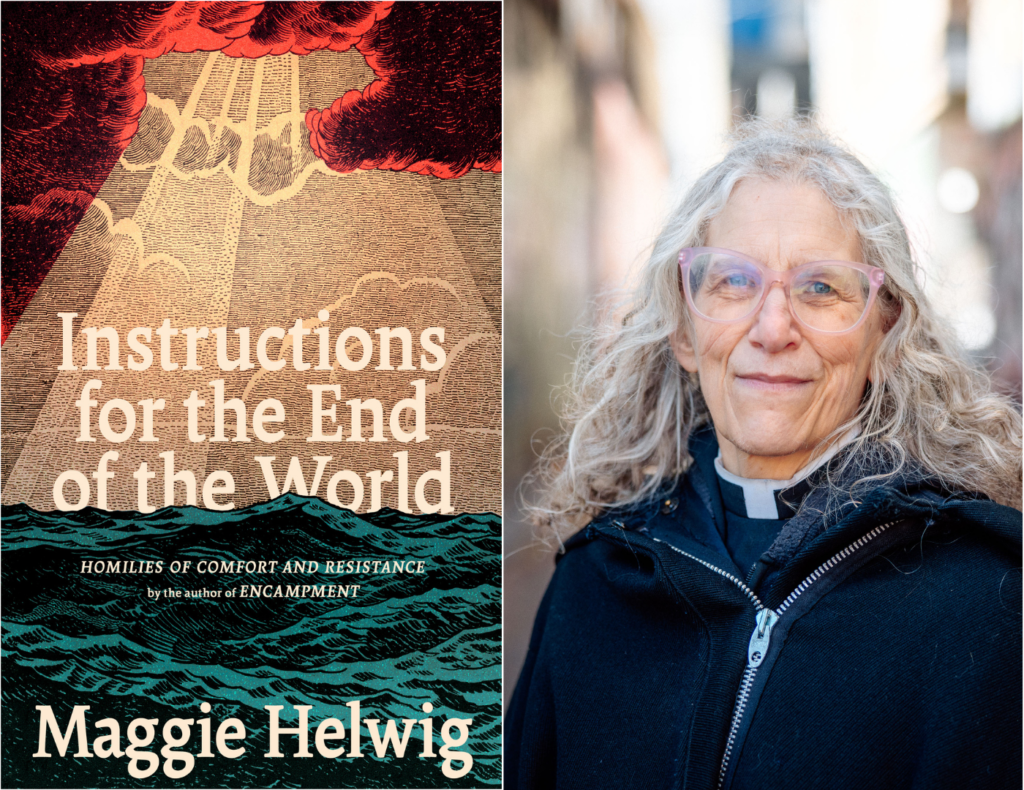
Comparatively, her latest offering, Instructions for the End of the World: Homilies of Comfort and Resistance (Coach House Books), might seem more conceptual. The book is a collection of homilies written and preached by Helwig over the span of several years, employing literary criticism to bring a contemporary theological lens to ancient biblical texts.
Where Encampment navigates the thorny language wielded by city bureaucracy to hamper the safety and freedom of Helwig’s neighbours, this new book revels in language’s liberatory capacity, undoing hegemonic understandings of biblical narratives through readerly acuity and close attention to context. Under Helwig’s astute eye, scripture is sacred, but not irreproachable. Through her analysis, Helwig insists that the knowledges and strategies of an ancient people grappling with the end of the world as they knew it can accompany us through the manifold crises of contemporary life. These homilies embolden us wherever we find ourselves practicing resistance and care, from global uprisings to quiet Toronto kitchens.
What I found in Helwig’s latest book was a way of peering slantwise through the stained glass, a way of hearing the well-worn bible stories of my childhood anew.
The vegetables are parsnips, Helwig tells me as she returns to the camera’s frame, settling in. Sweet potatoes too.
I imagine the potatoes’ deep orange flesh darkening in the oven’s heat, the cut edges starting to gild. Their starchy pulp mashes into my memory, transposed across the church of my early childhood, its dappled orange carpeting straight out of the 1970s. In adulthood, I’ve tried to absolve myself of that place—the hum of the chapel’s fluorescent lights, the prairie dust kicked in by Sunday-best shoes walking down gravel range roads. For a queer kid in rural Alberta, the church and its scriptures often felt like the end of the world, or, at the very least, the end of the line. What I found in Helwig’s latest book was a way of peering slantwise through the stained glass, a way of hearing the well-worn Bible stories of my childhood anew. I still bristle against the gospels at times. I don’t know that I’ll ever stop feeling them as the pulsing ache of a tailbone sat for too long in a straight-backed pew. But in the register of Helwig’s voice, they become an inheritance that I want to hold on to: stories and songs that offer tools for the urgent task of making a more hospitable world.

Emily Hoven: Perhaps we can start by talking about the genre of the homily. I’m interested in the distinction that you make between homily and sermon.
Maggie Helwig. Yes, it’s the Catholic and Anglican language. Alana [Wilcox, my editor] and I had a whole back and forth about, “do we use ‘homily?’ Do we use ‘sermon?’ Which one do people recognize? What are the different overtones?” I was concerned that no one would know what a homily is. But it’s a fascinating genre. One of the things I like about it is that, in a sense, it’s just textual analysis. And coming from a literary background, textual analysis is very familiar to me. To take a piece of text and say, “let’s work with this, let’s look at context issues, translation issues, let’s see how it stands in relationship to similar pieces of text, let’s see what else we can make it play with.” That’s all really familiar. But homilies are also a very controlled oral form [created] at a specific moment in time for a very specific group of people. And so all of those things play into it.
EH: In many ways, it does read as a book of literary analysis or criticism, where the texts being considered are scripture. One of the things that was particularly interesting to me as someone who comes from a religious upbringing—which I know is not your experience—is that you were given a Bible at a very young age by your father, but it was given to you as a piece of literature. It seemed really interesting to be given that invitation as a child, to have someone say, “this is a text that we can analyze and interpret.” I wonder about that invitation in relation to how you define faith in the book, as a commitment to a particular narrative.
MH: There is a bit of a tendency to take a very surface approach to scripture. Or not even a surface approach. A surface approach might be more interesting—to say, “well, here’s this text, and here’s what everybody in Sunday school said it meant. So there we are.” People can do that in ways that can be touching and meaningful and speak to their community. But that’s not what I do. I try to strip away all the preconceptions and look at this piece of written work to see what it really seems to be saying, and how it plays with the other texts that it’s been put into this very arbitrary relationship with. There’s so much richness in that, and so much potential unfamiliarity. I want, in a way, to alienate people from traditional readings of the text. I want to say, “let’s just scrap what they told you in Sunday school that this book means. Let’s look at the book itself and see what it’s saying to us.”
And that’s where liberation theology came from. The roots of liberation theology were […] groups of Latin American peasants just sitting down with the Bible and saying, “what does this text say to us? What does this text say to our context, to our lives?” And an entire—and ultimately massively influential—school of theology grew out of that. I should check on my vegetables.
*Veggie Interlude*
MH: Most of the parsnips are done. The sweet potatoes are only starting to get there. I’m going to go back in a minute for the last of the parsnips.
EH: This speaks, to my mind, to this theme of constraint that emerges throughout the book. Partly in the formal constraint of saying, “I have these texts that have been preselected for me. How can I play with them? What can they say?” But then also the constraints encountered in the world of scripture and in the world we live in now, in the congregation you’re preaching to. Political constraints, economic constraints, social constraints. I don’t want to negate the very real harm and pain that constraint can cause, but I also wonder what constraint makes possible?
MH: There’s two kinds of constraint in our lives. There are the imposed constraints of economics, of oppression. And then there is the inevitable constraint of being moral creatures in community. And that second kind of constraint, I think, is absolutely necessary. A lot of the evil in the world that’s being done right now is being done by people who reject that kind of constraint, who want to be the absolutely untrammeled ego: “nobody can tell me what to do. I am not responsible for any other being. My own power and pleasure and priorities rule over everything, and I should never have to consult another being.” But the kind of constraint that comes from being responsible and answerable to other people and to creation is a constraint that is good and natural to us. If you have a child, you’re really constrained in a lot of ways. But people keep on doing it, and it’s a relationship of—ideally and much of the time—deep love. And that’s why you choose that constraint.
I try to strip away all the preconceptions and look at this piece of written work to see what it really seems to be saying, and how it plays with the other texts that it’s been put into this very arbitrary relationship with.
EH: I think you gesture to that, too, when you talk about Paul’s letter to the Corinthians, right? That the calling there is to actually choose to be willingly constrained.
MH: Yes.
EH: This work of being in community, which is necessarily constraining as you say, also leads to a kind of messiness. In one scene you describe in the book, during the height of COVID, you talk about the stripping of the altar on Holy Thursday. You say, “it is not beautiful, it is not solemn, it is awkward and uncomfortable. It does not feel like worship.” I’m interested in the distinction that all these messy or imperfect things that maybe don’t feel like worship can in fact be just that. The healthcare aids washing people’s feet may not be happening in a church, and yet there’s a sacrament happening there.
MH: One of my most profound moments of realizing my own vocation happened while I was outside a church, in the rain, sorting the garbage and recycling. And somehow it was the first moment when I really felt a vocation. And not particularly a vocation to sit in the rain sorting garbage, but that somewhere in all of this was a calling to ordained ministry in the church. And that’s not separate from sorting garbage in the rain.
EH: Right. All of that is the work of ministry.
MH: I love the liturgy at my church because we’ve come up with all these catchphrases we use to describe it. It’s a high Anglo-Catholic church. We have incense, we have robes, we have all the rituals. But we also have this total openness to anything that might happen. We have lots of people who are very new to the church, or very new to this style of church. We have recovering ex-evangelicals and people who’ve not been [to] church since they were babies. And so in a way, everybody’s learning as they go along. There’s also people wandering in from the street who bring what they bring, and there’s the fact that we are a very poor church in an old building, so at any point anything can just physically fall apart in your hands. Right at the beginning of Lent, Jesus fell off the cross. And we had to actually tie him on.
*Veggie Interlude*
EH: I’m thinking of this image of Jesus falling from the cross and being kind of haphazardly tied back up and I want to connect that to the title of the book, Instructions for the End of the World. Not to say that a single broken crucifix is an indication of the world ending, but it does bring us to the language of falling apart that the book often returns to.
MH: That phrase came up for me when I was thinking about Mark’s gospel, which was probably written within a few years of the destruction of Jerusalem. For that community, their world had ended. Their temple had been destroyed. People had been scattered all over. The world that was known to them was over, and someone sat down and wrote the Gospel of Mark. And he wrote it, obviously, in a hurry. He wrote it because he knew that the oral tradition was starting to fade and if he didn’t write it down, there might be nothing left. And he wrote it partly to [ask] people, “how do you live in this time?”
The big things are what goes down. The small things are where you find pockets of survival, the little supportive communities, the little places that nobody pays attention to.
EH: It seems to me that that’s what your book is doing too. In its way, it’s the kind of guidebook that you talk about the gospels being. You’ve sectioned it into three parts: first, the homilies written when COVID becomes disruptive in our lives for the first time, then the homilies written during the back-and-forth of the encampment being taken down, and then, in the third section, the rise of authoritarian governments, the genocide happening in Palestine, the ICE raids happening in the United States. Each section, in its way, is documenting an end of a world: the world as we knew it, or as your congregation knew it. How did it feel to be writing these homilies, which sometimes do speak directly to these moments, but more often just have them hanging in the background?
MH: It varied from time to time, but there were certainly times when I got up there feeling a tremendous responsibility on me. There were times right at the beginning of COVID, during the really dramatic developments around the encampment, and then the Sunday after Trump was inaugurated. There are times when I’m really aware that, as much fun as textual analysis is, I am having to use this textual analysis to talk to people who are feeling confused and afraid, and I need to have something I can say to them. Obviously it’s not always like that, but there are times when the responsibility is quite heavy.
EH: I felt that particularly in the homily you gave the weekend after Trump’s inauguration. When I was first reading it, I was struck by its tonal shift. In that moment, there seemed to be a need to articulate plainly what was happening, in a room with other humans, vocalizing it into space. How does it feel, then, to send these homilies out into the world now in textual form, outside of that context and outside of your body speaking it?
MH: It is odd. I’ve actually spent the last 3 days recording the audiobook. And I think this is one of those really rare cases where I’m going to tell people that the audiobook is the preferable way to encounter this, because we recorded it all with me standing at my pulpit in my church.
EH: Wow.
MH: My congregation wasn’t there, but I could look out at all their seats and imagine them. I think I am able to draw out more in the delivery, because these were written to be spoken. They weren’t written to be text on a page. I hope that they work as text on a page, but I think the audiobook may actually turn out to be the better way to encounter this. We started to record the audiobook with me sitting down. I did the first two that way, and then I just thought, “I can’t do this.” I need to be standing up. I need to be at my pulpit. I need to be moving. And I need to be seeing if not the people, then at least where I remember the people being. Even for all the services that we were doing on Zoom during the period of the COVID pandemic when we didn’t have in-person services, I was standing while I preached.
*Veggie Interlude – one gigantic sweet potato remains*
EH: Throughout the book, you talk about the body, the ways that people, together, form this body of the Church, which doesn’t feel so dissimilar from the lessons that the natural world teaches us about togetherness and interdependence. And inside that language of the body, I noticed the language of smallness. First, you give the explicit instruction that one of our tasks is to be small. But then, throughout the rest of the homilies all throughout the book, there’s this return to the idea that we are small. Of course, as you write, Jesus himself was spending time with small people in small places. I’m a high school teacher, and so often I’m talking with students about how we move forward in this moment of collective crisis. And in those conversations with them, the smallness of being just this one human can feel immobilizing, but that’s not how it feels when you write about it. And so I wonder if you could talk about the relationship between both smallness and the wholeness of the body or community.
MH: I preach in a very small church. I have a small congregation in a small church in a little, dense neighbourhood. And the people in my congregation tend to be people who are, to some degree, and in some way, marginalized. They’re not people with a lot of power. I am far and away the best off financially of anyone, and that’s a weird position for me to be in. So I’m talking in that context. And you would have to speak differently if you were in a big church, if you were in a church with people who had power or money or privilege. You’d have to really try to convince people of it. Whereas with my people, we know we are small. We know we are weak. But that is exactly how God comes to us. Our central story is the story of one guy from a tiny poor town wandering around this little occupied area talking to some people. The only time he encounters anybody important is when they’re about to kill him. He spends his life among people who are unimportant and small and that’s our story. That’s the central thing that anchors our faith.
EH: To riff off the title, it’s this small story that then creates a world. There’s a world that emerges from it.
MH: The early church was very small. Later, the church became this gigantic hegemonic thing. But the context in which the scriptures were written was a scattering of little communities here and there around the empire, with lots of women and slaves. Initially, the church was kind of a low-class thing to belong to. And I mean, if we’re talking about ends of worlds, what survives is small things. The big things are what goes down. The small things are where you find pockets of survival, the little supportive communities, the little places that nobody pays attention to.
Emily Hoven is a writer, teacher, and PhD candidate at the University of Alberta. Her chapbook Sourdough Infinity was published by Hedon and Anstruther Press, and her writing has appeared in Canadian Literature, Canadian Poetry, and elsewhere. She lives on Treaty 6 territory with her beloved sourdough starter.