
Useless Pleasures: An Interview with Lisa Robertson
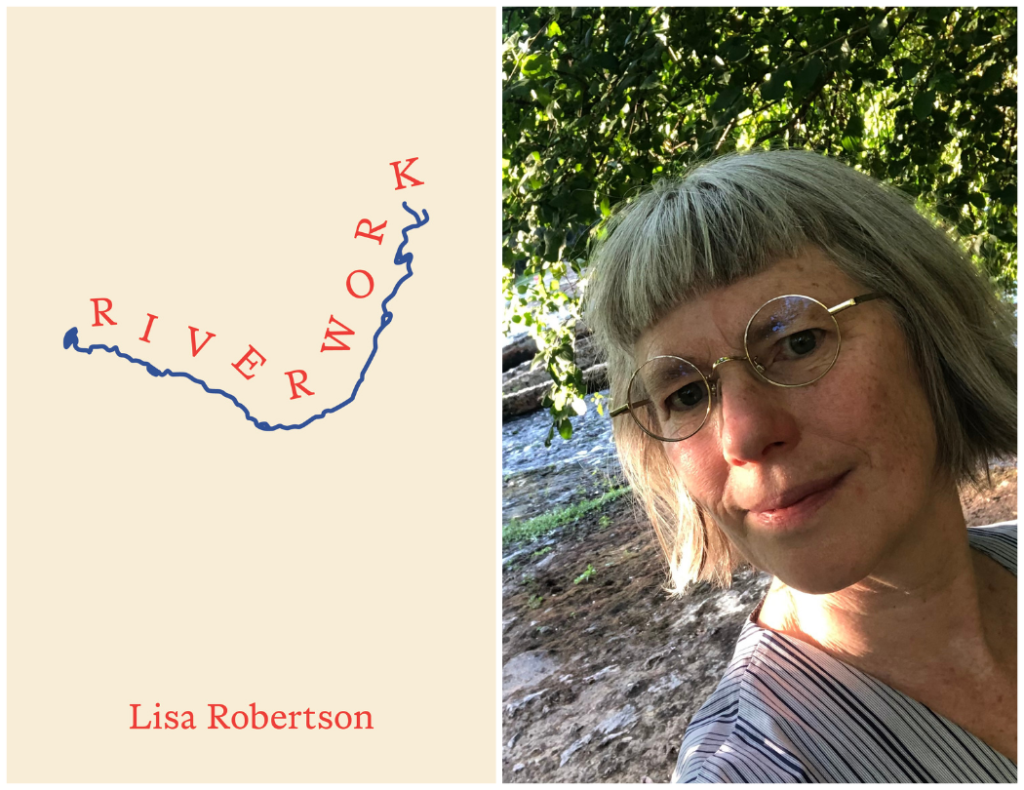
I read Lisa Robertson’s newest novel, Riverwork (Coach House Books), by the East River of Manhattan, which is not a river at all, it turns out, but a tidal estuary—a river in name only. It extends like a silver billowing sleeve, performing under an adopted moniker. It seemed appropriate, since Riverwork also adopts brief identities in the form of its copious epigraphs: each chapter opens with one or two chunks of quotation, which serve as a kind of embedded bibliography. I started thinking of Robertson’s annotation practice as a kind of adornment: a beaded hem, perhaps, glassy orbs of other books clinking against each other, or a jaunty noun-ish button on the chapter’s collar.
Robertson, like her narrator Lucy Frost, borrows and pockets what’s hers and also what isn’t, as she strolls through the canon, as well as the extra-canonical or the sub-canonical. She builds a nest out of language, an ad-hoc shelter which glints like a magpie’s. Argent detritus woven among balletic twigs, whirl-shaped.
But for what is taken, she also gives, and gives generously. In fact, she makes giving and taking seem like a single elegant gesture, a literary style that carries almost utopian implications. Born in Toronto in 1961, the significance of Robertson’s contributions to the Canadian poetic tradition is immeasurable. Across twenty-eight books and chapbooks, mostly poetry but also essays, translations, and two novels, she has proposed a mischievous, gaudy, dusty, vagabondish, moiréed, menopausal, communal, specific, exquisite approach to literature. There are sentences in Riverwork that I will carry with me for the rest of my life. They are now sewn onto the lining of my feminism, my metaphysics, and my most inner vocabulary.
As I read by the river that is not a river, I started to write an index of Riverwork, which follows Lucy’s own meanderings through the haphazard index of her great aunt’s research on a river that is no longer visible, the buried Bièvre in Paris. Here are some of the headings of my index: RAGS, TOMBS, THE VOICE, AUNT-NESS, LATE-NESS, PROUST, WEEPING, WALKING, INSOMNIA, ARENDT, DUST, HOUSEKEEPING, FABRIC, DECAY, REVOLUTION, THIEVERY, RIBBONS, WETNESS, LAUNDRY, RUINS, ARCHIVES, NIGHT CLUBS, DISAPPEARANCE, DRAFTS, and so on. Robertson’s writing is always oriented towards more writing, words that beget words. Before we met over a video call, she in Paris and I in New York, she sent me an updated version of Riverwork, which I had received previously as an advanced reader’s copy; I assumed it had a few tweaks here and there, some grammatical nudges. But it was significantly changed, and I sensed a reluctance on Robertson’s part to finalize it at all. It was still alive to her, a place of possibility. It remains so.

Audrey Wollen: This book often seems to be about the writing of another possible book, a book that Riverwork surrounds or wanders through, but doesn’t actually embody. For me, this puts Riverwork in conversation with other texts that are about the unwritten text or the hoped-to-be-written text, such as Roland Barthes’ lectures in The Preparation of the Novel: it stages the novel itself as a kind of notetaking system for an imaginary book yet to be materialized. How do you trace where Riverwork ends, and where Lucy’s other just-beginning book begins?
Lisa Robertson: I came to writing novels in my late 50s; now I’m just about 65 and this is my second novel. It’s a curious beginning that’s happening way past midstream. So the question of how to do it remained urgent at every moment of the composition, even more so than when I was writing The Baudelaire Fractal (2020). I had more of a plan for The Baudelaire Fractal. It seemed like a very lightweight lark when I was writing it, whereas my feeling towards writing this one was more awkward and self-conscious, which I hear is not unusual for a second novel experience. At no point did I actually know what I was doing. It felt at every point of the writing like I was preparing to write a novel, as opposed to actually writing it… So the problem of “What is a note, as a unit of written thinking? Or, what is an annotation, as opposed to what it is to narrate or to compose a narration?” did remain active, not just in the fictional sense of Lucy Frost moving through the terrain of her great-aunt’s notes, but also for me, in parallel, actually writing the book.
When there’s generation after generation of this erasure, how do we found our practices? How do we figure out how to advance? Or, even how to stay in place, and not just sink and disappear.
AW: There are two unfinished books in Riverwork. Lucy’s, and also the book that Lucy’s great-aunt was researching, which she wasn’t able to see through…
LR: Yes, her great aunt was writing on the Bièvre River and on the laundresses that worked there. Lucy’s trying to come to terms with that [body of knowledge] as she’s also trying to live her own clunky, weird life.
AW: Riverwork opens with Lucy stealing her great aunt’s research about a river that no longer exists, a buried river in Paris. I immediately thought: wow, inheriting, or even filching, an unwritten book is a really good metaphor for feminism. On the first page, Lucy declares, “I was loyal to her disappearance, I was loyal to her heresy. I was loyal to the illegitimacy of time, her scattered documents.” Of course, feminist practice is always left with a lack–the books that were never written–but I was excited by the way this sentence immediately establishes that absence as a thing one could be loyal to, a thing one could have a fruitful relationship with. How do you think about working with absence or being in relation to emptiness in your writing?
LR: That was the core problem of writing this book, and that’s why the Bièvre river became interesting as an image. In terms of feminist writing and historiography, there’s the constant problem of the lack of an established methodology. The methodologies of writing narrative and history require access to an archive, access to a fundament of documents from which to begin, which have been agreed upon culturally. So we have this problem, as feminists, whatever kinds of feminists we are—perhaps each of us are several kinds at once… We are inheriting a tradition, but we’re inheriting a tradition that is perhaps questionable, and perhaps it’s not our feminism that we’re inheriting.
Then more broadly speaking, we’re inheriting a tradition which is being systematically disallowed by the larger culture. Either these documents never existed, or there’s been an obliteration of them. This is going to be an even bigger problem in the future, as libraries and archives are being dismantled everywhere: an absence of documents. That’s not an excuse not to work, but it obviously keeps the problem of how to work open. That was both an active problem that I was having, partly as a totally non-professional historian without any kind of institutional access to the hallowed archives, but also it was the problem that I was framing and fictionalizing within the book itself.
When there’s generation after generation of this erasure, how do we found our practices? How do we figure out how to advance? Or, even how to stay in place, and not just sink and disappear. I don’t think that Riverwork presents cogent solutions to those questions, but I think it stages the questions in such a way that they can come to the foreground again.
AW: I think what Riverwork does so effectively is expand the notion of what the archive could be. Alongside her great-aunt’s notebooks, Lucy also receives her broken costume jewelry, scraps of fabric, some hair, a book by Poe, and a lot of dust, which you also offer as another type of archive. I’m really interested in “the Aunt” as a literary figure or trope– she’s a matriarch, but she’s often outside of the family tree of reproduction, often associated with spinsterdom and witchery. An ancestor that dwells a little outside the bounds of the family. I’m thinking about these forms of anti-inheritance, forms of thievery from the family, and how that maybe relates to the Aunt as a role?
LR: It was an intuitive move, thinking towards aunts and great aunts within my own family. There seems to be a freedom in the position of the aunt. She doesn’t have the full-on nurturing responsibility. It’s more like her responsibility is to lure or to tempt the younger family members out of the inner folds. Not all of our aunts are our blood relations either. Within my family anyway, sometimes my mother’s or my grandmother’s female friends might be addressed as aunts. It’s a way to have these tentacles out of the patriarchal family structure, into all kinds of zones of lives lived otherwise.
AW: She’s like a portal.
LR: Totally. Between eras too.
AW: Riverwork is particularly invested in late style, and you mentioned earlier, feeling like you came to novel-writing late, wanting to explore what lateness means. There’s this fascinating part in the novel about late style as a kind of political witnessing, or a post-witness way of thinking, so that when Lucy says that she came “too late” to this work, it means something politically as well as temporally.
I’m also struck with how she writes about her own body, particularly phrases like “the swagger of my bodily decay,” which seems like another vector on late style. A late style of the body itself, the body doing a kind of lateness. And I just wanted to ask about decay as a kind of style.
LR: A few years before I conceived of this book, I was spending a lot of time reading Edward Said’s On Late Style, which led me to read Genet’s last book, Prisoner of Love (Un Captif amoureux). And so this question of lateness, in terms of literary stylistics, was something I’ve been thinking about for a long time.
Regarding the body and decay and so forth, I think that one of the points of inflection, or infection, of this stylistic notion comes [to me] from the tradition of the grotesque, particularly through Djuna Barnes’s work. Her little book called The Book of Repulsive Women, for example, where women’s bodies are this oozing, collapsing zone of lugubrious excess. It seems hilarious, but also not so far away from the actual experience of corporeality after all. To cast that not as an abjection, but as a humorous grotesque seemed to be the best stance to take.
I’m super compelled by […] Severo Sarduy, the queer Cuban writer who left Cuba to study in Paris and became friends with people like Roland Barthes (Barthes dedicates The Pleasure of the Text to Sarduy). He also wrote a couple of novels. One of them is called Cobra, a novel about trans bodies written in the 1970s. It’s framed in a theatre of dolls. They’re growing moulds and weird medicinal plants in the toilet. They’re going through all these bodily transformations, experimenting upon themselves and upon their sisters, and it’s completely fabulous and over the top. One of the things I love about these works is their humour, a refusal to pathologize very opaque experiences of bodily difference. All these experiences become opportunities for some sort of abundance, culturally. I wanted to start this book with an absolutely symptomatic body, a really neurotic body, not to make it pathetic, but to make it as diverse as possible, and for that to be a model of how to read and how to write.
I wanted to bring this maintenance labour—which is aligned with productive labour but is not the same—into a textual space, and consider if textual labour is also a kind of maintenance labour. How do we maintain stories?
AW: This relates to something else I was thinking about—a relationship to materiality and sensation which also functions as a kind of reading experience. I kept returning to your description of silk shattering, especially this amazing bit about Rousseau’s stolen ribbon. There’s your phrase, “the semantic potentials of the shattering of silk.” It proposes text as a kind of textile. It places Rousseau in this lineage of thinkers that are philosophically altered by an encounter with a material. But particularly a material that’s associated with frippery or adornment!
LR: It seems shocking to me that I actually found that in [Rousseau’s] Confessions. I read the Confessions years ago, obediently, and shockingly, I liked it! But it wasn’t until going back to it during the composition of this book that this ribbon just—boing!—sprung out of the text. And then all of the Confessions became about the shattered ribbon for me.
AW: There’s this dance between “text” and “textile” going on throughout Riverwork. You refer to a closet as a kind of library. And I was really moved by the image of Lucy’s great aunt wearing a layer of newspaper underneath her mustard-coloured, worn-out Schiaparelli raincoat. It made me think about keeping language close to the body, as a sort of interior lining. I was wondering if you could talk a little bit about the text-textile connection.
LR: First of all, I have always been textile obsessed. I will take almost any writing situation as an excuse to do more research on textiles. But apart from that personal quirk, there’s the fact that historically the Bièvre River was the core site of textile production in Paris. I was very interested in the Bièvre as a site of labour. The prestigious textiles of the Bièvre became tapestry weaving; it was believed that the water of the river had certain properties that were propitious for dyeing. Tapestries were a very high value trade item… but alongside these prestigious fibre manufacturers, there’s this very debased fibre labour going on, which, in the case of this river, was laundry.
I came to focus on these figures of the laundresses as a kind of chorus to the book. I was fascinated by them. How does laundry get done? How does it get washed? How does it get bleached? How does it get dried, etc.? Because laundry had to be picked up all over the city, these women had a lot of mobility. They are going to very rich households. They’re going everywhere… and they are working together… and talking together, all the time.
So they had a kind of fermenting role, ironically, because fermenting was one of the processes used to clean laundry before detergents existed. The laundresses had this fermenting role in terms of social movements and ecological movements because they’re right there, seeing what’s happening. They’re together, moving around, plunged into the water. They’re wading through it. Their arms are thrust into it. They’re being shunted from zone to zone by the civic government and police, because everybody needs their laundry done, but nobody wants to see it being done.
I wanted to bring this maintenance labour—which is aligned with productive labour but is not the same—into a textual space, and consider if textual labour is also a kind of maintenance labour. How do we maintain stories? How do we make sure certain things remain in circulation, remain present? How do we care for the documents that come into our possession by whatever means?
AW: I was also wondering: if it was a garment, what kind of garment would Riverwork be?
LR: Of course, it’s the smock! A protective over-garment, a labouring person’s garment. It’s the insignia of the kind of work you do.
AW: Maybe my favourite part of the novel was the catalogue of incendiary garments, which was a list of the clothing worn by the women communards of the 1871 Paris Commune. You write that the river Bièvre was “for centuries an artery of urban textile activity and popular uprising.” And through the red-dyed river, the red ribbon of the river, you explore the making of a particular shade of red—the red fabric which was made into cockades, signifying a person as a Communard. This was fascinating to me, because it means that the red fabric is both the output of their exploited labour, and also the ornamentation of their resistance. The fabric embodies both things simultaneously. How do you think working with fibre affected the form of the Commune itself? How did their labour as laundresses and textile workers inform or shape their practice as Communards?
LR: The short answer would be, I wish I knew. There’s this great book by Kristin Ross called Communal Luxury, about the craft tradition of ornamentation and the people who transmitted and developed these ornamental skills, which includes all kinds of decorative arts: fringe-makers and wallpaper-makers and shoemakers, and so on. But she connects this work with a long and transnational radical tradition. It’s a socialist tradition that includes people like William Morris. Charles Fourier was a textile salesman. He is from Lyon, which is a silk city. And he’s going from place to place flogging textiles.
There’s this radical tradition of people who work with fibre and work with ornament. Maybe because of their mobility and because before the factory system had totally coalesced there was a certain kind of autonomy. There’s a lot more than just manual and material skills being transmitted. What is being transmitted along with them? Songs are being transmitted. Gossip is being transmitted. There’s all kinds of information [there.]
AW: You write about the rowdy sociality of the laundresses.
LR: Yes, everybody talks about how loud they were. They were big-mouthed women. They were strong. They’re carrying bales of wet hemp sheets. They were big women.
And they were often also engaged in some level of prostitution because they couldn’t make enough of a living to feed their kids. So, you know, they were really there in the public space in all kinds of ways, as bodies, as acting bodies.
AW: Which I imagine has to produce a kind of radical collectivity, which the Commune draws from and also proposes. Like, the laundresses already had day-to-day expertise in being a body together in public, which makes the acute public-ness of political action more accessible, maybe.
LR: I just thought of this detail I learned when I was researching, which I don’t think I ended up including [in the novel], but it is an example of what we’re talking about. Churches had been desacralized during the time of the Commune, so they were used as meeting sites [across different neighbourhoods]. There would be people charged with first-aid work, and people charged with educating children… One of the things that has persisted in France since 1871 is state-run daycares and free secular schooling for all children. That all started from these meeting groups, primarily of women, during the Paris Commune.
One of these groups of women, who were meeting to organize education for the children of the workers, decided that they were going to move all the floral arrangements from the churches, which were decor on the altar and so on. All of that was going to be re-routed; the flowers were going to be sent to children’s schools. The Communards thought that children needed to enjoy the presence of flowers in their educational settings. There’s an example, not of fibre, but of ornamental pleasure being considered to be a core right of the people. It’s not something that only upper classes should have access to. People have the right to useless pleasure.
Audrey Wollen is a writer who lives in New York City. Her writing has appeared in The New York Review of Books, The New Yorker, Harper’s Magazine, Bookforum, The Nation, and elsewhere.