
The Art World’s Bodily Economy
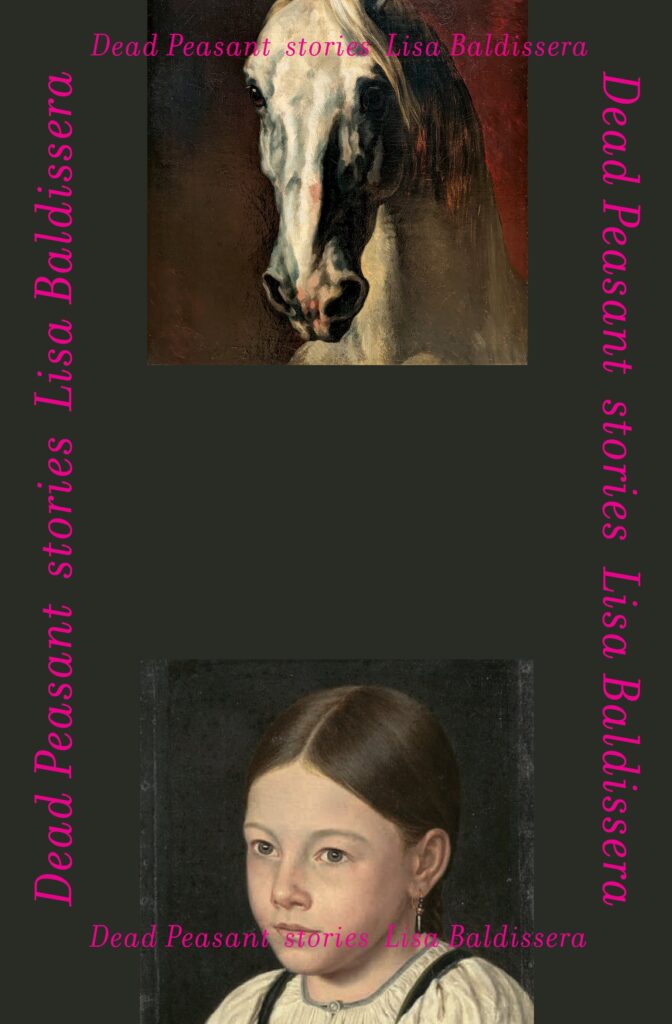
Dead Peasant
By Lisa Baldissera
Book*hug, 150 pp., $24.95 (paperback)
November 10, 2026
“Dead peasants insurance,” slang for corporate-owned life insurance, is a type of policy that companies quietly purchase on their workers, sometimes without their knowledge or consent. The companies mark themselves as the sole beneficiaries and collect substantial payouts upon a worker’s death—tax-free, of course—based on their entitlement to the money their employee could have made for them had they lived (and worked) a little longer. This kind of policy reduces minds and bodies to passive financial hedges, turning mortality into a tax-advantaged asset.
Lisa Baldissera’s debut short story collection takes its title, Dead Peasant, from this particularly ghastly financial invention. And it’s this blatant corporate extraction that forms the central motif across its thirteen short stories, depicting how the hypercapitalist art world commodifies, disciplines, and profits from the precarity of its human machinery. Drawing on decades as a curator and scholar, Baldissera brings these dead peasants—the stewards, invigilators, archivists, and low-level gallery workers who buoy the high art economy—into view. Her career spans major curatorial roles across western Canada, from the Art Gallery of Greater Victoria and the Mendel Art Gallery to Contemporary Calgary and Griffin Art Projects, which affords her fiction a deep understanding and degree of authority. Across several of the collection’s stories, characters observe themselves and others with a judgmental eye, from the senior manager’s “body sitting mildly in a cream sweater set” in a shared curatorial office, to the communications consultant who “created brand strategies for Google and Uzbekistan” and “used terms like Thought Leader and Key Influencer without irony.” While critical of their colleagues and the system, these administrators are also hyperaware of their own place within that system, and the ways in which they play the game to stay afloat or get ahead.
The fact that AI-generated art is not preoccupied, as the human artist is, with mortality is at least one part of what robs it of meaning.
Her characters move through absurd scenarios. A former page-turner for classical musicians becomes a tear-wiper for an academic who starts weeping whenever she lectures on “the osteoporotic economics of art,” launching a whole cottage industry of professional wipers. An auction house staffer is dogged by an oligarch who pays student artists to “make antiques,” until she accidentally vomits on him. A curator chats with Lindsay Lohan about exhibiting her collection of horse paintings, which Lohan says she began after reading Anna Karenina, struck by the realization that Vronsky loved his horse more than the heroine. And while her vignettes border on the otherworldly (a pneumatic tube forms in the ground to suck artworks away; an archivist observes Earth from space), they’re anchored by the presence of real contemporary art: a “regal and lumpen” sculpture by Rebecca Warren; the “undulated spatial puzzles of Michael Armitage’s landscapes”; a “candy pink Lucio Fontana painting.” That is to say, the author and her characters know about art, and they can tell you why Fontana’s scratched canvases are absolutely not the same as what your toddler can do with an errant knife. By furnishing her narratives with real art, Baldissera makes clear that she isn’t here to undermine artists but rather the system in which they’re ensnared.
Baldissera has been favourably (and rightly) compared to Miranda July for her surrealism and humour gone askew. I thought of July’s early work, long before the successes of All Fours (2024) or the film Kajillionaire (2020), like 2009’s Eleven Heavy Things—playful, interactive sculptures with a wry textual element—and the short story from No One Belongs Here More Than You (2007) in which a woman teaches a swim class on her apartment floor. In Dead Peasant, raves held in a museum holding bay attract “the men in town who had read Catcher in the Rye in high school and liked it.” Amusing as these lines are, Baldissera’s intimacy with her subject matter occasionally runs the risk of turning her stories into inside jokes. How many readers will recognize those gallery interns with smiles “lit from the inside, from laser eye surgery and teeth whitening, from Christie’s MFA programs and insider knowledge of shaky provenances,” if they do not hold some insider knowledge themselves? Perhaps July’s broader appeal comes from the fact that even when she’s working with niche material, her stories (in whatever form) are rooted in familiar feelings like vulnerability, desire, fear of failure, or crushing disappointment—feelings we never quite access in Baldissera’s more detached vignettes.
This isn’t to say Dead Peasant is inaccessible or that the reader won’t be moved by the stories. Baldissera plays with tropes applicable across many of the so-called “culture industries.” I recognized myself with a pang in “Multiples” when a senior colleague tells the narrator that she’s lucky someone important knows her name—the implication being that such recognition will save her job, or her skin, when she inevitably does something wrong. “It turns out the brand strategy work I have been undertaking will save me after all,” she thinks, “gorging on streams of Guardian articles, excreting unpaid writing for academic journals, hours and hours spent summarizing reviews of academic texts, all of it finally paying off.” I recalled the late evenings of unpaid editing that got me into my first assistant role—a major university press had just laid off dozens of its senior staff and hired new graduates like me at a fraction of the price, all of whom felt blessed to be chosen from the hundreds of identical applicants vying for the chance to work in publishing. It wasn’t long before I realised that even the senior commissioning editors there were making salaries below the national average, expected to live off of cultural capital and the supposed prestige of their job titles (titles that were meaningless outside of the publishing industry—for years, my grandparents told people I worked at a newspaper). My friends fawned over my boxes of free review copies while I rationed couscous and dodged train fare inspectors.
The author and her characters know about art, and they can tell you why Fontana’s scratched canvases are absolutely not the same as what your toddler can do with an errant knife.
Where she could have concentrated on the administrative or critical classes, Baldissera expands her satire—and compassion—to the people on the gallery floor, whose bodies are on the line. Who are the superhuman gallery guards, standing in uncomfortable dress shoes or perching on a stool for eight hours at a time? Surely they’ve exhausted any interest in the work on the walls before the bulk of gallery-goers even arrive. I notice, with some embarrassment, that I feel apprehensive about the guard’s schoolmaster-like authority and find myself relieved when I enter a room without one. I like to observe, unobserved. Baldissera knows this, as does the new museum guard in “Weepers II/Guard” who quickly learns that “viewers want to know about bathrooms. They want to touch things. They want the guard to leave them alone.” But the guard is under as much surveillance as the visitors—a chummy manager jabs him in the ribs with a clipboard when he accidentally starts to doze. The guard is still learning the tricks of the trade, which turn out to be nothing more than fatigue-denial and strategic shifting in one’s seat.
The guard’s story reveals not just the pervasive, silent surveillance within the museum’s sterile white cubes, but also how a worker’s time is controlled by an industry that ought to facilitate the opposite—the boredom, dreaming, and a slippery, unaccountable time necessary for art to exist. I think of the creative who “might have sat round the clock lost in thought” in Virginia Woolf’s A Room of One’s Own while Baldissera’s characters reckon with:
“the regulation of the body down to the second—either as self-regulation toward a desired productivity, or as adaptive behaviour driven by the new smart-academies that now download data at every gesture and betray us by logging our pauses, our daydreaming, our necessary breathing-madness.”
In many of the collection’s stories, administrative tasks exhaust any time for creative work. “Before this violence,” Baldissera writes, “to dream was to deepen knowledge—to know, rather than to work without knowing—to know the constellation to which our work and our dreaming belonged.”
Though she’s critical of “the little jewelled clasp called curatorial expertise,” her wistful talk of dreams is evidence that Baldissera still mourns it, or is at least in a period of anticipatory grief. One story’s narrator sums up this position well: “I had been devoted to curatorial wizardry. Enchantment was something that had once kept me getting up in the morning but now it was digital.” In “The Mirage,” Baldissera thinks about generative AI’s growing impact on art (and literature—or perhaps creative practice as a whole). The story is a series of unanswered AI prompts: “In the style of Herman Melville’s Bartleby the Scrivener [sic], write a story about 21st-century Lazy Girl Jobs featuring Tolstoy’s Levin” or “In the style of Hildegard von Bingen, write a story about Levin’s discovery of bubble baths as an antidote to structural violence.” Some of these elements reoccur throughout the book: Levin, fate, globalized capitalism, celebrity, careers (particularly women’s), and clocking out à la Bartleby, to name a few. Like her descriptions of real contemporary artists’ work, these nods to the canon and its socioeconomic themes have a grounding effect, even when placed among a slew of tongue-in-cheek generative AI requests. “The Mirage” shows how this new technology simply increases opportunities for exploitation in the industry. Why pay artists or writers for what a machine learning program can do for free? In leaving the prompts unanswered, Baldissera asks the larger question: can an algorithm make something truly meaningful? In the end, we can cram our servers to the brim with AI-generated art, but it all amounts to nothing.
The art world’s dreams of immortality are nothing new, but neither is our incessant self-accounting.
The fact that AI-generated art is not preoccupied, as the human artist is, with mortality is at least one part of what robs it of meaning. In “Azalea,” Baldissera suggests that all the art industry’s time-keeping, record-keeping, and safe-keeping does nothing more than attempt to dodge death. The archive is pure pretense. When the protagonist, Maya, drifts off during a shift at the National Historical Museum, she dreams that medical devices chart and measure her vitals, turning her into “an archive in the archive.” The art world’s dreams of immortality are nothing new, but neither is our incessant self-accounting. Baldissera links the two in “Kafka’s Daughters,” in which critics at the Venice Biennale notice the “archeological grime” of the city’s historical inhabitants:
“all the time they had on this earth to call each other’s names, give birth, provide an account of the day they first met their beloved—carved into the floors of the cathedrals: remember us, remember us, remember us.“
But the magic and charm of these enduring artworks is nearly choked out by a “much tighter” Venice during the festival, a Venice “with rules, scrambling hierarchies, budgets, deadlines.” Do the workplace timesheets of Baldissera’s characters still act as a record of their existence? So much of that “finally paying off” feeling doesn’t come with a paycheque, but in that record. It’s in seeing your name in print or in hearing it spoken by someone more important (that is, better known) than yourself—a connection through which the junior gallerist or curator or even the book critic might secure a ticket into future notoriety. It’s to be remembered after death, and not just for insurance purposes.
A magpie slips into the same story through the window to pore over the critic’s open notebooks “as though the pages were interlaced with treasure.” As a reader, I initially felt a kinship to the bird, who enters the narrative injured but nonetheless hops along one-taloned, curious and grateful for the scraps of insight among the institutional debris. Dead Peasant is a razor-sharp, deadly funny assessment of the state of the arts, but its cumulative effect is one of melancholy. Baldissera offers no neat conclusions for the reader-scavenger, nor an escape route from the extractive machinery of the creative economy and its creeping automation. But she sticks by the eccentric, defiant human cogs in that machine as they keep working for, and dreaming of, the payoff.
Hannah Jochmans is a German-Canadian writer and photographer. Her criticism has been published in World Literature Today, Words Without Borders, Asymptote, Kismet, and more. She is a National Book Critics Circle member and has served on the Gregg Barrios Book in Translation Prize committee since 2024. She lives on the south coast of England.