
Bad New Things
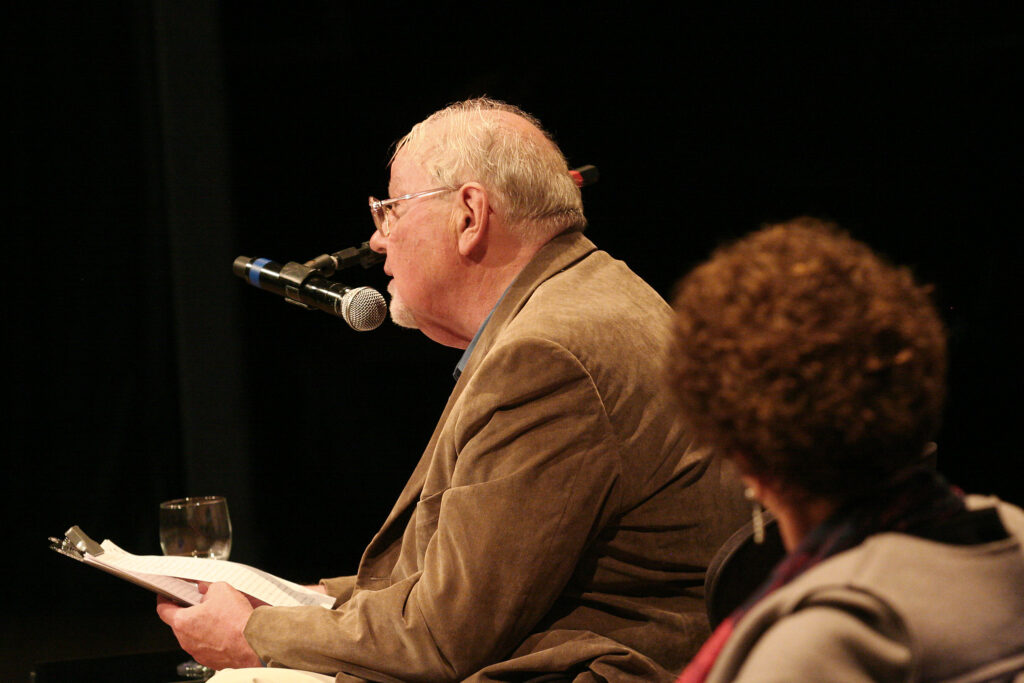
Late Theory: Fredric Jameson, or The Persistence of Reading
By Phillip E. Wegner
University of Minnesota Press, 304 pp., $41.99 (hardcover)
March 17, 2026
It’s hard out here for a Marxist critic. When you declare yourself one—or indeed even suggest that, okay, maybe you’re a little informed by the tradition—people’s eyes sorta tend to glaze over. And okay, yes: the contemporary acolytes of Marxism don’t necessarily make it easy for the rest of us, just out here trying to do a little literary criticism. We imagine, y’know, guys with wispy mustaches and throwback berets, guys who edit Wemby into Maoist propaganda. We imagine the type of guy who proves so irritating in Ferrante’s The Story of a New Name: a guy still prevalent enough that North Americans in the 2020s can identify with being irritated and Italian in the 1970s. And thus we imagine the type of criticism these fellas produce as useless: either dogmatically cretinous or joylessly mechanic or perhaps so obvious and jejune that the only conclusion to draw about the person behind the thought is that, yes, they hate literature: their work’s brute prudish simplicity betraying their torture-porn mad-scientist impulse, their desire to disembowel literature and coldly study its articulation and muscle.
Sure, I’m building a strawman here, but I don’t think I’m wrong. Speaking from experience: you use a classically Marxist word like “dialectical” one time in a public-facing review, and people will message you on X: The Everything App just to call you names (even though you’re certainly taller than them). And speaking from experience: if you ever tell another public critic that you take a Marxist approach to public criticism, they will smile and nod with such dim politeness that you can’t help but reckon with the fact that your avuncular height can only carry you so far in the cruel, dog-eat-dog world of literary criticism. Even your McCarthyite editors at Toronto Review regularly want you dead for the all things considered completely victimless crime of being too damn dialectical.
Yes, it’s hard out here for a Marxist critic.
Which is funny, because I think that there’s a decent amount of both sympathy for and curiosity about Marx, the progenitor himself: his forms of thought, his targets of critique, and certainly his desire for a better world. I would suggest, though, that his historical distance is precisely why his progeny make for predictably risible figures.
Literature becomes the calculation of rhetoric, the metering of ideology, the keys shaken in the gaze of a pate-faced baby.
On the one hand, because Marx’s work is philosophically dense, the dynamics of his thinking can easily be ossified into vulgar economism: material existence is reflected in culture; economic conditions commit you to a certain form of thought. This is where, I think, that roteness of our strawman Marxist critic arises. Literature becomes a way of indexing economic precarity and domination; criticism becomes a way of exposing how the novel form is conditioned by the original sin of enclosure. And on the other hand, academic philosophy, recognizing the need to dissolve Marxism’s historical specificity and make it applicable to a West in which the eight-hour working-day was a (nominal) reality, turns Marxism into theory: a thick, circumlocutive way of reading ideological conditioning in everyday life. And now literature becomes the calculation of rhetoric, the metering of ideology, the keys shaken in the gaze of a pate-faced baby: and criticism becomes a way of, Rowdy Roddy Piper-style, disclosing the lies structuring the contemporary order. I came here to kick ass and imagine new futures: and I’m all out of new futures…
Yes, we imagine the “theory bro,” don’t we, overdetermined by words like negation and dialectical and overdetermined. We imagine their “criticism” as closer to “criticizing”: books name retrograde social ideologies and exploitative social relations. We imagine, in short, people who don’t “like” literature—who see books as useful tools, machines only to think with.
But in that case, we demand of our straw-Marxist, why read at all? What sorts of pleasure can we find in art if we can only ever discover that this pleasure is historically conditioned? The Marxist literary critic, we imagine, strips a book of its resonance: they presume a mastery of the world and, therefore, the text. Indeed, a book becomes a text; the work of art becomes an art object—or worse, a cultural artifact. Yes, it’s hard out here for a Marxist literary critic.

Perhaps the Marxist critic most prepared to furnish an affirmative model is also the one whose name you likely already know: Fredric Jameson. Born in Cleveland in 1934, Jameson began teaching Comp Lit at Harvard in 1959 and never left academia. He taught with Herbert Marcuse at UCSD and Paul de Man at Yale, and, in 1985, began teaching at Duke. Despite the rarefied milieu in which he did his thinking and writing, his name soon became a byword for Serious Criticism at large, mostly due to his two most-cited books, The Political Unconscious (1981) and Postmodernism (1991). The former is mostly famous for its “Always historicize!” slogan (frequently thickly rendered as “Always provide social-historical context!”); the latter for its effectiveness at tracing the undefinable present. (And indeed, the “total space” of Toronto’s Eaton Centre is itself a sort of jumping-off point for Postmodernism, making the concept “postmodernism” one of Ontario’s more significant ‘90s cultural exports, right up there with Barenaked Ladies and Donovan Bailey.) You could probably walk into a lit mag launch like tonight and throw a rock and hit someone who has recently cited Fredric Jameson in a public-facing outlet. And I can’t deny it: “Fredric Jameson says…” is one of my favourite ways to start a sentence, intoned as if a message from on high.
Yet beyond his name’s easy authority, I’ve always found reading him a pleasure. This is perhaps contrary to how Jameson tends to be imagined. Indeed, Dennis Dutton’s Bad Writing Contest awarded Jameson the prize in 1997 (for a book published seven years earlier). Dave Roden, writing the majority opinion, uses lots of prescriptively correct, craft-focused language: Jameson’s demonstratives are without carefully defined objects, Roden argues, thereby belying the essential silliness of his content. And Steven Pinker—a scientist! the most objective source there is!—uses this selfsame sentence as an example of how not to write in one of his many irritatingly common-sense-based books, The Sense of Style. (I will admit, though, that insofar as America gets a Gladwell and Great Britain a Dawkins, I’ve a soft fondness for Pinker and his patriotic commitment to ensuring that we Canadians also get our own scintillatingly dim public intellectuals.)
And though I like reading him mostly because words like “negation,” “dialectical,” and “overdetermined” toggle some fucked-up plastic chunk lodged in my brain’s pleasure centre, his criticism also models a strategy of reading founded on, well, the joy of reading. For Jameson’s criticism is, in the first place, structured by a critical generosity, an expansive ecumenicality. He read everything, cited everyone, seemed to find it all productive. This avuncular inclusion of thought reads less like indecisiveness or decadence than as a simple love of thinking, of the ways seemingly opposed writers similarly diagnose the world’s ills. Indeed, for Jameson, Marxist critic par excellence, even nominally conservative thinkers can body forth new ways of thinking about the world, in all its febrility and excess. And though these new ways of thinking about the world may be inextricable from their historical necessity, we can disentangle them from their fettering to real history without abolishing history entirely, holding two separate ideas in our mind at the same time—which ability he explicitly defines in Postmodernism as crucial to “thinking dialectically.”
For Jameson—as, of course, for Marx himself—thinking dialectically is foundational to thinking historically. We cannot split history into a mechanical series of causes and concomitant effects. Dialectical thinking means reading a condition as also always an effect and an effect as also always a new condition (which in turn engenders new effects, perhaps even out of the long-forgotten conditions of residual effects, out of effects we had long since forgotten were effects at all and which thus are interpreted as new conditions, though, of course duh doy they’re effects). While, as Jameson says, the siren song of this “austere dialectical imperative” is to retreat to the “more comfortable stance of the taking of moral positions,” history does not always sanction this retreat, refusing as it does to be coded along the lines of morality.
Though I do hate to keep it glib (indeed, I think now of an Adorno aside in one of his lectures on dialectics: “forgive me if I give ‘examples’ here, for I know I should not really do so, but it’s a hard life being a dialectician”): things have happened that didn’t have to happen. But since we tend to apply a billiard-ball causality to history when history is received as a narrative, the fact that things have happened seems to furnish another set of things that happened; the implied causality means that we interpret this latter set of things as having to have happened—even though this latter set also didn’t have to happen. It is this notion of having to happen—the slip from contingency to necessity—that couches history in the stentorian grammars of morality, intoning it as a narrative explaining—and thus obliquely justifying—our current world and way of existence. Effects are received only as effects. We remain blinkered to the conditions for change these effects may produce. History becomes a structuring, interiorized narrative about why things have to be the way they are. “History,” Jameson reminds us, “is what hurts.”
Reading, though, is a way of reviving, even for an instant, the instability—the uninevitability—of everyday life: of making history into the present, and vice-versa. When properly historicized, books aren’t just tokens of social-historical context, and crucially, neither are they sealed-off and vacuous and autonomously aesthetic; rather, they are both at once—what Jameson would call “synchronic” and “diachronic.” They are both shackled to history and eternally present. A Jamesonian historicization revives the life behind the dead letters, never failing to remember that writers were people and that the creative act is an impulse-ridden mystery. It does not presume we can explain exactly why an artist made the choices they did. It instead discloses the conditionality of the writing process—and thus the conditionality of everyday life.
So, yes: books are anchored to historical specificity, and thus index extratextual attitudes, postures, and imaginaries; and, yes: the critic must, of course, pay attention to these sociopolitical attestations. However, insofar as these poses are expressed via the sumptuous interior dynamics and aesthetics of form—that is, insofar as someone decided to tell a story instead of write a manifesto—then the critic must likewise stay with formal aesthetics. These interior dynamics are likewise constructed from historical specificity, but are extended by the mysteries of the subject: the mysteries of personal preference and proclivity, of why someone chose to tell such-and-such a story in such-and-such a way.
As Jameson says in “Towards Dialectical Criticism,” the final essay of Marxism and Form (1971): “The works of culture come to us as signs in an all-but-forgotten code, as symptoms of diseases no longer even recognized as such, as fragments of a totality we have long since lost the organs to see.” And reading—reading widely, reading generously, reading closely and with an eye to one’s pleasure of the reading experience—becomes a way to restore the lost organs of sight. Criticism does not disclose the object of sight—indeed, books themselves do that. Rather, criticism helps us understand how people imagine their swirling present, in all its chaos and instability, and thus helps us understand that history is a series of choices made by people.
The latter 30 years of Jameson’s career, from Postmodernism (1991) onward, think through the impossibility of the present, defining a different set of problems for the critic. Jameson’s earlier, “always historicize!” work sought to revive the real histories from which writers harvested their raw material. But under postmodernism’s regime of the image and financialized capital, the critic is made to consider whether the raw material with which they work is “raw” at all––or if it’s already been processed by apparatuses of capital and the culture industry.
Jameson’s post-Post texts are a little knottier than his early work, and the questions they consider are almost necessarily a little less stable, seeming to demand a near-constant reformalization. And so as his productivity increases (publishing about 20 books in his last 30 years, compared to the ten or so published in his first 30 years), the difficulty of just jumping in increases in proportion. The late books tend to be shaggier, their organizing principles looser, their allusive sentences more disorienting. Approaching the later work of America’s preeminent Marxist critic can seem a heaving task, particularly when it is one who, even in his advanced age, always stayed with the exigencies of the present.
You could probably walk into a lit mag launch like tonight and throw a rock and hit someone who has recently cited Fredric Jameson in a public-facing outlet.
Thankfully, we have Jamesonian scholar Philip Wegner’s new book Late Theory to guide us through Jameson’s late writing. Organized after Walter Benjamin’s Der Passagenwerk, Wegner refers to the book as a “dossier.” The “subfiles” comprising this dossier’s “constellation” are the 26 chapter sub-headings: the chapter on Poetics, for instance, is broken up into “A. [Reading],” “B. [Allegoresis],” and so on. The earnest if slight attempt at formal experimentation here is part of Wegner’s insistence that, rather than an “introduction, overview, or survey” of Jameson’s late writing, the book instead “‘thinks with’ [Jameson’s] writings, inhabiting them as if they were a second language, in order to unfold potentialities within them [of which] even the native speaker, Jameson himself, may not be aware.” That is, the Jamesonian method resists an easy step-by-step guide. You kinda just have to model it and read enough that it starts to make sense. (This is probably why people get really mad about his sentences, and likewise probably why people get really mad when other people defend his sentences by repeating, “Tolle lege, brother.”) As if riffing on the “show, don’t tell” trope, Wegner asserts that his desire is to “show the enduring vitality of all of Jameson’s work,” and thus democratize, or make “available equally,” what Jameson “has described as the ‘thought mode of the future,’ the dialectic.”
Rehearsing the difficult writer’s late thought, rather than signifying it, allows Wegner to, contra his assertion, generate a remarkably clear and lucid overview, introduction, and survey of Jameson’s fuzzy late work. Indeed, even when the book’s idea of “unfold[ing] potentialities” becomes a little obscure—such as when Wegner reads Jameson’s mode of allegoresis against Late Antiquity theologian Gregory of Nyssa’s practice of the same—Wegner’s rehearsal of thought almost always keeps the reader out of the dark. I do suspect that, even if you aren’t a real head, you could get your hands on Wegner’s book and walk away with an awkwardly sprouting nub of an organ, calibrated just for Jameson prehensility.
Of course, as is almost par for the course with these Marxist fellas, there are a few instances in which Wegner’s book projects a few tensions regarding the whole “democratized legibility” thing. We can think here about how Wegner positions Jameson’s late work as bringing into “sharper focus the three interrelated problems that have been central throughout his career.” The first problem is “periodization”: also described as“the unique challenges raised by the effort to periodize ‘this intolerable present of history,’ the contemporary.” Okay, following loud and clear. The second problem is “moralizing criticism,” or a criticism in which critics commit sweeping moral judgments to their objects of study. Still following!
But the last of the three problems: “Jameson expands the possibilities of original forms of readings made available in the four-level allegorical hermeneutic and the Greimasian semiotic square.” Okay, maybe a little insider baseball here. And indeed, even highly respected Jamesonian scholars have privately confided and laughed with me over Jameson’s steadfast commitment to the semiotic square and the ways in which its deployment represents, for them, a page to be skimmed or even skipped. This last seems less like a problem than a specific point of interest for Wegner. And while his book does admirably extend the square, representing novel frontiers for the true heads, the intensity of its esoterism perhaps gently complicates the democratization of dialectical thought nominally undergirding Wegner’s work.
Still, harping on academics for overinflating their pet projects is one of the lazier forms of criticism—particularly given the ease with which it can warp into the elite/populace dialectic so structural to conservatism as such. Real people don’t think like that, bucko! Moreover, such a critique would be especially inappropriate for Wegner’s book, inasmuch as its most exciting chapter, “The Persistence of Moralizing Criticism,” defends Jameson from charges of ivory-tower-ism. In doing so, Wegner mobilizes a truly rancorous attack on “moralizing criticism.” For Wegner, Jameson’s strategy moves beyond moralizing binaries: beyond a criticism that first identifies “good” (identical to what one does) and “evil” (identical to what others do) practices and then reads “in such a way to affirm these practices.” Wegner takes as an example of the latter University of Pittsburgh professor Paul Bové’s book Love’s Shadow, reading it for such filth that one can’t help but wonder if, like, Bové once kept Wegner’s kid from making varsity.
For Bové, Jameson renders “human agency suspect or pointless, and the divine is either beseeched or lamented.” Texts only gesture to the mode of production which produced them—the creative subject disappears, and with it a form of criticism capable of passing aesthetic judgment. A Jamesonian reading discovers contingency and the potential for new forms of social organization within the necessary present, thus “happily [wrapping] itself in the rhetoric of the ‘political,’” Bové writes. Yet the contemplative pose of such an activity—reading, writing, critiquing—will always fail to penetrate and change reality. Thus, for Bové, the Jamesonian “thought mode of the future” arrogates to the quiet work of reading an undue political agency: a headstrong belief in the future undoes the need for “imaginative and creative responsibility” in the present, and politics withers.
Of course, this isn’t what Jameson means, and defending both him and Marxist lit-crit writ large against these charges is, admittedly, one of the occupational hazards of being a Jamesonian. But as Wegner notes, Jameson never claims that “criticism or scholarship or reading… is in itself a political act, be it aimed at real systematic change or even the minimal first step of the achievement of a social democratic movement.” Reading is a way to stabilize the present, to claim sumptuous purchase on just one element of totality. Political action perhaps follows: in order to change reality, one must first understand it. But reading (or criticism) does not, of course, automatically arrogate upon itself political relevance or autonomy. (Indeed, if MeToo taught us anything it’s that sometimes people who spend all day with art are dogshit evil. And we can likewise remember a not-too-distant past in which world leaders, even the dogwater dense neolibs and -cons, could cite their favorite books: Bill Clinton and Invisible Man, ol’ H.W. and War & Peace.) Reading and criticism can revive or disclose the object of sight, yes; it’s on us, though, to decide what to do with it.
Ultimately, for Wegner, Bové’s moralizing criticism is nostalgic for a lost “order of educated life in liberal cultures.” Such a critical approach nurtures a more dully retrograde goal than the restoration of ossified organs. Bové’s goal is simply to defend “poiesis,” on which the imaginative capacity of “freedom depends.” Or, that is, as Bové later argues in an essay about, well, the essay form, criticism must “go back to fundamentals, to the sentence, to judgment.”
What is lost, though, in a return to judgment is the spatiotemporal access our cultural forms can afford. When criticism focuses only on judgment—on determining if something is good or bad, Beautiful or Degenerate—we in fact fail to learn anything about the world. Beyond the political ramifications of failing to think the concrete, this seems to me as more than anything a terribly boring form of criticism: a solipsistic tail-chasing endeavor, serving only to ensure we each remain ensconced within our grim centres of self. Passing judgment, naming the good and the bad, grants us entry to the subject passing the judgment while foreclosing the world outside the object on which judgment is passed—and from which world said object gathers its raw material. We learn little about how a thing is beautiful: only that a specific person once found it so at a particular point in history.
Elsewhere, Wegner continues with the theme of non-moralizing criticism. In describing Jameson’s practice as one in which “every text is a beloved enemy,” Wegner reminds us of the unspoken form of Jameson’s own thought. Which is that, end of the day, the guy just really enjoyed reading. Indeed, how else to take his insistence on the present when his advanced age may otherwise suggest, like Bové, a penchant for polemicism? Or perhaps a series of victory-lap play-the-hits books? Part of loving all we read—indeed, part of loving in general—is a willingness to stay with the Bad: the tepidly mediocre, the outsider and singular, even the genuinely evil.
Rather, criticism helps us understand how people imagine their swirling present, in all its chaos and instability, and thus helps us understand that history is a series of choices made by people.
In this willingness we see Jameson’s ecumenicality at work. His early and genuine engagement with pulp sci-fi, for instance, later culminates in the totemic Archaeologies of the Future, the mentoring of Kim Stanley Robinson, and an entire critical cottage industry just fucking obsessed with sci-fi and its futures. We can also think about Jameson’s part in the early-‘70s recuperation of György Lukács, perhaps the most significant literary critic of the first half of the 20th century, and whose reputation—and with it, his audience and influence—tanked following his cranky rejection of aesthetic modernism and his concomitant Stalinist celebration of dull social realism. Even Jameson’s dialectical reading of a figure like Céline resists the easy algebra of fascist politics = fascist book = you’re a fascist if you like it; at the same time, it avoids settling into the opposite posture: one that insists it’s fiction, it’s all fake, so who cares?
A moralizing criticism writes off the Bad as unworthy of consideration, and thus writes off entire swaths of human experience. Jameson models a criticism that chooses to stay with the Bad: each Bad thing, after all, reflects a different form of thought, and thus translates each swirling present into a sensuous and sense-making narrative.
But in staying with the Bad, we must also want the New. Jameson argues that the homogenizing processes of postmodernism—the gradual subsumption of an entire world under the same mode of production—vitiate “the very thrill of the ‘modern’ itself, the New.” Our cultural forms and aesthetic categories must therefore strive for difficulty; they must poke holes in our smooth, mystified modes of existence, revealing the weaknesses, the rickety accidents that structure everyday life in the lonesome crowded West. Aside from this simply being just sorta how narrative operates, it likewise identifies the instability of everyday life: the uninevitability, relocated from time into space.
And even beyond the political implications, I think that this invocation should probably determine your inquiry as even a nominally non-Marxist literary critic. Why would you want to read something you’ve read before? Why would you want your benumbed life reflected right back at you? You should always want new things. You should always even want, as Wegner pithily notes, drafting on Brecht, “bad new things.” It just happens to be remarkably useful for fellas like me that these obviously correct critical criteria furnish both a political and aesthetic agenda that resists the allure of nostalgia: the familiar grasp of those “good old things” which smother us in hugs, fettering us to a past we think we can know.
Cobi Chiodo Powell is a writer based in Brooklyn, NY. He is an assistant editor and contributing writer for the Cleveland Review of Books.