
Legacies and Landmarks of the Filipino Diaspora
This triptych of stories is structured around three sites marked by artifacts (permanent) and activities (impermanent) that hold significance for Filipino communities across Canada. I see these artifacts and activities as data points for the recollection of personal and collective memory. Taking a tour through Toronto and Vancouver, I move between plaques, public events, picnics, and the park systems that constellate grief, joy, and belonging in the Filipino diaspora and beyond.
49° 15′ 25.3512” N, 123° 3′ 0.0648” W.
On April 26, 2025, a driver plowed through a bustling Filipino street festival in East Vancouver, killing eleven people. The victims included a five-year-old child and her parents, as well as a woman visiting family in Canada. Thousands of people had gathered that day for the annual Lapu-Lapu Day festival, a celebration of Filipino heritage held in Sunset, Vancouver, one of the most ethnically diverse working-class neighbourhoods in the city. The perpetrator, 30-year-old Kai-Ji Adam Lo, was arrested at the scene.
I learned about the news from my friends Samra and Rebecca. It was early in the morning on a Sunday, so the string of texts was confusing to me in my weekend daze. Sterile descriptions of violence, confirmed numbers of death—I tried to make sense of the facts from afar. The scale of the situation felt somehow nebulous: though I’d never been to Vancouver in my life, ripples of grief reverberated to reach me and the Filipino community here in Toronto.
I thought about how rituals are staged in the diaspora, about the ceremonies and dances and meals that might get watered down with distance, and about the new interfaces and frictions that emerge in a multicultural city.
Over the course of the day, we went on exchanging links to mutual aid resources and GoFundMe pages as the reality of the situation set in. I rewatched videos from the scene and news reports on a Smart TV: debris at the foot of food trucks, spaces left cleared by just-pulled-away bodies, a crowd incensed and in anguish. It pained me to imagine such a proudly, joyously Filipino celebration turn into a national tragedy without any one person to blame. It was like the aftermath of a typhoon, where a vector of rage is directed at anyone—the perpetrator’s community, organizers, police, the government—who might have at least tried to stand in the way of the oncoming violence.
Word was that the festival’s security had been insufficient. Voices from local activists claimed that Filipino organizing communities in Vancouver were fragmented, stunted by “crab mentality,” as the Tagalog idiom goes. The singular crab makes headway as it climbs out of its deep bucket, but the other crabs pull it back down rather than allowing it to escape into the prosperity beyond. Crab mentality is a portrait of what might also be called a scarcity mindset.
As for the perpetrator, Kai-Ji Adam Lo, a slew of alleged mental health issues formed only the beginning of an explanation. His older brother, Alexander Lo, was brutally murdered a year prior, and Kai-Ji’s immense grief led to delusions, paranoia, and eventually a psychiatric emergency just hours before the vehicle attack. This all came shortly after Lo’s mother had attempted to take her own life. The funeral bills that had accrued from her son’s death played an undeniable role in destroying their family. A short clip of a pixelated Kai-Ji played across multiple news networks, showing a young man looking distressed, almost bashful, as Lapu-Lapu Day bystanders cussed and cornered him against a chain-link fence, illuminated by the light of a rising sun. Closely watching his face, even before I knew about his devastating backstory, I couldn’t locate the anger I figured I should harbour towards him. So, I looked elsewhere.
The crowd had gathered in the first place for Lapu-Lapu Day, a celebration that honours Lapu-Lapu, a datu or chief, memorialized for resisting Spanish colonization in the southern Philippines during the 16th-century. His dominion over the land and water on which he and his warriors lived came under the threat of intruders. Legend says that he defeated the Portuguese conquistador Ferdinand Magellan, with hand and sword, after tensions arose during Magellan’s self-righteous endeavour to convert local leaders to Christianity and thereby secure allegiances for Spain. Lapu-Lapu is depicted as sexy: a bronzed, generally shirtless man, long hair flowing under a scarlet headcloth, fist forever clasped around the hilt of a blade.
Filipino BC, the nonprofit organization running the Lapu-Lapu Day Block Party, was founded with the goal of eventually building the Filipino community a permanent home in Vancouver. “At the heart of our work is the dream of building the Filipino Community and Cultural Centre,” declares the Filipino BC website, a “lasting home where traditions are preserved, culture is celebrated, and care extends beyond our own community.” Like Filipino BC, there are many organizations across Canada that proactively provide social, educational, and legal programming to sidelined racialized communities, and long for a more permanent home in which to host cultural celebrations. When Lapu-Lapu Day was officially recognized by the government of British Columbia in 2023, it was an effort to acknowledge the cultural contributions of the Filipino-Canadian community, mirroring the declaration of Lapu-Lapu Day as a “working public holiday” overseas in the Philippines five years earlier.
It is important to note that the decision to make April 27 Lapu-Lapu Day back in 2017 was made by the profane and populist former Philippine president Rodrigo Duterte. Duterte—nicknamed “The Punisher” for his “war on drugs” policies—issued the proclamation that posits Lapu-Lapu as “the first Filipino who led resistance against foreign rule in the country.” He had been vying for Lapu-Lapu’s inclusion in the list of Philippine national heroes and created the Order of Lapu-Lapu to reward those who made a major contribution to the government’s campaign against illegal drugs. In testimonials, human rights groups have estimated that the death toll of Duterte’s drug war may be as high as 30,000.
An irreverent mythology cloaks Lapu-Lapu’s place in the collective Filipino psyche—it’s abstracted enough from its context that it can be called upon as reinforcement in matters of justice and pride. In his film Magellan, which played at TIFF in 2025, the Filipino director of “slow cinema” Lav Diaz intentionally chose to portray Lapu-Lapu as imaginary, a well-planned myth. This, he said, came out of years of deep research and inquiry. Critics called Diaz a historical revisionist, outraged and unable to cope with the loss of this hero onto whom so many had projected their revolutionary desires.
There’s an image that remains with me from Magellan. The final scene depicts unbaptized villagers celebrating their victory against Magellan around a fire, dancing with the decapitated head of the fallen conquistador mounted on high. Was it secondhand or firsthand embarrassment that I felt creeping in my blood? Auteur, why show us to the world this way—or, rather than representing “us,” are these the same savages that our forebears had long told us to scorn? First comes indiscriminate devotion, then glee slips towards violence. Voices conjoin and harmonize until finally flattening into the collective.
Lapu-Lapu is a transient, ambivalent figure, taken up by many to different ends. Irreverent, Lapu-Lapu used strength to resist his adversaries, and the communities mourning the Lapu-Lapu Day tragedy alchemized his legend into vulnerability, grief, and reprisal against the obstacles that impede their gathering. Conversely, Duterte championed Lapu-Lapu as an icon to propel the Philippine war on drugs and to fracture interdependence. While Lapu-Lapu might be a convenient, deadly fable, I think about how we can wrest his legacy from tyrants and honour its anti-imperial ethos, reclaiming him for both joy and mourning.
43° 45′ 10.2708” N, 79° 26′ 4.9236” W.
I attended a candlelight vigil at Earl Bales Park for the Lapu-Lapu tragedy a week after the events in Vancouver, in the northwest of Toronto where many Filipinos live and work. The vigil was organized at the site of a small bronze bust of Jose Rizal. “PHILIPPINE NATIONAL HERO, BORN ON 19 JUNE 1861. THE LIVING SOUL OF THE 1896 PHILIPPINE REVOLUTION, HE WAS EXECUTED ON 30 DECEMBER 1896,” reads his plaque. Trained as an ophthalmologist, Rizal also had remarkable talents as a novelist, visual artist, fencer, judoka, and a polyglot—he spoke over twenty languages. He represents a more palatable model Manileño, having spent much of his studies abroad in Spain, France, and Germany. His first novel and magnum opus, Noli Me Tangere, was written in Madrid and Paris before being completed in Berlin in 1887. Unlike Lapu-Lapu, Jose Rizal is celebrated for a more intellectual and literary, rather than militant, defiance against colonial rule.
The bust of his likeness at Earl Bales was installed in 1998, marking the hundredth anniversary of Philippine independence. By the late 90s, Earl Bales Park had become the site of the local Filipino community’s many summer picnics. Not far off, the Bathurst and Wilson corridor was known to be home to a large community of Filipino caregivers, arriving decades earlier to tend to the neighbourhood’s aging Jewish residents. That scramble of blocks—with its dynamic strip mall signs, makeshift parking lot beach huts and gazebos, smoke rising from barbeque pork on charcoal—would eventually be proclaimed Little Manila.
Nearly 30 years after its installation, the bust stands small but proud. If you stand back enough, Rizal’s smiling, lapelled figure is dwarfed by the Holocaust memorial sites that shared the park’s expanse. But, during the vigil, the bronze bust was a beacon.
In the throngs of extended family and family friends, clad in spring jackets and brandishing candles and signs, I was out of place. This is a familiar feeling. My “Filipinoness” came to me later in life, since the examples presented to me in my youth in Scarborough failed to resonate. These were varied enough: the hypebeasts, the athletes, the altar boys, and lastly, the girls—gossipy and well-groomed, pretty and precocious. My suspicion about how un-Filipino I was temporarily distorted into aversion: in my late teens, I found it easier to just say I was born in Jakarta than to sift through the stereotypes cast onto me obliquely by strangers and peers. In lieu of textbooks or teachers, I came to discover the heroes of my own culture through films, statues at parks, workshops, and books that I had time to read only because my work in the art and design world happened to involve long periods of extensive researching.
The work continues, and we can turn to landmarks as inspiration, as time capsules for grief and joy.
In Rizal’s time, the word Filipino wouldn’t have even applied to him. Under Spanish rule, it belonged to Spaniards born on the islands. The natives were indios and the islands themselves were scattered polities. Reformists like Rizal widened the word “Filipino” until it could hold people like him. Or, people like me.
On the day of the vigil, I hadn’t bothered to check which of my friends were attending, but I knew that I had to be there. I was motivated by a desire to be amongst people affected, to varying degrees, by the tragedy, even if anonymously. Anonymous felt better, even. I wore a black trench coat and heeled boots that made only a hushed sound when I stepped across the grass. I looked around and wondered if anyone in the crowd was related to the victims, questioned my claim to grief, and sat in nameless melancholy.
I thought about how these rituals are staged in the diaspora, about the ceremonies and dances and meals that might get watered down with distance, and about the new interfaces and frictions that emerge in a multicultural city. Our communities here fit together in varying ways—sometimes they fit uncomfortably, placed within a hierarchy created by capital or soft power. This is why safe, designated spaces for cultural celebrations can preserve diasporic memory and facilitate trans-generational connections and knowledge transmission. The absence of an enclosed, circumscribed space for congregating can lead to forgetting or even, as was the case in Vancouver, to frictions which ignite harm.
And yet, ad hoc community spaces can inspire shimmering solidarities, a cosmos of transcultural meetings. After the Earl Bales vigil, I took a seat alone on a bench near the parking lot. Despite the crowd, I felt alone, in need of air. A cute boy came up to me and offered me some freshly smoked food. “It’s Turkish,” he said to me proudly, and said I could get some water from their picnic table if I wanted to. My phone beeped and reminded me that my Uber would only wait five minutes. “Teşekkürler,” I stuttered to his group of friends, to delighted and surprised eyes.
43°42’38.8″N, 79°20’19.7″W.
We have so many parks in Toronto, whether branching off of the Don Valley, hidden behind residential neighbourhoods, and in small green pockets where streams and ravines gleam. I do not take the parks for granted. I jog through them every week until winter envelops the city, and from week to week I observe minute changes in the landscape, intervening construction sites, and plant life.
On my weekly jogs, I typically end up at a junction where I have to pick one of two paths. Right: I end up at the botanical gardens. Left: the trail merges with the Don Valley, where forests converge and spit me out on Bayview Avenue.
A personal landmark shows itself to me on the path well into Seton Park on the Don Valley trail. It is an underpass bisecting a small stream—a cavernous thing tracing the shadow of the Charles H. Hiscott Bridge, atop which Overlea Boulevard runs. This is usually where I pause by the water, catch my breath, and turn back home.
For early generations of Filipinos in Toronto, Seton Park was a community gathering point that preceded Earl Bales, the park where I’d attended the candlelight vigil. Here, I’ve noticed a small plaque on a cracked slab of wood. It is mounted near a set of picnic tables and a pavilion made from folded concrete. A zig-zagging line, its thickness topped with umber roof tiles. “DONATED BY ALLIANCE TO COMMEMORATE PHILIPPINE NATIONAL DAY 1987,” the plaque reminds me. The picnic tables have always been empty, every time I’ve passed by.
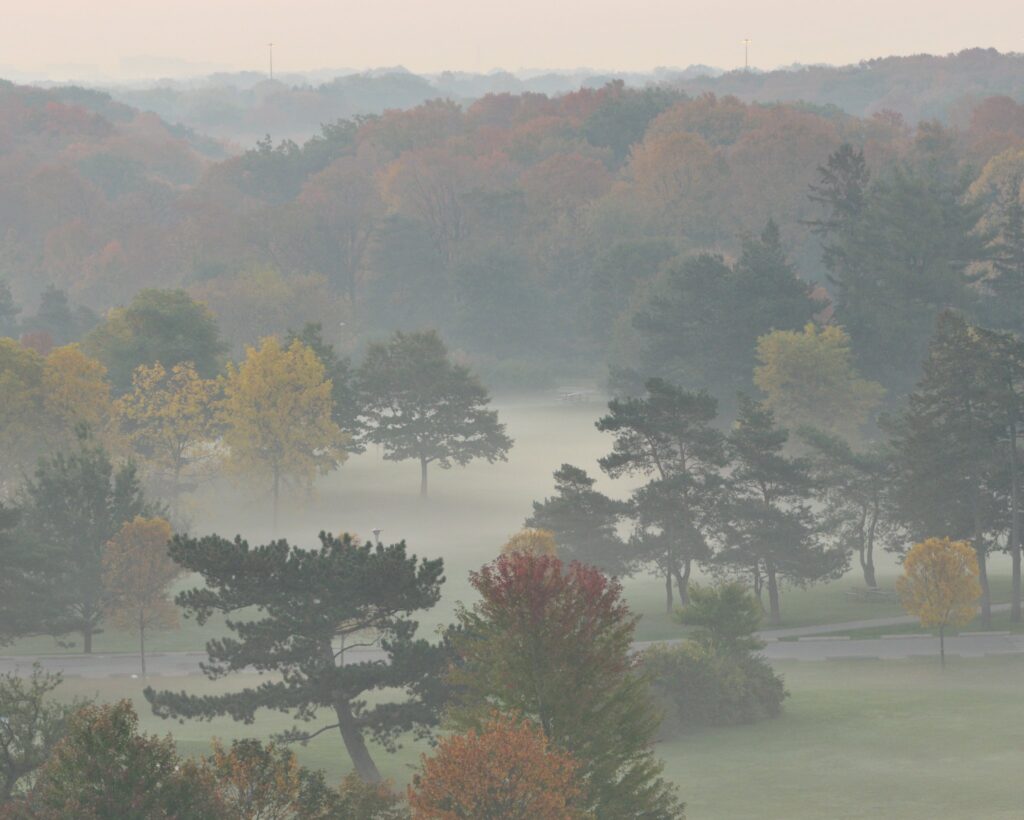
At the park, held by the ghosts of another generation of socially-active Filipinos, I hosted my 28th birthday party. It has been a tradition for me to celebrate my birthdays, in the early stretches of summer in Toronto, by assembling my closest (or most cooperative) friends at 5:30 in the morning to watch the sunrise. Last year, I coordinated one such viewing in the Don Valley, right below an underpass. The joy I felt that day in the mist and dewy grass felt worlds apart from the grief that washed over the crowd at the Earl Bales Park vigil just months before, but both had been meaningful mobilizations of community in public space.
I trace the lineage of my birthday tradition back further, to the “fam jams” I was raised on in the early aughts in Scarborough. These were the barbecues and picnics my parents would host at the local park near Kennedy and Eglinton with our Filipino family friends, related less by blood than by proximity. The reason they chose the park is now obvious to me: our apartment back then was small. The parquet floors didn’t spread wide enough for the sunlight to hit their surface in any meaningful way. I couldn’t remember any occasion when we had our circumstantial, ragtag family over in our living room, but I remember the sheen of tablecloths spread over wooden picnic tables at the park. I raced up between trees on the slopes of hills with the other daughters, until we got stuck and our dads had to rescue us.
Beyond the notable warriors and poets, Filipino labour is largely invisible and yields no plaques. I learned this from a young age, hearing complaints about supervisors and long shifts from my parents’ friends who worked various blue and pink collar jobs. While domestic labour has historically granted generations of Filipino women and men mobility across geographies and economies, the work is undervalued and often precarious. Academic Neferti Tadiar writes about 1990s Philippines and “the human costs of the nation’s participation as labor provider in the new global service economy.” The Filipina domestic workers in Little Manila would sometimes pool money together to rent “weekender” apartments or rooms where they could take communal refuge from the isolation of their employers’ mansions. We have never failed to come together despite the lack of a cohesive, permanent community centre in which to gather in Toronto.
The small plaque in the Don Valley donated by the Alliance to Commemorate Philippine National Day 1987 was a small gesture in service of claiming some part of this city for a community that makes up the third-largest immigrant group in Canada. The plaques are great, but we want space. We want for the labour and celebrations of our communities to be recognized and to endure.
Finally, a large-scale, city-backed, permanent cultural hub is in development. In July 2026, Toronto City Council unanimously approved a motion to explore partnerships for a Filipino community centre, the first step toward creating a cultural hub for the city’s Filipino community. The vote took place a day after hundreds assembled for a Filipino community town hall at Earl Bales Community Centre, steps from where many of them must have mourned the Lapu-Lapu tragedy.
It is interesting to note that, a year after the tragedy, the Lapu-Lapu Day festival was renamed “Lapu-Lapu Day of Togetherness” and moved indoors to Vancouver’s Italian Cultural Centre. In a parking lot in Vancouver, the community’s claim on the street was provisional and, as it turns out, undefended. The parks and streets belong to the municipality, which is why a festival that loses its street has to go looking for someone else’s roof. But gathering anywhere—and the work of keeping one another safe, connected, and schooled in our own history—depends on community effort. These claims to space and time were borne of the diaspora and mirror cultural activities originating in the homeland. The work continues, and we can turn to landmarks as inspiration, as time capsules for grief and joy.

I’m on another jog at the park. I turn left at the fork, pass the stream, the underpass, the tables. They are empty again. The community that gathered there has aged, moved, dispersed into subdivisions further from the ravine. I notice the vestiges of the parks we once turned into living rooms. Running down the Don Valley, meeting Jose Rizal’s face at Earl Bales Park, surrounded by the small and barely visible monuments made by migrant working-class communities, I am mapping a transgenerational, transcontinental instinct. The archaeology of a city that undeniably belongs to us, too.
Bianca Weeko Martin is a Toronto-based writer and researcher with a background in architecture. She is the author of Architectural Guide Manila (DOM Publishers, 2024) and is working on her first literary book, El Camino, a nonfiction collection. A story from the collection, “Tita Tallulah,” was longlisted for the 2026 CBC Nonfiction Prize. Bianca reports on Canadian and international design and art for publications including Azure. Her Master of Architecture thesis, The White House (2022), examined her father’s ancestral home in the Philippines as a site of counter-narrative, informing her recent curatorial project A Room of One’s Home at the University of Waterloo. Born in Jakarta, she has worked in architectural practice in New York City, Mexico City, and Melbourne.
This essay is part of Toronto Review’s series “Our Toronto” which spotlights writing about Toronto by Torontonians, and is generously funded by a Literary Projects grant from the Toronto Arts Council.