
Kamau Brathwaite’s New World Poetry
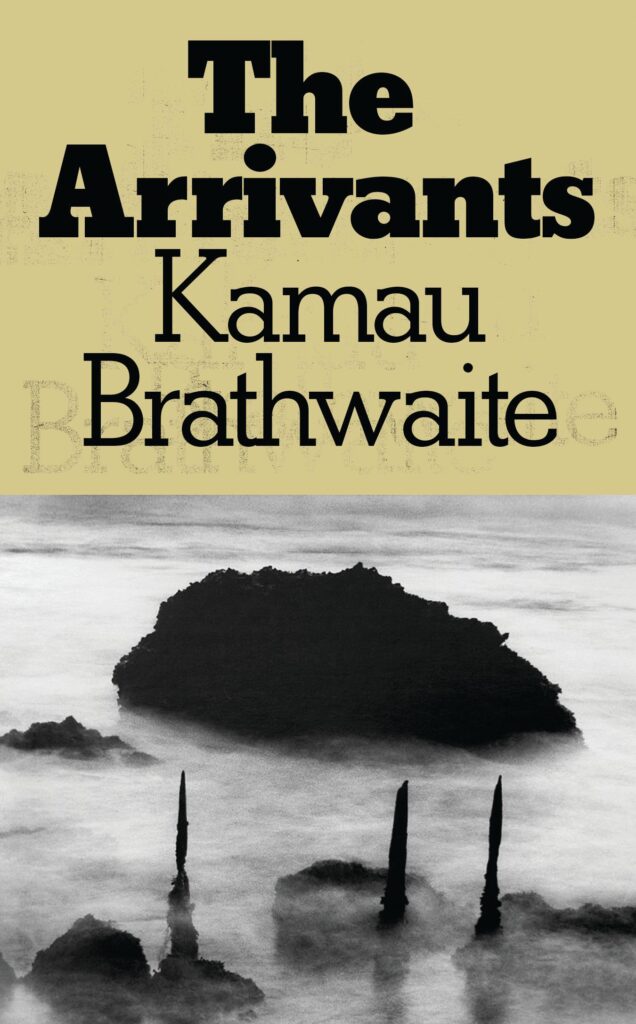
The Arrivants
By Kamau Brathwaite
New Directions, 288 pp., $34.95 (paperback)
September 15, 2026
This past March at a special session of the United Nations, Barbadian national poet Esther Phillips got to work. Phillips took the podium to observe a major moment in reparatory justice, the “Declaration of the Trafficking of Enslaved Africans and Racialized Chattel Enslavement of Africans as the Gravest Crime against Humanity.” The Declaration came to a vote on the International Day of Rememberance of the Victims of Slavery and the Transatlantic Slave Trade, a date established in 2007 by a UN General Assembly resolution.
In front of a silent room of mainly advisors and state representatives, Phillips wore a dark green pinstripe suit, a striking outfit in concert with the emerald stones on the podium’s backdrop. The space was bureaucratic to say the least, a chilly venue that seemingly resisted the recitation of poetry. In her two poems, “My Ancestors Gifted Me Their Silence” and “Hard Love,” she cast a harrowing view of the costs of enslavement in the past and ongoing present: “Ancestors” focuses on a young girl walking through a plantation as her forebears pray that she remains unaware of her own history; in “Hard Love,” an enslaved mother gazes upon her newborn son, whispering his name, Adofo, so that he will not forget who he is or from where he comes. On occasion, Phillips shushed her audience, and exhaled the breath of history into the room.
Yet militant resistance and revolutionary afterlives do not make for a pretty postcard, a lush travel destination, or a willing set of neighbours.
Phillips began by noting that the other silences in her poems—marked by pauses, enjambments, dashes, and shushes—are those of the enslaved ancestors, those that the Declaration meant to address and redress. “Ancestors” shushes right when the young girl might learn what the “stink of—” and “the stain of” the plantation represents. It stops short of naming what is known and what can be passed down. The performance concludes with an injunction to the member states present to turn words into action: “There are spirits of the victims of slavery present in this room at this moment,” Phillips says, “They are listening for one word only: justice.” The motion passed, with major support from African, Asian, Caribbean, and Latin American states. Most Western states abstained, including major beneficiaries of transatlantic slavery like the United Kingdom, France, Spain, Portugal, and their global partners. Three states voted a resounding no: Israel, Argentina, and the United States.
A much-belated and contradictory motion, the declaration tells a quiet story of formerly enslaved societies’ endurance against the bloody hands of the UN’s member list. But as a litany of disaster accumulates in the Caribbean on a daily basis, the framing of this resolution marks another silence. Take the devastations of the past year alone: Hurricane Melissa, who ravaged Jamaica and other islands; the Western blockade on Cuba; the U.S.’ boatstrikes on “narco-terrorist” fishermen; intensified collaboration between the Global North and South to destabilize Haiti. These quotidian disasters mark the aftershocks of slavery, colonialism, and imperialism in a region whose foreign collisions and local courage impelled Black freedom. The only words put into action by Western states are those of distortion and confusion—words that impede Caribbean freedom amid the choking tentacles of the empire.
So, what does it mean to write poetry in and of catastrophe? How does one write from and through the painful beauty and terrific calamity of Caribbean life? Phillips’ shush tells us a story different from that of the Declaration. Lingering in the stillness of the moment, she brings her finger to her lips, caressing them, and purses a shush as her recitation veers toward the truth. Her silence overtakes the room, brushing up against the limits of poetic or political declarations; the shush is directed at the audience for sure. Perhaps the shush reverberates beyond them, to the task still at hand: interrupting the incomplete histories imposed on the enslaved and their descendants.
Part of this troubled lineage invokes another set of ancestors—poetic ones. To hold the proposition of this scene of poetic protest, we must go back to a recently departed ancestor. Another spirit is in the room with us, beckoning to the contradictions and genealogies that make the Caribbean inherent to the pressing question of Black liberation. That is Bajan poet Edward Kamau Brathwaite, who Phillips described in a eulogy as the one who, to freedom’s great fortune, could “slash and burn an entire lexicon,” ruling “among the harbingers of language.”

Brathwaite’s life spanned both the Atlantic and the history of his island. Born in 1930 in the Barbadian capital, Bridgetown, the poet later co-founded the Caribbean Artists Movement in Britain, invented new experimental modes for Caribbean poetics, and wrote extensively on slavery, freedom, and their cultural developments.
A renegade and a scholar, Brathwaite operated on simultaneous registers of intellectual culture. He wrote widely, his oeuvre comprising the poetry collections Black + Blues (1976), Gods of the Middle Passage (1982), Dream Haiti (1995), and Born to Slow Horses (2006), as well as landmark works of history like Folk Culture of the Slaves in Jamaica (1970) and The Development of Creole Society in Jamaica, 1770–1820 (1971). He held degrees from Cambridge and the University of Sussex and teaching jobs at the University of the West Indies, Harvard, and NYU, yet also fought for his home, Cow Pastor, to become a maroon space and a hold for his archive, despite the Bajan government’s desire that it be made into an airport.
Reissues demand multidirectional reading. From past to present, they conjure futures foreclosed, feared, and fought for.
Brathwaite’s work as a critic mirrors his poetics as a “world-maker, world-breaker.” In his essay collections and nonfiction writing, he provides a lexicon for poetic warfare, tools which were later taken up by scholars in Caribbean, postcolonial, and environmental literary studies: namely, “nation language” and “tidalectics.” The former term muses on the ways a writer might work in the colonial tongue, and the eccentric, devious, and defiant ways they subvert it. The latter signifies how the rhythms of the ocean have come to affect life as human activity affects the ocean—something slavery and the revolutionary currents of the Atlantic bring into sharp relief.
Emboldened by the intimate magnitude of Caribbean being, Brathwaite traced multiple historical counterpoints in his poetry. The pages of his works teem with the rise of Caribbean independence and the decline of the British empire, anticolonial African roots and diasporic routes, and the fugitive and furtive practices of Black freedom.
Now, in New Directions’ recent reissue of Brathwaite’s epic, The Arrivants: A New World Trilogy, readers are returned to a poetic tactician equipped to combat the overwhelming onslaught of cultural and political crises. The collection assembles the long poems Rights of Passage (1967), Masks (1968), and Islands (1969) into the collected tragedy and triumph of African survival and struggle in the New World. Across the Middle Passage, into the maroon spaces of the hills, into the plantation, The Arrivants sounds a war cry.
The vexed spaces occupying Brathwaite’s imagination emerge differently as the collection proceeds. Take Islands, which concerns map-making, or how any island must be erased and reduced by cartography to justify its permanent, bounded state of extraction. The formal features of the poem experiment with the poet’s characteristic use of enjambment to enclose the reader within the time-space of the Caribbean. Brathwaite’s speaker avers that by “Looking through a map / of the Antilles, you see how time / has trapped / its humble servants here.” Dismissing a historical and geographical trajectory of progress from slavery to freedom, Brathwaite instead demands that the reader observe the Caribbean’s distorted representations closely. For what lies hiding in plain sight—unsurrendering time, physical and metaphysical traps, forced service—challenges the drive to survey the region and long for its geographical representation. This formal enactment of constraint and freedom is a crucible of the poet’s style, and serves as the story and song, the fire and force for Caribbean life.
When Brathwaite died at age 90 in February 2020, the world of letters mourned a craftsman, a poet of the people, and a Caribbean radical intellectual par excellence, whose work contested the discontents of formal decolonization. The year after he passed away, Brathwaite’s home island, Barbados, transitioned into a Republic, renouncing the British crown. He did not get to witness this stage in official freedom, but his life’s work helps to clarify the contradictions of such milestones, particularly as they play out in a world intent on undermining Caribbean liberation and sovereignty. As his poetic voice asks it in the poem “Negus,” after a crescendo of “It is not”: “Where is your kingdom of the Word?”
Reissues demand multidirectional reading. From past to present, they conjure futures foreclosed, feared, and fought for. In the wake of Brathwaite’s career and of Caribbean revolution and counter-revolutions, our contemporary critical protocols rub up against the historical weight of The Arrivants in its initial moment of publication and upon its republication. Can we account for the sameness and difference? What provocative comparisons can be made by publishing the book again, now? The revolutionary fervor of the long 1970s, when the Caribbean experienced a decolonial recalibration of global Black Power politics, helped The Arrivants ingrain a radical poetics of relation between Africa and the Antilles. To read Brathwaite—reissued, remixed, restyled, renewed—alongside Phillips’ intervention at the UN challenges us to think about poetry’s place in the Caribbean freedom struggle. A salve for what a republic is and what decolonization might become, The Arrivants shatters the false promises of progress. Reminding us that the weapons of counterinsurgency may change—the fight for liberation in the islands is currently scattering under bomb, drill, cruise ship, and plane—the collection remains caught between the pitfalls and promises of the conditions of its production and the world in which it is now reproduced.
“Negus,” in the final section Islands, exemplifies Brathwaite’s style of juxtaposition, reproduction, and invocation. Rustling against the English language’s fences, the pen transforms into both a metaphysical and material elevation of Black liberation. “Negus” catalogues forms of multinational collaboration: “Japanese-constructed, United-Fruit-Company-imported hard sells,” “Barclay bankers on the telephone,” “United States marines,” “Miami structure skyscrapers.” If it is not enough to be free while others suffer, “Negus” situates language as a front for that struggle, to be given words “to shape my name to the syllables of trees,” “to refashion futures like a healer’s hand,” “to confound the void” and “to raze the colony,” to “blind your God.”
Where the poem dials up its rage with each intensifying mode of destruction, it concludes with an appeal to spirits of West African-descended Vodun, Legba, in a Kreyol imperative, “Ouvri bayi pou’moi.” Far from the first time Brathwaite relies on spirits (Ogun, Erzulie, and Shango) and the Christian and Afro-diasporic gods, these invocations hold the simultaneous meanings of ouvri bayi as open the door or gate for new interpretations. Both calling back to slavery’s “door of no return” and forward to the boundaries between human and spirit, the poem’s mystic presence emphasizes that freedom will be both a material and metaphysical battle: permit me to initiate, to begin again. In that way, the spirit Legba invites the speaker to the gateway between the living and the dead, beyond the void and the colony. Calling up the spirits for their permission, Brathwaite finishes at the threshold. There is no going back.
Readers may approach the text having already heard of the term “arrivants,” or of Brathwaite’s extensive, seemingly endless, contributions to Caribbean literature and politics. During the 2010s, the term experienced a revival as academics working in the various fields of postcolonial studies, Indigenous studies, and Caribbean studies used the concept of the arrivant to contend with African presence in the Indigenous Americas.
To use the term is to ponder how enslaved people in the Caribbean navigated, without reproducing, the brutal legacies of genocide, removal, and the dispossession of Indigenous peoples that marked Western conquest and settlement. Afro-Indigenous history animates the region: like, for example, the fact that the name “Haiti” results from the Taíno origins, or in the Garifuna people’s current land defense struggles in Honduras and Belize. As contemporary Black and Indigenous freedom abuts counterinsurgent state violence, these conflicts inherit a longer history of liberation. Yet militant resistance and revolutionary afterlives do not make for a pretty postcard, a lush travel destination, or a willing set of neighbours. For the West, Caribbean freedom through Black-Indigenous solidarity is forever its antagonist.
In Brathwaite’s text, “arrivant” originates from a quotation of the Kumina Queen, whose African spiritual practices haunted postcolonial Jamaica. Brathwaite cites her in the beginning of the collection, drawn from the depths of his archival work, and she recounts in legend: “Well, muh ol’arrivance … is from Africa …. That’s muh ol’ arrivants family. Muh gran’muddah an’ muh gran’fadda. Well, they came out here as slavely … you unnerstan’?”
Yet Brathwaite neither defines arrivant, nor does it appear in the poems or glossary. The term is tinged with ambivalence and opacity, such that to understand arrivant requires a precise elision that only poetry provides. Is it an identity to be reclaimed or a consequence of violence to be repressed? If arrivant offers a set of coordinates between and beyond settler and native, how do we account for the arrivant’s presence in the ongoing states of war taking place in the Caribbean, or what Brathwaite calls “fresh wars an’ rumours of war”?
If arrivant offers a set of coordinates between and beyond settler and native, how do we account for the arrivant’s presence in the ongoing states of war taking place in the Caribbean, or what Brathwaite calls “fresh wars an’ rumours of war”?
For the Caribbean to serve as a vantage for Black-Indigenous solidarity means taking the question of survival and resistance seriously. When Kumina Queen asks “…you unnerstan’?” her elliptic pauses serve as a kind of silence from the ancestors. Who is she talking to? Who doesn’t understand? In her phrasing, the Middle Passage appears quickly in terms of its origins and consequences. The arrivant is still trapped in a new place, forced to make new kin amid the bloodthirsty market. “You unnerstan’?”
Returning again and again to the land of the islands, Brathwaite proffers ecological and spiritual knowledge systems as the basis of both the ethics and poetics of Caribbean freedom. But to do so, he must he first dramatize the brutal conditions of enslavement. In“Work Song and Blues” from Rights of Passage, Brathwaite has his speaker listen to his surroundings as the enslaved build new villages for the colonizers: “Drum skin whip / lash,” “Dust glass grit / the pebbles.” The sensory milieu heightens the crime and indignity of their stolen labour. Situated within the deadening heat, the carcasses, the shit, the sweat and saliva, the insects nibbling, the rotting flesh, and the buzzing black zones of silence, the speaker attunes the reader to how building the colonial Caribbean forced a heightened bodily awareness and awful endurance of the elements.
Under these conditions, when the speaker asks God for fires to warm women and children, the act of care transforms to an act of revolution: “Flame is our god, our last defence, our peril. Flame burns the village down.” From then on, a flaming act of insurrection inaugurates the poems as they contend with this nearly thwarted history of survival. When the poems animate the tools that will destroy the plantation, they commit Caribbean freedom less to the actions of a few individual leaders and more to the collective and ongoing mobilization of the environment. To start this war cry, we might recall the wish for flames; that which starts humbly as regard may ember into a revolution.
Rights of Passage shifts between different historical modes and genres of Black struggle. As the poem “All God’s Chillun” inhabits the “Uncle Tom” figure, so too does it question the presumptive unity of the enslaved and their descendants. Repeating “I am a fucking negro,” another poem reflects on the violence that grafts the quality of blackness onto a stolen people. Another traverses “the miles / of unfortunate islands” that circulate between the harbours of anticolonial agitation in Chicago, Paris, Haiti, and Latin America. Arrival, arrivancy, arrivanthood takes many shores and shapes, formed through movement and escape.
Turning to a violent form of arrival, “The Emigrants” attends to Christopher Columbus’ travels to the new world, touching down in Canada, the Panama Canal, Mississippi, and Florida, following the migration of “these New World mariners / Columbus coursing kaffirs.” “What did this journey, mean this / new world mean: dis- / covery? Or a return to terrors / he had sailed from, known before?” the speaker asks of the infamous explorer. Charting centuries of Atlantic history to the global upheaval of the 1960s, the speaker notes different modes of Black nationalist adornment—wearing a beard, a turban, calling yourself X (a la Malcolm). Brathwaite points to how a focus solely on the exterior—that results from both imperial agents and radical self-fashioning—is to lose an entire interior realm of consciousness. To close he deploys an ambivalent couplet: “Our colour beats a restless drum / but only the bitter come.”
If the opening long poem Rights of Passage is about the impossible quest for the arrivant’s home—where, as it concludes, “There is no / turning back”—the subsequent volume Masks summons the spiritual realms of struggle. Whereas Rights explores the making of blackness in colonial and anticolonial movement, Masks ascends to the divine for help. For instance, “Atumpan” sounds the drums to address the spirits above—“Kon kon kon kon / kun kun kun kun”—before the beginning of the ceremony. This poetic crossing to West African religion marks another geography of struggle, that of the spiritual, which overtakes the Middle Passage and situates arrival as a practice of return.
This ceremonial poetics in Masks further grounds survival in the space of the forest. When the first Africans arrived in chains in the “New World,” they fled to the forests and the hills; in “The Forest,” the speaker hacks through the wilderness to clear space to make a farm, a line that gives in to a rhyme with “no harm.” The poem dances and sings its way through the trees, which then provided a temporary protection, and which now symbolizes what we owe to those “before us / to prepare the way.” Preparing the way means cherishing those who passed down modes of survival and struggle for those who will cultivate new strategies for living. Ending with “preparing the way” reminds the reader of what little reprieve is to be found in the future and what terrible, beautiful, life-giving resistance has come before.
In Brathwaite’s time, the question of whether the Caribbean and Black people the world over had a history was very much in play. In 1962, echoing the European idea that Africa was an unhistorical continent, the writer V.S. Naipaul quipped that the Caribbean had no history, that nothing was created in the West Indies. Brathwaite, ever the historian, does not neglect the continuity of history, of continuous slave voyages, of “the new dead” made in endless passages over the Atlantic. But writing historical documents back to the empire would never be enough when radical histories, devoured by the archive, live on in the poetry of everyday life. The poem “The New Ships” repeats “beware / beware / beware” before the harrowing question “whose ancestor am I?” These impossible queries at first seem to never find their answer. They ask a heart-wrenching question for those whose families survived slavery, but as consequence cannot locate the beginning of a line. Yet Brathwaite is also pointing us to the future, as in the generation to come who are watching for how we prepare the way. Masks ends with an instruction, the brutal gerund “I am learning / let me succeed.” Positioned as “learning,” the middle collection forms an experiment in poetry and pedagogy—a transition toward the world ahead.
Islands completes The Arrivants’ new world trilogy, synthesizing the historical, environmental, spiritual, and political implications of enslavement. The polyvocal poem asks: What happens if prayers aren’t listened to? What purpose is prayer, when your labour—and obliteration—is required for the world? How do the waves listen to lament, to those who threw themselves over in search of freedom? Will the sky turn to dawn or are the enslaved forever left in the darkness? “There is no destination / our prayers reach” a speaker puts simply. “The sea is a divider,” another speaker asserts. The New World is “a new world of negroes,” so if “the stars / remain my master’s / property,” what hope is there for liberation? What does it mean if “to live here / is to die”? This pessimism directs a more honest, more unsparing descent. An aesthetically militant force, negativity rejects the obfuscations of history and insists that the totality of catastrophe be remembered. To illuminate the impossibility of freedom in even the sea, the stars, or the sermon is to clarify the ungiving world and to beckon, reach at last, for a new one.
Nevertheless, Islands pulses with the kinesis of rebirth and revival. One speaker’s tongue “is heavy with language / but … cannot give birth speech.” If the world is dying, it necessitates a search for new terms beyond those inherited from the colonial world. Another speaker attends to the potential murder of an enslaver, only for the prospect to have “made / nothing, un- / made nothing.” Even so, the sequence relies on ancestral, spiritual, and historical kin who pulse throughout, so much so that the Word comes alive. As familiar lines repeat and intensify, Brathwaite’s speakers invoke the past upon this broken ground. The ending is that the “kingdom of the Word”, as Brathwaite terms it, comes alive, as if from thin air. So much so that Caribbean freedom transforms into a rhythm, “some / thing torn / and new.” As familiar struggles intensify in the region, to reissue the collection now is a way of forming something itself torn and new. New languages for liberation break the churning cycle of despair and call upon past generations of resistance.
Some thing torn and new. I am at a loss as these lines accumulate, as I turn over this new volume. I too am learning, hoping to succeed. I am sitting with what is torn and new at this conjuncture for the Caribbean. The problem of Caribbean freedom is (and has always been) a question for poetry: the stolen tongues; the Western collusion on the islands; the nimble revisions to the terms of debate; the lyrics, songs, gestures, and performances that anticipate victory; the breaths, voices, and screams that move us from the UN to the streets. Reading Brathwaite now is to see his frustrations with slavery’s durability at all points of formal emancipation.
The Arrivants is a war cry against the states of war that have dominated the Caribbean throughout that centuries-long invasion. To grapple with Brathwaite’s poetry is to glimpse survival at each possible articulation of freedom. Resistance takes form on every scale, every note, every song, and every incantation of the struggle. It is what we must do when we cannot go back.
Matthew Molinaro is a cultural worker and journalist. His writing has appeared in Canadian Dimension, The Local, Cultural Critique Online, and elsewhere. In his doctoral work at the University of Toronto, Matthew specializes in African diaspora, Caribbean, and hemispheric American literatures, histories, and politics.