
Thinking About June Jordan
This essay is part of Toronto Review’s ongoing column on 2SLGBTQIA+ aesthetics, funding for which has been generously provided through the Queer & Trans Research Lab Emerging Projects Fund at the Mark S. Bonham Centre for Sexual Diversity Studies.
All of this started with a drink. Whether it began with mine, my great-grandfather’s, or some other forebear’s, I don’t know. When I really got going at 14, I adored drugs and alcohol, and for a while I was pretty sure that alcohol, at least, liked me back. When I ruined yet another night by crying in the bathroom at a party, an ex told me I was at my best after three drinks. For most of my life, I have been shy and inhibited, so I could see what he meant: at three drinks, I could begin to command attention. I was bolder, intense, confident. I felt intellectually secure. My laugh, ever full of flavour, would reverberate through the room.
The problem, dear reader, is that I could never have just three. You know how the story goes.
Or do you? Substance use treatment is a multibillion-dollar industry that sells a well-known narrative arc of purity, often one in which moral judgment or character assassination are followed by betterment. As a teenager, I loved the literature that makes up part of this industry, albeit the salacious details more than the overcoming. But the more I lived, and the more black literature I read, the more times I evaluated my own relationship to alcohol, and the more I revised my family history, the more I tried to figure out what this conventional body of recovery literature had left out.
Poetry is often imagined as therapeutic, a form of self-expression in a smooth march toward personal healing.
Somewhere along the way, I also learned to look for relief elsewhere. My debut poetry collection Nightnursing is a record of that never ending search. As I tried to disorganize a language of recovery that promotes abstinence over harm reduction, the self over the collective, criminality over abolition, and death over safety, I ended up dividing the book into two parts: 1. (Ante)Recovery and 2. (Anti)Recovery.
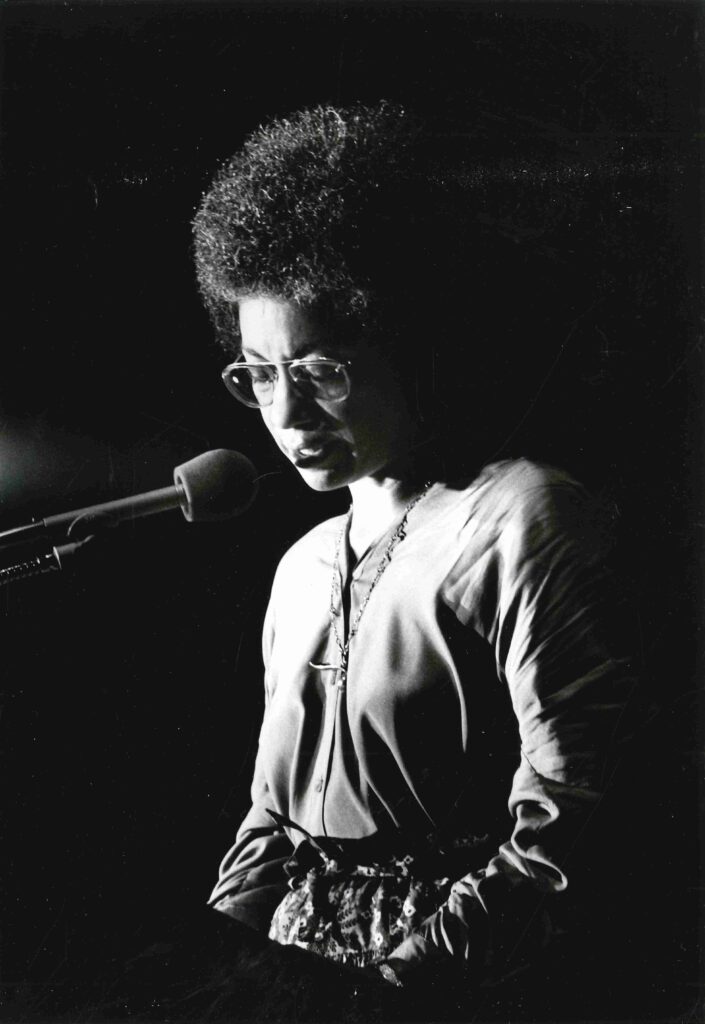
In recovery spaces, poetry is often imagined as therapeutic, a form of self-expression in a smooth march toward personal healing. But because my relationship with poetry has been steeped in black poetics, an insistently collective tradition, I bristled at both the linearity and the individualism of writing for the sake of resolution. Like the speaker in June Jordan’s “Poem for Haruko,” “I never thought I’d keep a record of my pain / or happiness / like candles lighting the entire soft lace /of the air.” What Jordan (and other women and queer poets, especially in the late 20th century) taught me was a matter of scale—how to toggle between the personal, the political, and the formal. Rereading Jordan reminds me of the change that writing (and the writer) undergoes by virtue of attention to history: Jordan is just one member of a community of poets who led me away from poetry-as-desperation toward a struggle over language and its politics.
Perhaps it goes without saying, but Jordan is a foundational black poet, one of our foundational black queer poets—an anti-imperialist, anticapitalist, black nationalist, feminist, internationalist, political, antiwar, civil rights, radical poet who fought for the well-being of children, for Angola, for Namibia, for Palestine, for Lebanon, for Black Studies at all levels, for sexual freedom, for participatory urban design, for “curvilinear features of street patterning,” et cetera. Poets and their ways are infinitely complex, but Jordan took the role to the extreme, deploying her work to entwine both her world and the world.
In her foreword to Civil Wars: Observations from the Front Lines of America, a collection of political writings published in 1981, Jordan writes:
“My life seems to be an increasing revelation of the intimate face of universal struggle. You begin with your family and the kids on the block, and next you open your eyes to what you call your people and that leads you into land reform into Black English into Angola leads you back to your own bed where you lie by yourself, wondering if you deserve to be peaceful, or trusted or desired or left to the freedom of your own unfaltering heart. And the scale shrinks to the size of a skull: your own interior cage.”
For her, writing is about learning how to fight. Civil Wars includes reporting, letters, scenes, essays, and lectures, demonstrating the multifacetedness of what constitutes political writing. Her syntax is porous: “land reform into Black English into Angola leads you back to your own bed.” The opening line of this essay is itself modeled after one of Jordan’s openings: “All of this started with my uncle,” she opines about the family probation officer who taught her how to “disarm/disable an assailant,” an assailant who was sometimes her own father.
Poetry began as a way for me to practice being bad at something.
One of the writings collected in Civil Wars is a magnificent essay called “Thinking about My Poetry,” first published in 1977 in the feminist magazine Chrysalis. In it, Jordan details not simply her varying aims as a poet but also why and how she became a poet in the first place. It’s a record of practice. Since she was a little black girl, she writes, “poetry was the inside dictator to whom I more or less simply submitted myself.” Writing poetry consisted early on of a “quasi-automatic process” that was interrupted by exercises of purposeful apprenticeship, emulating the likes of Percy Bysshe Shelley, Robert Herrick, or T. S. Eliot. This study of canonical poetry was encouraged by the racist environment: “All my life,” she writes, “the rule was that if you were Black you had to be twice as good/smart as anyone else just to get started.” Mastery of a white language too often supersedes what Audre Lorde called that “quality of light” that forms the basis of poetry.
I had read this essay for the first time when I was in graduate school but was drawn to it again recently, since it occurred to me that with my book of poems forthcoming, I’d be asked to speak publicly about my own poetry for the first time. Like Jordan, I was an anxious overachiever as a child. When I was in grade one I was in a split class and I took it upon myself to do a grade two project, then spent the evening before it was due pulling my hair out and terrorizing my mother. In other words, I have spent a good deal of my life (including a dozen years in post-secondary education) trying to disabuse myself (and my students) of “the rule” of which Jordan speaks.
Poetry began as a way for me to practice being bad at something. I was getting my PhD and working regularly as a critic in the art world, becoming professionalized in and recognized by institutions about which I was ambivalent, institutions I knew were extracting from me and my peers. I remember scribbling poems in my notebook from my single bed in the detox unit, thankful the other bed in my room was empty. I fretted that inpatient rehab would leave me even further behind on my dissertation.
“Of course,” writes Jordan, “preoccupation with one’s self and with technique does not yield an art of interest to anyone else, necessarily.” Because writing about oneself, or writing as a means of processing, can become solipsistic, what I really needed was to turn directly toward the world I had wanted to leave behind by disappearing into drink. Thinking about Jordan’s lifelong relationship to writing poetry has allowed me to (re)narrate the publication of my book as not the end of something but the continuation of what she described as “a conscious desire to change our environment, to scrape and ax away at the status quo.” Nightnursing presents a different kind of intoxication: disintegration of the mind and the loss of self that finds a new expression through acknowledging that there is no normal state to which to return. Instead of wholeness and self-help, the recovery in this book is more about cataloging the intimate everyday. Poetry became a way for me to account for the rough and collective edges of recovery before singing from the so-called ‘other side.’
I studied Jordan’s attempts to pay attention to self, to craft, and to politics all at once, attuned to how “rhythm and political concept merged into a vertical event,” an idea she would outline several times, including while visiting Allen Ginsberg’s class at Brooklyn College in 1989. She cites her famous 1968 poem “In Memoriam: Martin Luther King, Jr.” as her “first attempt.” An unconventional elegy, the first of two parts reads:
“honey people murder mercy U.S.A.
the milkland turn to monsters teach
to kill to violate pull down destroy
the weakly freedom growing fruit
from being born
America
tomorrow yesterday rip rape
exacerbate despoil disfigure
crazy running threat the
deadly thrall
appall belief dispel
the wildlife burn the breast
the onward tongue
the outward hand
deform the normal rainy
riot sunshine shelter wreck
of darkness derogate
delimit blank
explode deprive
assassinate and batten up
like bullets fatten up
the raving greed
reactivate a springtime
terrorizing
death by men by more
than you or I can
STOP”
Okay, let’s stop, at least to consider what Jordan means regarding the connection between rhythm and politics. If you’ve heard her read the poem (and you should hear her), the opening line—“honey people murder mercy U.S.A.”—melts into itself. Even with Jordan’s crisp enunciation, the words are almost like honey itself. But does she want this gouging of the status quo to go down easy? No. Each syllable becomes its own word, its own weapon: a-ssas-si-nate. There are so many ways to say these lines, so many phrasings: “honey people” as in sweet people, “honey people murder” as in those sweet people, well, they murder. Honey, people murder! Honey-people, they murder mercy. Have mercy on the U.S.A. Have mercy, U.S.A.
On Jordan’s slinky tongue, U.S.-ian fecundity and manifest destiny juxtapose dispossession, and it is damning. Each line is short, consisting of no more than five words. But they’re dense as rock, in part due to the profundity of the nouns (death, bullets, greed, darkness, breast, rape) and the violence of the verbs (rave, terrorize, delimit, explode, burn, disfigure, batten up). The momentum typifies that “vertical rhythm,” which is sonically potent, heard and physically felt, a way to keep a listener or reader’s attention. There are four one-word lines in “In Memoriam”: line 6’s “America,” line 24’s “terrorizing,” line 27’s “STOP,” and the closing line that comes later, line 40’s “more.” “America” earns stanza breaks, room to breathe (and you can hear Jordan breathe on the recording), only to then plunge back into the violence; “terrorizing” could be a gerund, but either way it’s verbal, ongoing; “STOP” is emphasized through capitalization; “more” is final, leaving the reader unsure of the future.
I think about this poem now because, as Jordan’s first attempt to marry self, form, and politics, it gives me a renewed sense of what is possible in writing that moves beyond the personal. As scholar Anthony Reed said about “In Memoriam” in 2023, Jordan “gets herself out of the way in order to present the poem.” But, of course, as her reading of it demonstrates, the poem is laced with a meaning that no one can punctuate quite like she can.

In graduate school, there was a period when everyone would ask me if I was a poet. For a time I experienced it as a kind of anti-blackness—a demeaning of the academic knowledge I was so desperate to acquire, per Jordan’s explication of “the rule,” and what it takes to get going as a black writer/thinker/person. The first poem I ever published, in a poetry magazine called Elderly that featured “writers outside the main streams of poetic writing,” was written feverishly after Donald Trump won the U.S. presidential election in November 2016. Titled “Poetry Forever Ever?” (“forever ever” to the tune of André 3000 in OutKast’s song “Ms. Jackson”), I was vacillating between refusing what had been refused to me and surrendering: it was really a poem about not wanting to become a poet, but realizing, as I put it, “I was / a poet all along.”
In Let the Poets Govern: A Declaration of Freedom, Camonghne Felix goes as far as to say that “we are all born to be poets. We are all born with the ability to absorb and experience the details of our days—the light graze of a summer breeze, the tongue tasting complexity—and to transfigure those details into images that tell stories about how we live and who we are.” I began my first published poem like this:
“The other day, I became
a poet.
Thanks to the slow roaches
dancing with the porch lights on.”
Today I think it could be embarrassing to share a poem from ten years ago but, writing this alone on my mother’s couch, I’m actually kind of warmed. I had long been disillusioned by electoral politics, and so I was unsettled that the presidential election had affected me so much. I had not yet understood the scale of politics Jordan outlined in her foreword to Civil Wars: from your family to your street to your workplace to Angola and back to your room, the limits of your brain. I was lying in my bed alone wondering, like she wrote, if I deserved to be peaceful or trusted or desired or left to the freedom of my own unfaltering heart. Through writing this poem, I worked through the mess of my thoughts in an open structure that would form only the beginning of my play with personal detail as a way into world-historical understanding. I realize some of my same concerns were there: drug use, collectivity, daddy issues, projection, becoming. A slice of this poem survives in Nightnursing, in the line: “I know something about being declared upon.”
After Martin Luther King Jr.’s assassination in 1968 and the poem that followed, Jordan reframes the relationship toward her publics, noting in “Thinking About My Poetry” that: “Toward the close of the sixties, I reconsidered, and decided that I wanted to aim for the achievement of a collective voice, that I wanted to speak as a community to a community, that to do otherwise was not easily defensible, nor useful, and would be, in any case, at variance with clarified political values I held as my own, by then.” It was the 1970s, and blackfeminism was in the air. When asked to perform a poem at a 1973 Black Women’s Conference, she came up with “Getting Down to Get Over: Dedicated to my Mother,” where she transmutes stereotype, myth, archetype, and invention into that “collective voice.” But as the seventies continued, this wasn’t enough. “I reconsidered again; aspirations toward a collective voice seemed to me conceitful, at least,” she wrote. “Instead, I came to the idea of myself as ordinary.”
This is where she had landed in 1977 when “Thinking about My Poetry” was published, where she sought anew “to be accurate about myself, and to force my mind into a constantly expanding apprehension of my political and moral situation.” And because of this laboring toward psychic accuracy, intellectual transformation, and political clarity, she “refuse[s] nothing.” Revisiting my decade-old poetry, finding my reaction to be softer, I might sublimate the ambivalence, shame, and self-interest of publishing a book in the service of the poetry itself. I mean, I didn’t set out to write a book about recovery, but that’s one of the political threads that revealed itself to me in the process of writing. Jordan likewise concludes her essay as a matter of faith, ever open to change. “And I choose to believe that my enemies can either be vanquished or else converted into allies, into Brothers.”
Jordan wrote “Thinking about My Poetry” after her selected poems, Things That I Do in the Dark (1977), edited by Toni Morrison, was published to an “unexpected silence” from feminist and black literary communities. Going “poem by poem,” Jordan took it upon herself to throw light on her formal and political approaches to writing, spanning a slightly authoritarian and “quasi-automatic process” of study focused on craft and imitation; to a focus on rhythm, sound, and politics; to a 1968-informed aspiration to collective representation that would rise to addressing material conditions. This formal analysis is followed by an emphasis on individual (not individualist) truth and singularity, before going back again to beauty, blackness, ambivalence. Howard University professor Jennifer D. Williams writes that, “In keeping with Black feminist autobiographical practices, Civil Wars subverts the autonomous individual or exceptional figure of conventional autobiography.” And then finally, though not finally, Jordan gets her bearings, a “progressively political self-assertion.”
I’ve resonated with and to some extent passed through these stages in Jordan’s edification, though with less grace, skill, and time. Throughout almost two decades of publishing my own writing, there was a period when my essays shifted toward poetry. These days, in my prose, I mostly strive toward clarity. Some of that is political clarity. I have seen how different genres, styles, or modes are disciplined in and encouraged by liberal institutions, where what is known as “Craft” is, as Fargo Tbakhi has written, “a machine for regulation, estrangement, sanitization.”
I write this essay as something of a corrective, a way of tapping back into the common project of black literature.
In late June, I read some poems from my forthcoming collection at a community art space in Toronto. Poetry was the last thing on my mind; I was compartmentalizing. On my phone: U.S.-Zionist imperialism, the Knicks, the Toronto Island airport expansion, a typhoon in Japan, a worsening Ebola epidemic in Uganda and the D.R.C., the Cyrus Carmack-Belton verdict. At home: a new medical diagnosis, a death anniversary. At work: the thick of co-organizing a three-day colloquium to mark the 15th anniversary of Christina Sharpe’s Monstrous Intimacies: Making Post-Slavery Subjects, which had once again obsessed me. Here are some of my notes from that day, which I scribbled in haste in the hours before the event:
“Nightnursing is about a lot of things but one way I will talk about it now is in conversation with the last two days of the colloquium: as elaborating on the impossible possibility of a post-slavery subjectification, wherein one form of subjection is what some activists refer to as the treatment or rehabilitative industrial complex, a system bound up in not just carcerality as such but also the site of the physical prison.”
Amid themes of care and cure, the poems demonstrate that sometimes the institutions, procedures, and ideologies that are said to save our lives also produce other exposures to death. I read a couple of poems from each section, “Ante” or before recovery, and “Anti” or against recovery, as a way to refuse the typical redemptive narrative of getting better.
Because of how people drank in my family of origin, I had been familiar with 12-step programs since I was a child and had long witnessed and listened to people reckoning with the sacrosanctity of linear development. As a preteen, “It Gets Better” was a popular anti-suicide, anti-homophobia, and anti-bullying campaign of the early aughts that sought to tell queer kids to just hold on. Sometimes it gets better. Sometimes it also gets worse.
In my brief opening remarks, I said nothing about the formal or aesthetic tradition out of which I had emerged, not whole but not really broken either. I write this essay as something of a corrective, a way of tapping back into the common project of black literature.
Wait.
To say I had emerged suggests that I have moved away, but what I mean to say is that I am immersed: the tradition in which I am immersed.
Make no mistake, Nightnursing is not a diary. In Rastafarian culture, as m. nourbeSe philip tells us, there is no me, no I, only I and I, only we. In literary criticism, we refer to a speaker who tells the story of the poem, similar to a narrator. Nightnursing mines the ambiguity of the relationship between the speaker and the author, giving me a distance that can make it bearable to write the truth. In order to tell you how I came to write this book, I was compelled to explore Jordan’s political approach to poetry—another effect of distancing. During the book’s revision process, my editor, the generous Tolu Oloruntoba, suggested I rework some of the poems using formal constraints. In one of our many rounds of edits, I wrote a glosa, a 15th-century Spanish form that appropriates or ‘glosses’ lines from another poem—in my case, “All Men Come to the Hills” by the Jamaican poet Roger Mais. My poem “Ferventory of Letters” uses four lines of Mais’ work as an epigraph and then reuses each line at the end of its four stanzas. There is Mais and there is the third-person “she” of the poem as well as the speaker of the poem. And then there’s me, creating a whirlwind of poetic agents.
Using personal details in many of my poems allows me to distill concepts, often ones that intertwine the theoretical, political, and literary, but anything autobiographical is not the only or most important part. I realize now my avoidant penchant for distance is an impulse worth revising. I turn back again to what Jordan referred to as “my life [as] an increasing revelation of the intimate face of universal struggle.” What I take her to mean is that poetry can form a language for rejecting barbarity. Nightnursing’s structure is organized to mess with the narrative conventions of healing. That “intimate face” looks different for all of us, but the struggle might be, could be, articulated in a common tongue.
Tiana Reid is assistant professor in the Department of English at York University where she teaches black literature. She is the author of the poetry collection Nightnursing (2026), which was shortlisted for the Writers’ Trust of Canada’s Dayne Ogilvie Prize for LGBTQ2S+ Emerging Writers. Her essays, reviews, and academic articles have been published in many places, including American Quarterly, Bookforum, Dissent, The Nation, The New York Review of Books, Theory & Event, and The Yale Review. She is also an editor at Pinko, a magazine of gay communism.