
I Who Have Never Known Fame
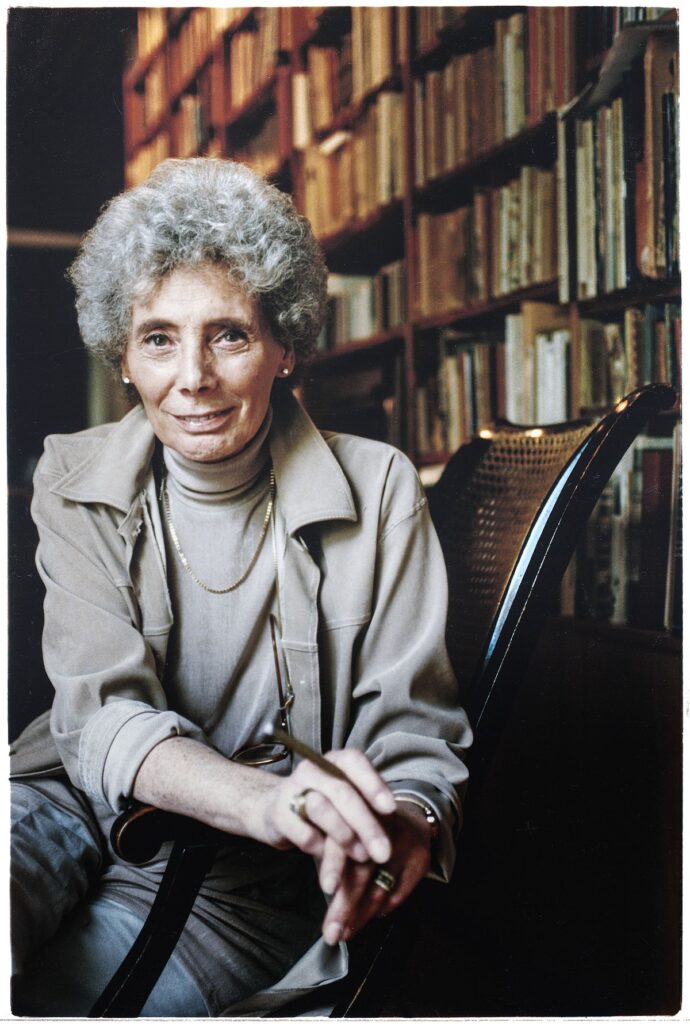
We Were Forbidden
By Jacqueline Harpman, translated by Ros Schwartz
Transit Books, 108 pp., $29.50 (paperback)
July 17, 2026
Jacqueline Harpman, the late author of the recently viral novel I Who Have Never Known Men (1995), was desperate to be remembered. Her short story “The Broom Closet” (2001) closes with the lament of a woman writer bemoaning the futility of labors that may be forgotten:
My goodness! I have desired so much throughout my life, fought so hard against myself and others, so conquered my passions and hated my enemies, so despaired: when I think about it, what stupidity! I wanted to be loved, respected and appreciated: but I will be forgotten. Not straight away… if I’m lucky, a novel will be lying in a bookcase in the home of one of my great-grandchildren, yellowing, dried up, likely to crumble to the touch––we know how poor the quality of paper is these days––and my great-grandson’s new girlfriend will open it, read a few lines and say: ‘Woah! That style of writing is so outdated!’
Which will bury me once and for all.
And, knowing that, I live obdurately, a witness to human folly which, century after century, makes each of us take a passionate interest in our own fate… in truth stories always end badly, everyone dies and humanity will continue to delude itself until the end of time, if the sun does not die prematurely.
It is impossible to read this without irony: the legacy of Harpman, who died having written some 15 books in the late 20th century, remains animated, if still inconclusive. A Belgian who wrote in French, her work is being zealously embraced by way of new translations to English. Her unease about obsolescence pervades this body of work: though their environments are changeable, her characters are quick to expose their anxiety about the insolubility of their mortality. For Harpman, like other writers obsessed with legacy, death’s deadline is unforgettable, and “The Broom Closet” foregrounds its display. In this instance, Harpman’s horror vacui is solipsistic: the void afflicting her is the absence of herself.
A writer’s life is also lonely. It requires struggling tirelessly to produce something that is true and also timeless, which is wont to be exceedingly rare. Hélène Cixous first taught me this lesson: in Three Steps on the Ladder of Writing (1993), she writes that the authors who labour tirelessly in their work must “suffer, also [undergoing] a sort of suicide, also [getting] lost in forests––and this is frightening. You do not want to lose your life so easily in writing.” That is, unless you are sure that the work will be worth it.
It is young, internet-savvy women who have become her greatest proselytes. Without them, her work would live dangerously close to being out of print.
Most books fail to achieve posterity. The duration of the book-object, with its spine (so human!), contents, and covers, will be reduced to dust. It will acquire a smell and must, giving the reader a headache. Pages will fall loose from their arrangements as if leaking out. Writing books is therefore a practice with existential stakes. Good work extends the margins of an author’s brief life; they become an artist who, unlike the narrator of “The Broom Closet,” cannot be dismissed on the grounds that their work is no longer in style.
This brings us back to the imagined girlfriend of the great-grandson, who typifies, for the narrator of “The Broom Closet,” the reader to whom she clings in her human folly. I imagine her, perhaps unfairly, as being stylized without a style of her own. In other words, I can see that she is young. She is marked, in this fantasy, by the narrowness of her vision. She is the silly thing called a girl. And how ridiculous this is to us, Harpman’s readers, since it is young, internet-savvy women who have become her greatest proselytes. Without them, her work would live dangerously close to being out of print. There would be no more translations, no revisions or reappraisals. For readers of English, books like I Who Have Never Known Men would have died in their infancy.
Harpman’s concern for her legacy is, of course, selfish. It strikes me as repellent and infantile when she moans that she will never be understood, as though (like a therapist once said to me) she is so exceptional that she is something more than human: a genius in exile. But I look past it because I, too, possess this weakness. It is a condition that is utterly ordinary.
Critics have speculated that Harpman’s work enjoys a mass popularity because it deals with fascism, or gender, or rights, or sexuality. This is the reading that, in the author’s own words, acts as the “good form that imposes limits on good sense.” But this reading elides the other spectre in Harpman’s work: the reader. Harpman knows that language doesn’t express an existent self, but creates it. And so texts without readers annul their author. The narrator of I Who Have Never Known Men writes the following near the end of her life: “The briefest conversation creates time. Perhaps I have tried to create time through writing these pages. I begin, I fill them with words, I pile them up, and I still don’t exist because nobody is reading them.”

It’s 2026 and I have read the most recent addition to Harpman’s contemporary revival, We Were Forbidden: a collection of three short texts translated into English by Ros Schwartz. It comes by way of Transit Books, an independent Oakland-based publisher that previously reissued a revised translation, also by Schwartz, of I Who Have Never Known Men in 2022. The latter was first translated to English and published by Harvill Press in the U.K. in 1997, two years after its publication in the original French in 1995. It was initially given the title The Mistress of Silence, diverging from the French Moi qui n’ai pas connu les hommes (this change recalls the title of a bodice-ripping, Harlequin novel—a choice which, in my mind, was a tragic decision). Harpman appears somehow conscious of the misnomer, when in We Were Forbidden she offers this petty dedication before “The Broom Closet”:
To Jacqueline Barthe, my French teacher when I was fourteen, who handed back my essay saying disdainfully: ‘At this rate, Mademoiselle Harpman, you will end up writing serial novels for magazines.’ And thus she determined my fate.
It was the American publisher Seven Stories Press that gave it the more successful title by which we know it today: I Who Have Never Known Men. But fame did not follow. In her 2022 afterword for the novel, Sophie Mackintosh writes that despite its singularity that “rings with truth,” the book was only appreciated by a “small and intense core of readers” of the first translated editions. Eventually, it sunk into irrelevance, and by 2018 was selling between one and three copies per year, available only by print-on-demand.
Now, with its fresh pastel cover, I Who Have Never Known Men is everywhere. “BookTok” is to blame: it is a novel that is perpetually trendy, and four years into its reissue, sales keep inflating. In 2022, it sold a couple thousand copies before it became truly viral, with 100,000 sales in 2024 and 275,000 in 2025.
It has been impossible to cleave my reading from these facts. As a bookseller, I am haunted by the banality of the viral novels that sell in outlandish quantities, demand often outpacing the production capacities of publishers. They require no recommendation, as the reader’s desire comes pre-conditioned. They are pretty when propped on tables, ready to be snagged and bagged. A picture of the cover can be posted in lieu of reading, providing some flash of participatory pleasure. I tend to become suspicious, then hostile, and even refuse to read these books because I do not like my reading tastes to be artificially controlled. Or I at least do not like to admit when they have been. I must protect the act of reading, which Cixous calls a “clandestine, furtive act,” from the vacuity of virality and spectacle. The popular novel has died of exposure: there is no mystery left to wrest from it. And it is easy, even pleasurable, to loathe novels that incite such predictable desire.
“Reading is doing everything exactly as we want and ‘on the sly,’” says Cixous. In We Were Forbidden, Harpman tells us that as a teenager she read in defiance of the adults who kept her shrouded in ignorance. Her bookishness was cultivated with a “fury,” which upon discovering Freud’s The Psychopathology of Everyday Life, provided an immense relief. I maintain, then, that reading should wake a person up.
Never mind that Harpman’s premises are often bleak. I Who Have Never Known Men centres on 39 women and one child, the narrator, who live in a cage underground. All have forgotten their prior lives and have no solid rationale for why and how they are permitted to exist, except for the narrator who, being a child, had no prior life to begin with. Male guards surveil them constantly, whipping them when they disobey a despotic list of commands: no whispering, moving, or touching is allowed. The women are reduced to animals, deprived of privacy, and eat only food delivered to them in meagre scraps through the bars of the cage. The older women, who remember a more mannered world, take particular offense to using the toilet in the open air. The narrator says, “If the only thing that differentiates us from animals is the fact that we hide to defecate, then being human rests on very little.”
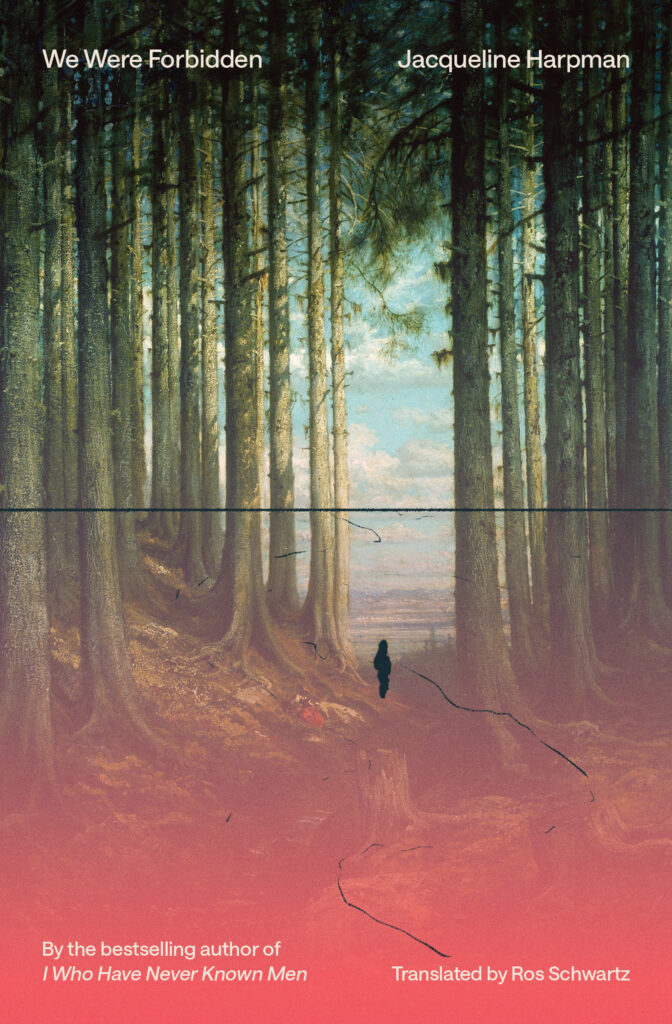
Born in 1929 in Etterbeek, Belgium, Harpman was raised partly in Casablanca, after her family fled the Nazis (her father was Dutch and Jewish). When Harpman returned to Europe in 1945, she began to study medicine but quit after contracting tuberculosis. In 1954, she began writing and published four novels before 1966, when she began a 20 year hiatus and became a psychoanalyst. In 1987, she returned (one could ask: from where?), publishing a novel titled La Mémoire Trouble. The nineties were a decade of great outpouring: Harpman wrote eight novels, among them Orlanda (1996), winner of the Prix Médicis, and I Who Have Never Known Men. She died in 2012, which––ironically for the author of a post-apocalyptic novel––was one of those years when the world was supposed to end.
A psychoanalyst and novelist, she described in a 1999 interview the symbiosis of both professions: “Understanding what goes on in people’s minds has always been a major interest of mine. It may even have shaped my literary tastes… Psychoanalysis seemed to me like an extension, a way of doing the same thing in a different field, in a different way.”
If read psychoanalytically, the novel is a technology of excavation and elaboration, its “objectives” the fraternal twin of analysis. Both draw up contracts of interpretation––the text is encrypted with information, the expression of which is a perpetual dance of revelation and negation. And Harpman’s characters are, like patients, always forgetting themselves, unable to penetrate the opacity of their impulses and innermost desires.
We Were Forbidden is knit from such neuroses. It is a triptych of Harpman’s minor works, in which we are shown a carousel of characters in states of anguish and exile. The first story, like IWHNKM, arrives as a dream: a group of soldiers wanders the Ardennes forest with “post-hypnotic orders” to carry out a mission in total ignorance. The war lies dormant––planes are absent and bombs are unheard. The catastrophe is invisible, and with it, the enemy. Shoes, decaying, must be repaired and replaced; hares must be snared, skinned, and cooked; weapons must be cocked, ready to be fired, even though they were long ago emptied of bullets. The combatants are condemned to survive, which is to say, they are very, very bored. They ask impossibly, “We were living under the law of a world that might have disappeared: were we not mad?” And later, “We felt we’d forgotten everything, and we didn’t even know what we were meant to remember.”
In “The Outcast,” a work of memoir, the consequences of rejecting this trance of rote obedience are elucidated when thinking with abandon turns a young Harpman into a scapegoat. As a 15 year old student in Morocco, she had a friend with whom she spoke honestly about teenage concerns, mainly “the existence of God, the meaning of life, human destiny, and who was likely to win the war.” Their conversations are both the conduit for and proof of their mutual affection (language, again, is the firmament of existence). Henriette, the special friend, has potentially lost a brother. He has been missing for six weeks, having gone off, in some capacity, to join the war. Henriette traipses around with the “airs of a tragedy queen,” leeching sympathy from her peers and superiors. The teenage Harpman is fantastically envious of, and enraged by, the injustice wrought by this mock tragedy. And then there is the limpness of Henriette’s politics, which bend gleefully towards the path of least resistance. She receives an A on a literary assignment analysing Charles Peguy’s nationalist ideology, while Harpman receives a C. Harpman cannot in good conscience agree that it is good to die for something like a country, even if it is one to which you supposedly belong. This seems reasonable for a girl who was, through an accident of birth, expelled from her homeland, lest she be killed.
Harpman retaliates against Henriette’s expressions of self-pity by telling her that rather than mourning the loss of her brother, his death should make her happy; if she agrees with Peguy’s appraisal of patriotic sacrifice, she should be relieved that her brother has attained the ideal espoused in the assignment which earned her an A. Henriette tattles on Harpman to their teachers, who react swiftly and publicly. Harpman, the smart girl almost denied education for being a Jew, is humiliated by a logic misattributed as her own. She strikes too close to empire’s rotten core––to delight in violent deaths, to insist on their goodness, is the pledge of the patriot. It is to parrot common sense when caught in a current of idiocy.
She is also struck silent, as if “hysterical,” unable to perform her apology before her friend and teachers. Without language, she asks:
But how does one speak? I thought I ought to be reasonable. To overcome my resistance, I imagined the horrors of being ostracized, everyone shunning me, the silence and losing all my friends, but it didn’t want to. What it? An incredibly powerful force made the words stick in my throat. I think I must have even opened my mouth once or twice to say them: but nothing came. I wanted to utter the expected phrase, after which they’d leave me in peace, but I was paralyzed. My body simply refused.
She will attend school, but is expelled from the realm of speech, permitted neither to speak nor be spoken to. It is traumatizing to be treated, so early in life, to an approximation of death. Yet forty days later, the same duration as Lent, the curse is broken. She maintains power in the only way she knows how, by rejecting, voluntarily, her position amongst the living. “They had waited for permission to reinstate me: but I no longer wanted to be reinstated.” If assimilation demands that she forfeit reason, then she deserts.
She maintains power in the only way she knows how, by rejecting, voluntarily, her position amongst the living.
“I hold grudges of Biblical proportions,” writes Harpman, the atheist. The writer takes her experiences, unconscious and otherwise, and in “The Broom Closet,” the most formally ambitious text in the book, she begins to kill, slipping seamlessly between competing characters and plots to a dizzying effect. “I have always easily been able to be two people at once,” says the narrator, who is travelling back from Paris to an undisclosed destination. She feels that her presence on the train has made her someone else: “I was a woman from bygone days, when a lady travelling alone could only be wealthy and mysterious.” We are jerked headlong into her fantasy of an alter ego, a young woman named Hortense, who is the unhappy wife of an “incorruptible” judge in the 1920s. She is young and miserable because their sex is bad. Her death sentence, which is conjugal, is an unbearable secret kept until it bursts from her in the form of an affair. The title location is the scene of the crime: she enters a closet instead of coming out of one, and has sex with a young man to whom she is irresistibly attracted. They require no words to address each other: “I felt as if I were dying,” she says while “submerged in the waves, in the grip of a storm that arose in a part of my body I had been brought up to ignore.”
The narrator, like Harpman, is a woman and a writer. Like Hortense, she too is condemned to an impossible love. She tells us that the wife of a man with whom she was once obsessed, Monsieur X, has died, but it has come too late. The opportunity to be with him was missed, like a departing train. The metafictional heroine decides to kill her husband, to dispense of the villain blocking her from her fate. Her creator, restricted by reality, fantasizes until the battle between creator and creation is brought to a cataclysmic head: the fictional woman is free to fuck, kill, and exit the constrictions of polite society unhumiliated. It is the project of revenge wrought by a woman: “I have always held it against Flaubert for having made Madame Bovary fail,” she writes. “I think Flaubert envied Emma.”
And so Hortense, the unhappy wife, has her husband stabbed in his sleep at her creator’s command. The narrator, who both is and isn’t Harpman, admits to the reader that her enemy is alive, though her marriage died years ago. Monsieur X. did not run to her as she wished, but married a “sweet-natured woman who also had a fat stomach.” A fiction must be fabricated to dispose of what the narrator doesn’t understand—it must be sublimated, forgotten, and repressed. She denies all fault: “Obviously, those thoughts are not mine for I am a sensitive soul. That is my mirror talking.” But Harpman, the psychoanalyst, knows that forgetting animosity isn’t the same as vanquishing it.
“Our unconscious will murder even for trifles,” wrote Freud. “It knows no other punishment for crime than death.” As a collection, We Were Forbidden is in the business of revealing, gradually, the latent violence of the mind. The soldiers in “The Ardennes Forest” fail to murder their nonexistent enemy, though they are, presumably, willing. In “The Broom Closet,” Harpman’s narrator displays the ease with which a woman fantasizes of enacting homicide. And in “The Outcast,” Harpman is somewhere in the middle—she is young, enraged, victimized, and helpless.
We Were Forbidden comprises an enigmatic portrait of a writer who is both facetious and grave, vain and diffident, and obsessed with these contradictions. With this collection, readers are afforded intimacy with Harpman the woman, who felt and thought more than what can be gleaned from the postapocalyptic tragedy that has made her a sensation.
Where do we go once we are exiled to death? Into the language of strangers.
While reading I Who Have Never Known Men, I was seized by the feeling that its readers had been tricked. There are much happier viral novels with which to delay thoughts of death. But Harpman was not interested in delaying anything. Readers receive not a distraction, but a series of devastations: social contagions demand a sacrifice; obedience is compulsory; each individual submits to something; nothing is free; brutality and terror are eternal, outlasting the body. And like the women of IWHNKM, we are captives without a cause, or so it seems. Not even the end of the world can spare us from this tragedy.
A cage provides the promise of an eventual escape. One is not yet free, but subsists on freedom’s possibility—cages are composed, equally, of steel and air. Harpman writes into this half-emptiness. For now the writer sees through a glass darkly, but if they are fortunate, they will find a confidante to meet them on the page. This, for Harpman, is our sole chance at transcendence.
The child narrator, old and alone by the end of the book, finds a strange kind of bunker, the likes of which she has never seen. It is a home, furnished with leather and wood, containing a bathroom, bed, an abundance of books, and most precious of all, sheets of paper. She learns to read, and, as if they are identical, also begins to write. A book is formed and in it is everything:
I am writing… for some unknown reader who will probably never come… but if that person comes, they will read [these pages] and I will have time in their mind. They will have my thoughts in them. The reader and I thus mingled will constitute something living, that will not be me, because I will be dead, and will not be that person as they were before reading, because my story, added to their mind, will then become part of their thinking… Then everything will be obliterated, the suns will burn out and I will disappear like the universe.
Where do we go once we are exiled to death? Into the language of strangers.
Emily Wood is a writer based in Toronto. She co-organizes Pack Animal Series, works at TYPE Books, and writes fiction, plays, and essays. In 2025, she graduated with an MA in Religion from the University of Toronto.