
Goldenrod
I turned 13 during the summer of the gun. It was in all the papers. Dad said Alexandra Park wasn’t the greatest, but at least it was better than Regent. That’s where all the trouble was coming from.
Don’t dress like those gangbangers, he said, with their pants around their asses. I rolled my eyes. Nobody said gangbanger anymore. But I knew what he meant. The boys in my neighbourhood wore a particular uniform: an oversized white t-shirt, low-rise jeans, low top sneakers, and two diamond studs, one in each ear. These boys were like celebrities to me, only a few years older and already the world treated them like men, their names overheard in whispers: Marcus, Tyler, Dante, Tyson. They probably didn’t know my name, but they might’ve recognized me by face: a consequence of growing up down the block from each other in a neighbourhood where every building was designed to look inward, toward your neighbour, away from the street.
The projects were a maze, a series of concrete paths that snaked onto Queen or Dundas or looped around themselves and ended in a cul-de-sac. Rows of three-storey townhouses sat on either side of these paths, the pattern of their identical red-brick facades interrupted by multiple parking lots and grassy courtyards overgrown with weeds; a playground; a community centre; an enclave of dumpsters; and two mid-sized buildings, eight floors each. All of this was contained within two city blocks, Spadina to the east and Augusta to the west, creating the sense of a fortified world. Dad encouraged me to find my way out, warning against gangbangers, his eyes wide when a teacher suggested I transfer into the gifted program. He said there were no opportunities for me in Alexandra Park, that I had to get out as soon as possible or I’d be trapped forever, walking around in circles. Eventually, heeding his warning, I left, but what I didn’t anticipate, what I couldn’t have anticipated, is that a part of me would always live in the projects, wandering the same paths, forever retracing my steps.
I live in Montréal now, in a five-and-a-half that my boyfriend Bruno found through a friend-of-a-friend. It’s the kind of place I’ve always dreamed of: tall ceilings, natural light, across the street from the park. Bruno deals with the landlords, an elderly Québécois couple who significantly undercharge us and insist on a pretense that we’re just roommates, despite all evidence to the contrary. We patched and painted the walls, installed shelves, landscaped the front yard, and purchased a modular sectional, the most amount of money I’ve ever spent on anything. We’ve been here for nearly a decade, the longest I’ve ever lived anywhere, other than Alexandra Park.
What I didn’t anticipate, what I couldn’t have anticipated, is that a part of me would always live in the projects, wandering the same paths, forever retracing my steps.
I’m older than my parents were when they got approved for a two-bedroom apartment in a rent-subsidized building on the southern edge of the projects, just above Queen Street. I don’t remember it, but I’ve seen pictures: me in a highchair, mouth slathered in tomato sauce; mom and I on the floor in front of a miniature pink plastic Christmas tree, wrapping paper discarded at our feet. A few months after that Christmas, mom had what would now be referred to as a mental health crisis, but back then was called a nervous breakdown. She smashed dishes against the wall, screamed that nobody helped her, that she was all alone. The other day, combing through a closet in that same two-bedroom apartment, I found an old diary in which she had written the following: I’m at the end of my rope. No money. No job. Life feels next to impossible, and I’d be willing to hit the road if it didn’t mean leaving behind the baby.
A neighbour heard the screaming and smashing plates and called the police. When mom didn’t answer the door, they knocked it down. Unaware of the intrusion, she continued to scream and break things like the cops weren’t even there until a dish almost hit an officer in the head, shattering on the wall behind him. Their guns were out before she made it to the door. According to the police report, it was only after the officer had fired the shot that killed her that he heard the wails from a crib down the hall.
Dad raised me on his own the best he could. Every night we ate rice and beans or ordered takeout, usually from the Java House, even though he once pulled a piece of plastic out of his pad thai.
That wouldn’t happen at McDonald’s, I said.
During the week he worked construction gigs under the table to supplement the welfare check that came in the mail once a month. Every morning on check day he smoked a joint, took a chair from the kitchen table, and sat outside our building until the mailman arrived, an activity he called “waiting for my ship to come in.”
Dad never expected to be a single father, let alone a widower. At first he became a bit of a local celebrity. He spoke to the media about what had happened to the mother of his young child, and even spearheaded a few campaigns against police brutality with a local activist group, including a phone zap and a protest at Queen’s Park. He went to teach-ins, read abolitionist manifestos, and chanted in the streets. But soon the news outlets stopped calling and people stopped offering to babysit. Finally, dad was left alone with a complicated loss and a son to explain it to. The trial of the culpable officer was continually delayed. Dad said it wasn’t our fault, that her death was the result of a world structured against us, but judging by the way he’d wince when I asked questions like Where were you when it happened? And why didn’t you do anything to stop it? I think he blamed himself more than he cared to admit.
One summer, when I was seven years old, dad signed us up for Single Fathers, Single Sons, a support group that met once a week at Scadding Court. The group organized a field trip to Bruce’s Mill, a wilderness conservation area about an hour away, renting a school bus to shuttle us there. As soon as we got on the highway, I started to panic. I’d never been out of the city before, and wasn’t aware how quickly the landscape transitioned into farmland, mostly grass and the occasional cow. I was used to concrete paths and people living on top of each other. I didn’t know the world could be so flat, so seemingly uninhabited, an infinite void. Maybe it reminded me of death.
I cried loud enough to disrupt the whole bus, spooked by the unfamiliar terrain and whipped into a tantrum I couldn’t control. Dad tried to calm me down using the skills he’d learned at the support group, a busload of fathers and sons staring at us with a mixture of smugness and pity. This continued for most of the drive until dad, eyes filled with tears, grabbed me by the shoulders and slammed me into the back of my seat, hard. I stopped crying immediately, as if a switch had been flipped. Stunned and embarrassed, we spent the rest of the bus ride in silence, and never returned for another meeting.
From that point forward, dad communicated in short directives: wash the dishes, pass me the paper. His orders were simple and clear, without intention to punish or humiliate. We entered into an agreement: I complied without complaint, and in exchange he gave me five dollars a week and left me to my own devices, an arrangement that suited me fine. I resigned myself to the fact that life was out of my hands, having come to the conclusion that childhood was a matter of biding your time, knowing your escape plan, and remaining vigilant against danger.

Lucky was our neighbour who lived down the hall. He had wispy grey hair, wore ribbed tank tops with jean cutoffs and flip-flops, and seemed to be a thousand years old. Lucky had a dog, a white chihuahua also named Lucky. After he won a lifetime supply of popsicles from a sweepstakes contest advertised in the back of a grocery flyer, Lucky fed his dog popsicles. Then one day the dog died.
Of course the dog died, dad said. He only gave the motherfucker popsicles.
Suddenly Lucky had a surplus of popsicles, so after school he’d stop me in the hall to ask if I wanted one, and then I’d stand in the entryway as he rooted around in the freezer. His apartment had the same layout as ours but flipped, bedroom on the left instead of the right. The uncanniness enticed me, his life so close to mine and yet so different. One foot in and one foot out, I collected what details I could: an orange leather couch, a spider plant hanging from the ceiling in a crochet basket, and, affixed to the fridge with a magnet, a photo of a man in a speedo, smiling at the beach. Lucky would hand me the popsicle and then I’d stand in the hallway to eat it, stuffing the stick and wrapper into my pocket after I finished. The whole exchange felt like something to keep hidden from dad.
Lucky used to give me themed gift bags on different holidays, one for Christmas and another for Valentine’s Day. He would knock on our door and when dad would answer he would ask for me like a friend from school. Dad would call me over and then stand behind me, arms crossed, as Lucky presented me with his gift. On St. Patrick’s Day, he gave me a bag of green objects: lime green gel pens, a bar of green apple soap from the Body Shop. At the bottom of the bag was a bottle of green ketchup, part of a new line from Heinz, which I had begged for at the grocery store and dad had called a marketing gimmick. For a while I put the green ketchup on everything, even though it grossed me out once it was on my plate. Eventually I grew tired of it, but sometimes I would open the fridge just to look at the bottle. It stayed there for years, at the back of the bottom shelf on top of the vegetable crisper. The day I moved out I thought about taking it with me, but instead I threw it away.
It took me until adulthood to feel like my life belonged to me, a feeling I anticipated while standing in the aisle of HMV, the face of Emily Haines staring back at me.
By the summer of the gun, Lucky no longer gave me gifts. I noticed a shift that summer, both in myself and the world around me. Adults who once ruffled my hair now eyed me with suspicion, a change I couldn’t account for. I borrowed a Metric CD from the library so many times that the librarian accused me of scratching it. In reaction I curled inward, my shoulders hunched like the top of a candy cane, my Discman clutched to my side to prevent it from skipping. The lifeguards at the pool said I didn’t need to pass a swim test to go into the deep end anymore. I was old enough to go anywhere I wanted. I’d always assumed the deep end went over my head, but when I finally got there I discovered it was only four feet ten at its deepest, shallow enough to stand on tip-toe.
So I began the practice of playing with myself under the sheets at night, my fantasies usually some version of comparing streams with a faceless boy at the urinal or wrestling with him in the grass. One night, overcome by one such fantasy, I felt a tingle and a pop, like the opening of a champagne bottle. Dizzy and panicked, I thought I’d injured myself, and considered asking dad to take me to the hospital. Then I noticed the sheets, trails of white slime dribbling down from a large, wet stain.
I gathered the sheets, grabbed the detergent from the hallway closet, and made my way to the laundry room on the second floor, taking care not to wake dad. I thought the laundry room would be empty at that time of night but when I opened the door there was Lucky. I felt a mix of embarrassment and excitement, a knot in my stomach like I’d been caught doing something bad. He watched me, his expression inscrutable, as I loaded the washing machine and poured the detergent, carefully measuring a quarter cup like I’d seen dad do before. I pretended not to notice him, but kept glancing back to make sure he was still looking. Whenever our eyes met I’d quickly look away, suddenly overcome by shame and the desire to be held by my mom.
Need change? he asked. I hadn’t considered it. Sheepishly I held out my hand and mumbled an apology, promising to pay him back. He gave me a handful of quarters and told me not to worry about it. His flip-flops suctioned against the floor as he walked back to his hamper. I watched him as he bent over and pulled his load out of the washing machine. His shorts rode up his thighs, revealing slivers of ass cheek. He turned to look at me, arms crossed as if in appraisal. I couldn’t help but stare at the basket of his crotch.
The summer of the gun was one of the hottest on record, a smog warning always in effect. Cautious to avoid the cops who now patrolled the projects in pairs, I spent my days windowshopping the boutiques along Queen Street, running my fingers across racks of vintage deadstock and plastic raver gear. I imagined myself as one of the sales clerks behind the cash desk, my hair dyed jet black or platinum blond, a row of piercings up my ears, a scowl on my face, a cheetah-print scarf around my tattooed neck.
It took me until adulthood to feel like my life belonged to me, a feeling I anticipated while standing in the aisle of HMV, the face of Emily Haines staring back at me. Behind her, a yellow silhouette, beyond which stood a building no different from the one down the block where I’d lived all my life. I wanted something that was mine, something over which no one else held any jurisdiction. I had the impression, however mistaken, that freedom was something to be earned through obedience or rebellion; disenchanted with obedience, I slipped that CD into the back pocket of my shorts, tugging my T-shirt below my waist to cover the square-shaped bulge.
When the security alarm sounded and the manager threatened to call the cops, a panic set in similar to that of the bus ride to Bruce’s Mill. Maybe the manager saw the fear in my eyes, or heard the quiver in my voice as I begged her, please, please don’t call the cops. Probably she hadn’t intended to call them at all; it was probably just something she said to scare kids like me. Whatever the case, she called dad, who arrived twenty minutes later with a handshake, an apology, and a promise it would never happen again.
This is very out of character for him, he said, which made me feel both guilty and proud. On the walk home he was silent, which was worse than if he’d been yelling. As we turned the corner to enter the projects, we passed a group of gangbangers seeking their freedom, their pants sitting low on their thighs, their diamond studs glinting in the sun. When we got back to the apartment, dad closed the door and then raised his hand as if to strike. He held it there, eyes filled with tears. Then he fished for something in his back pocket, found it, pulled it out, and shoved it into my chest, forcefully enough to make me take a step backward. I looked down at what he had given me and saw Emily Haines, her expression suggesting indifference. To this day, I have no idea whether he bought the CD or stole it.
When we arrived at Bruce’s Mill, the facilitators announced the day’s activities: a hike, a picnic, a three-legged race. Dad and I peeled away from the group, sitting down on a log adjacent to a narrow creek. After the last father and son meandered out of sight, dad lit a cigarette.
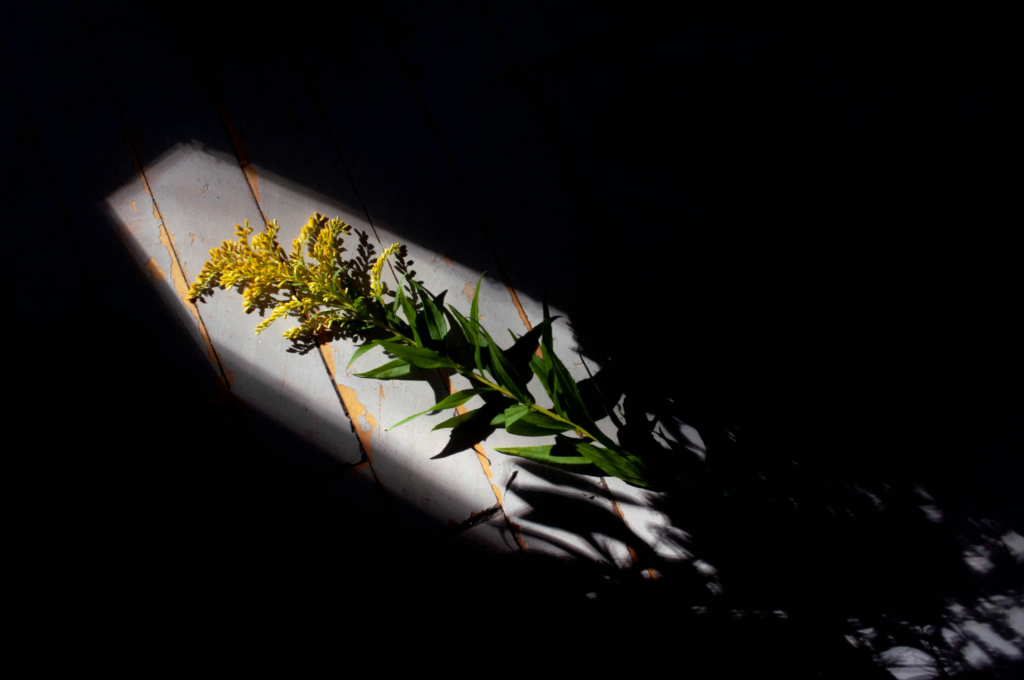
Your mother knew more about this stuff than I do, he said, gesturing vaguely. She liked the outdoors, knew every kind of tree, every plant. She taught me things. Like those… He pointed to a group of tall stocks that splintered into strands of yellow flowers. That’s goldenrod, he said. It blooms late in the season, closer to fall.
He took a drag of his cigarette, exhaled, scanned the surroundings nervously, and then proceeded to tell me, for the first time, the story of mom’s death. I remember his exact words, starting with the mental health crisis and ending with the gunshot, but what I can’t recall is what he looked like as he said it. I wish I could conjure his face in that moment, but when I try to imagine it all I see is dappled sunlight, water rushing downstream. He said I’d experienced something that most people would never be able to comprehend, not even him, but he promised to do his best to listen even when he didn’t understand. We sat in silence for a while, and then by way of conclusion he said, It was lucky.
I stared at him blankly.
He clarified: Lucky, the neighbour, the one who heard her screaming, the one who called the cops. He put his cigarette out on the log as if punctuating a sentence.
He didn’t expand upon the claim, nor did he ever talk about it again, but he made sure to remind me of it by shooting me a certain look whenever Lucky got on the elevator, or whenever he knocked on our door with a gift. The look said don’t trust that sissy, that snitch. Meanwhile Lucky held his arms open, offering atonement in the form of popsicles and green ketchup. Caught in the middle, I made silent pacts with each of them, accepting Lucky’s gifts while returning dad’s gaze. Dad hasn’t mentioned Lucky in the years since I’ve moved out, leading me to the assumption that they reached some tacit agreement to politely keep their distance, nodding to each other in the lobby and otherwise staying out of each other’s way. However dad may feel about him, Lucky has been his neighbour for over 30 years, making him one of his longest, most consistent relationships. Last week, for example, it was Lucky who found dad collapsed in the hallway, and who waited at the hospital until I caught a flight into town. When I saw him in the ER, he looked exactly as I remembered him, the same wispy hair and sphinx-like expression. The sight of him made me angry. I had the urge to scratch his eyes out, to scream at him, You’re not my mother! The feeling crested as he approached, and by the time he reached me I fell into his arms, sobbing. He held me until I composed myself, then looked me up and down and said, with a hint of surprise, You look just like your father.
Except for the occasional trip for work or to visit dad, I haven’t been back to Alexandra Park since I was a teenager. Awaiting news from the doctors, I’ve been splitting my time between the hospital and the projects, taking comfort in its winding paths. The area is in the midst of redevelopment, the neighbourhood transformed into a construction site, entire blocks sectioned off by graffiti-covered barriers. Soon it’ll be unrecognizable, lousy with luxury condos, so I try to catalogue details before they’re gone: the grey of the concrete paths; the red bricks of the adjacent townhouses; the doors, now boarded with plywood, that were once painted in an alternating pattern of yellow, blue, and green. Where are all the gangbangers, with their pants around their asses—not to mention the cops, patrolling in pairs? The neighbourhood has become eerily silent, everybody scattered like a flock of pigeons. I try to explain the sensation to Bruno over the phone, but he doesn’t get it; he grew up in the suburbs, his parents still together, his childhood bedroom preserved like a shrine. I try not to resent him for it. It’s not his fault he has a mother and father. I think about mom, what I know about her. She could name every plant, every flower. There are questions I want to ask her. How many species of trees grow in the projects? What’s that weed poking through the sidewalk, soon to be paved? There was never any goldenrod in the projects to mark the changing of the seasons, or if there was, I don’t remember it.
Instead I remember wandering the aisles of Staples with dad, our basket weighed down by pencils; pens; binders; highlighters; whiteout; Duo-Tang folders; and a scientific calculator, a requirement in the gifted program. I told him I was too old for back-to-school shopping, but he insisted.
The summer of the gun was almost over. In a few days the pool would close for the season. Grade eight would come in less than a week, high school a year later, but who could see that far ahead? We ate dinner in silence that night, CP24 in the background. There was a shooting, somewhere on Sheppard. He was eighteen.
After dinner dad asked me to take the trash down to the dumpsters, in the alley that ran alongside the building. I took the elevator down to the ground floor, a trash bag in either hand. Outside, the night was cold and the streets were a quiet, empty maze, all paths leading nowhere. In the alley, a breeze. By the side of the dumpster I saw a shadow. At first I thought it was a racoon, maybe a cat, but it was too tall. Then I saw a flip-flop, a sneaker, and a pair of low-rise jeans pulled down to the thighs. Then Lucky’s face against the dumpster, another face nuzzled into his neck. The buckle of a belt unfastening. The breeze, strong. The moon, up.
Cason Sharpe is a writer based in Toronto. His writing has appeared in C Magazine, Canadian Art, and Brick, among others, and he has presented work in collaboration with the Art Gallery of Ontario, the Museum of Contemporary Art, Art Metropole, and the Vancouver Art Book Fair. He holds a Master’s of Visual Studies from the University of Toronto and his first collection of stories, Our Lady of Perpetual Realness, was published by Metatron Press in 2017.