
To Become Modern: An Interview with Deborah Levy
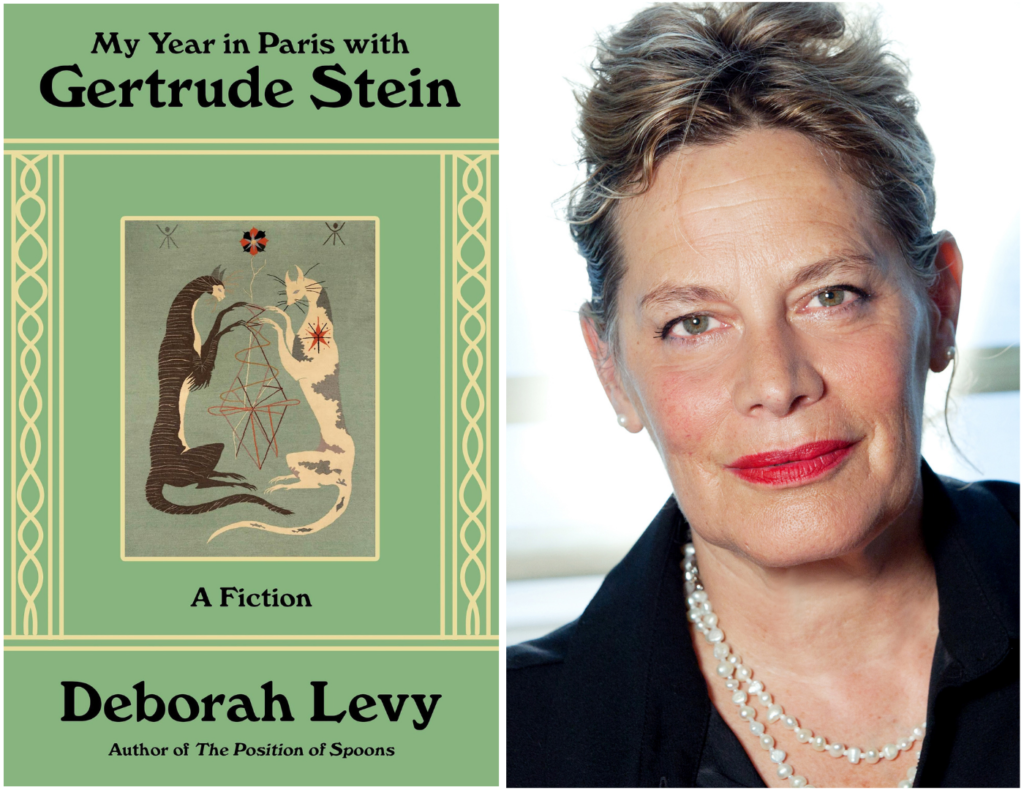
Elizabeth Hardwick describes Gertrude Stein’s body of work as a “pitiless companion.” Janet Malcolm likens being a reader of Stein to being “an uninvited guest arriving at the wrong side of a dark house.” Deborah Levy, the newest member of the Stein-studying pantheon, proposes that Stein “did not believe it is worth having a conversation if everything is understandable.”
Despite their exasperation with her, these three luminous thinkers and writers cannot resist spending time considering Stein and her prolific contributions to literature. In her new book, My Year in Paris with Gertrude Stein: A Fiction (Hamish Hamilton), Deborah Levy’s narrator wanders through Paris with two young friends, looking for a lost cat, frustrated and exalted in turns by Stein’s unknowability while attempting to write an essay about her. Stein, who in the 1890s studied psychology at Harvard with William James (notably, Henry James’s brother). Stein, who was one of the first people to have a robust collection of shocking modernist art, which was the backdrop and fodder for her famous Parisian salons. Stein, who was a close friend and mentor to two of the 1920s most famed lotharios, Picasso and Hemingway, and whose life’s central relationship was with neither of them, but rather Alice B. Toklas, her partner in love, living, and literature. Despite both being Jewish, the pair managed to protect not only their lives but their significant art collection during the Second World War through their friendship with a French Nazi collaborator (“left wing, right wing, she charmed them all,” Levy’s narrator says. “Is that a good thing?” her friend asks). Stein, who wrote–introducing her collected works in 1946, the same year that she died– that she “always wanted to be historical, from almost a baby on.” Pitiless, frustrating, opportunistic, unknowable, or not—“historical” she certainly achieved.
In contrast to the thorny experience of reading Gertrude Stein, to be a reader of Deborah Levy’s work, I have found, feels like being invited for vodka and cigarettes as a guest at Café Girls and Women: an invented, amorphous café that Levy collectively imagines creating with her daughters and friends, as it is detailed in Real Estate (2021), the final book in her Living Autobiography trilogy. Levy has written psychologically investigative and formally inventive novels, forged from pure imagination and attuned to her worldly interests, but it’s the Living Autobiography trilogy that I have treasured most. The trilogy finds Levy in her late fifties, remaking her life, leaving the domesticity of marriage and motherhood after divorce and her daughters’ departures for university. She turns sixty in the final installment, at David Lynch’s surrealist nightclub in Paris. The books are full of political thought and sensory desire, written with a clean, precise cadence that makes them the most illuminating and evocative of companions.
My Year in Paris with Gertrude Stein offers a kindred, but different, type of companionship. Levy occasionally employs some of Stein’s own compositional tactics—repetition, a word slipping between multiple meanings, wordplay in general, abrupt sentences comprised of only one or two words. Perhaps she does so as a way of getting closer to the quick of Stein’s literary mystery. And though they may have their differences, Levy and Stein do share quite a set of interests (modernism, psychology, geographical displacement, female desire and ambition, friendship, appetite, style), and so make a provocative, captivating pair. While My Year in Paris with Gertrude Stein is not written from the same “I” that we live with in the trilogy, this “I” is not altogether different. Though Levy has invented this narrator’s confidants, Eva and Fanny, and so the result is “a fiction,” as the book’s subtitle notes.
Levy’s narrator attempts to write an essay about Stein at the same time as she attempts to live in the 21st century. In the early 1940s, Stein wrote her book Wars I Have Seen. In Levy’s book, the year is 2024, and Levy’s narrator is watching “various wars” through her phone’s screen. Chapter six of My Year in Paris consists solely of two sentences: “Gertrude Stein wanted to kill the nineteenth century. The twenty-first century seems to be killing itself.”
“What do we have to lose to become modern?” Levy asks, in the book. It is a question that is important to Levy, to Stein, and to me, though the question means something different now, a century later, than it must have meant to Stein then.
Levitating behind Levy on our video call was a piece of art featuring a single word, its letters strung together with the same ease and intention as the necklace of freshwater pearls she was wearing. The word in the painting radiated a sheen of what—despite the century, the wars, and the technology that separates them—both Levy and Stein value, in my estimation, above all: physical or intellectual delight or pleasure. Which translates in French, fittingly, to one single word that says so much: jouissance.

Emma Olivia Cohen: I want to ask you about shoes in your books. I have here a taxonomy of shoes that have jumped out to me during my readings: the green suede shoes that appear across the Living Autobiography series; the leopard creepers of your teenagehood; Ingrid’s man’s loafers in Hot Milk (2016) and also her silver roman sandals; in The Position of Spoons (2024) there’s the gold lamé shoes of [Marguerite Duras’s]The Lover and Francesca Woodman’s boots; and then, in My Year in Paris with Gertrude Stein, we have Fanny’s red-bottomed stilettos and Eva’s white clogs.
Deborah Levy: The thing about writing novels and autobiographies is that it’s a bit like a film set, where hair and makeup and costume go through the writer. Do we think that shoes or clothes or jewelry signify anything? Feelings or a mood—something about the person? I do pay quite a lot of attention to that. For Ingrid, I got an image of her on the horse in those blue velvet shorts and those silver sandals laced up to her knee. I was spending a lot of time in Athens, thinking of Greek goddesses, looking at sculptures. I wanted to update this—I wanted it to be erotic and contemporary, so I made them silver, and that led the book, in a way. That image. Ingrid across the beach, shooting her arrow of desire into Sofia’s heart.
EC: I’m really drawn to how you write about the material world in all of your books. I was thinking about how in My Year in Paris with Gertrude Stein you have this quote from Freud speaking to Carl Jung where he says, “I must always have an object to love.”
DL: I do love objects. So much is projected onto them, somehow they speak to me. I’m thinking of [my novel] August Blue (2023), and the dancing mechanical horses. They have to carry so much: Elsa’s childhood, for a start, that childhood memory she can’t quite access. She knows she wants those horses but she doesn’t really understand why. I think objects do act on us in that way, they hold time, feeling, memory. And we make new memories with them. They live in the contemporary time. So they appear in all of my books. I like the material world to be in my books. One of my favourite books is The Poetics of Space by the French philosopher [Gaston] Bachelard, and there’s a really philosophical reflection on attics, cellars, nooks and crannies, what it means to open a door and close a door. “No ideas but in things” is absolutely the right way of thinking of it. If you’re going to journey into the wild outer areas of human consciousness like I do in my books, then you need to have quite a strong reality in parallel established.
There can be beautifully crafted sentences, but if I’m not interested in how that writer thinks, or where that writer’s gaze is settling, or how that gaze is looking, I’m not interested.
EC: Similarly to having the touchstones of objects, I was thinking about how in this newest book, and in much of your work, you bring in so many artists and writers and thinkers. And I wondered whether you ever have to try to keep them out?
DL: I had to read a lot of Gertrude Stein and a lot of biographies about her, and when I started to write this book I didn’t really know how to do it, because I didn’t want to repeat all the other biographies. I thought that’d be an unnecessary book. So why did I pitch this book? What interested me? What interested me was that she was the daughter of German Jewish immigrants. It interested me that Hemingway described her as having “immigrant hair.” What does that mean? What do words mean? Gertrude Stein was always asking, “what do words mean and why do we use them and what do they make us feel?” I was living in Paris in 2024 and I was sitting at my desk, and at my desk I could hear the bells of Notre-Dame from across the river. I lived quite near the Seine. I thought: here I am in 2024, and here was Gertrude Stein in 1923. Here I am a stranger in Paris from Britain, there she was a stranger in Paris from America; why don’t I start there? It was so daring, Emma, because I thought I was going to write a book about her and William James.
EC: That would make sense, because you’re interested in psychology in a lot of your work.
DL: Then I realized that actually—she was hugely admiring of him and influenced by him, and he was fond of her and considered her to be his most brilliant student, but there wasn’t really enough of that. So I thought, I’m going to set this in contemporary Paris and something has to go missing. I was also watching lots of the French director Éric Rohmer’s films, because it was raining endless rain at the time. I loved the way his characters exist in his films: they just kind of talk about nothing and everything. A croissant, life and death, their father, shoes. I loved how he has no close ups. He does long takes, but somehow it accumulates in the camera work a real psychological depth. So I thought I’m going to invent two fictional companions for the narrator, and they’re going to walk through Paris searching for a lost cat, and on the way they’re going to discuss everything: love, lust, loss, and Gertrude Stein and Alice!
EC: I love that Rohmer’s women were entering into the book. In The Position of Spoons you write about Violet Leduc, and you say that she “energizes what she gives her attention to,” which is a phrase that I keep returning to. And with the Living Autobiography series, the narrator shifts what she’s giving her attention to and investigates the power of that. Does that idea of attention apply to your writing?
DL: I think it’s everything for a writer, and for a reader. There can be beautifully crafted sentences, but if I’m not interested in how that writer thinks, or where that writer’s gaze is settling, or how that gaze is looking, I’m not interested. Attention is what all writing is about for me. Who do we give our attention to and what do we give little attention to? Sometimes because life is so enraging and infuriating, you can give a lot of attention to writing in a rage and whipping up a storm, and then you think, “I don’t want to give any of my attention to this, I’m going to delete all of this, and put it somewhere else.” That always turns out to be the more subversive and more loving way of approaching the writing.
EC: I’m really interested in this idea of composition that you bring up in My Year in Paris. You bring it up in relation to Stein’s practice: composition, as in putting things together, putting things against each other. Was composition interesting to you not only in your thinking through Stein’s work, but in your own writing of this book?
DL: It’s sort of the point of writing, because composition is the structure. It’s how the book is put together. So that’s why the edit is always such a wonderful place to get to, after the long long writing hours, and you have something like a first draft, as imperfect as it may be. That’s the moment to make a coffee and sit at the screen and really enjoy the editing, the putting it together, the composition of it. It is what makes the book the book, the form of it.
EC: Is composition coming more in the editing than in the writing then, for you?
DL: I’m not sure I ask myself that at the stage of writing. What I’m doing is working very hard for the book, to let in everything and remove my conceptions of what it’s going to be. I’m all for the comfortable zone where you know where you’re going and it seems to be working out okay, and then—bang! Something intervenes. It’s not the plan, and you hear its truth, or you hear its dare, or its humour. That does affect the composition of things. It can really change the structure. My Year in Paris with Gertrude Stein is a completely new structure for me—the past and the present existing simultaneously, 1903–46 and 2024, you know? That’s a real intervention. It gave me so many writerly problems, I was going to have to use all my ingenuity to pull it home. What are you in this game for, if you’re not going to let it take you to a place, a style, that you haven’t thought of?
It was the patterning in her writing, the repetition, that was going to take her into the 20th century.
EC: You’re investigating realism as an idea in this book. There’s this line I was really struck by: “It is entirely necessary for a writer to dismantle realism as we have been taught it and put together a new composition.” I think this goes with what you’re saying about each book being a new way of writing or a new structure, form. And I was thinking about the character Jean-Luc saying to the narrator about her essay on Stein, “You will write about the avant-garde in the language of realism.” It made me think about this idea from Alain Robbe-Grillet I’ve been fixated on, if I may read it to you:
Every writer thinks he is a realist. […] Each has his own idea of reality. The classic writers thought it was classic, the romantics thought it was romantic, the surrealists that it was surreal, Claudel that its nature was divine, Camus that it was absurd, and ‘committed writers’ that it is primarily economic, and must lead to socialism. They are all talking about the world as they see it, but none sees it in the same way.
Do you agree with this idea? Or are you more inclined to agree with Jean-Luc that there is a language of realism?
DL: Roland Barthes said it best: all writing is a kind of behaviour. So you must say, “how is this writing behaving?” Is it behaving in a surreal way, in a realist way, in an abstract way, is it incoherent, too coherent? At the end of the day this comes back to attention—what keeps the writer interested? Because the writer should be her most brutal editor.
It’s most important to establish a reality that readers believe in and that I believe in, and I think that’s what Robbe-Grillet is saying. Gertrude Stein said, reality has already been written, so write something else. I’m not a die-hard fan of Gertrude Stein, as you can tell from my book. I don’t love all her writing, but what I was interested in was that she was the first female modernist to write a long stretch of writing in The Making of Americans. She wrote it before Joyce finished Ulysses, and she couldn’t find a publisher for it. It’s infuriating, and absolutely brilliant in places too. And what interested me about her was that she was the first to really collect modernist art—the first writer to really think about it. Who wants to write like a cubist? Not me. But she had this idea in her word portraits that that was how she was going to write, and I can see the appeal of it because it was so new. So I’m looking at what we have to lose to become modern, to make something new. Fear, shame, stability, certainty.
EC: There’s that famous line that Stein wanted to “kill the nineteenth century.” Your narrator has to keep reminding herself that Stein was born in 1874, perhaps because she does have such a modern edge to her. I was curious what specifically in the nineteenth century Stein wanted to kill.
DL: It was the patterning in her writing, the repetition, that was going to take her into the 20th century. Think about the music of Philip Glass.
EC: I’m curious whether you think our concept of modernity and futurity has changed significantly given where we’re at right now, and whether we’re more fearful of experimentation in new forms because perhaps we’re more fearful of the future than Stein was?
DL: The future has always been fearful to every generation. I have an old-fashioned faith in the imagination as technology. You can have a thought that interrupts the consensus. It’s immediately going to take you to an interesting place.
Emma Olivia Cohen is a writer, editor, and event programmer living in Toronto. Her writing has appeared in Public Parking, The Whitney Review of New Writing, Dive Bar, Muumuu House, and Document Journal, among other places. She is the co-host of the literary reading series Pack Animal and fiction editor of Toronto Review. She can be found at emmaoliviacohen.com