
Claudia Rankine’s Scenes of Unrest
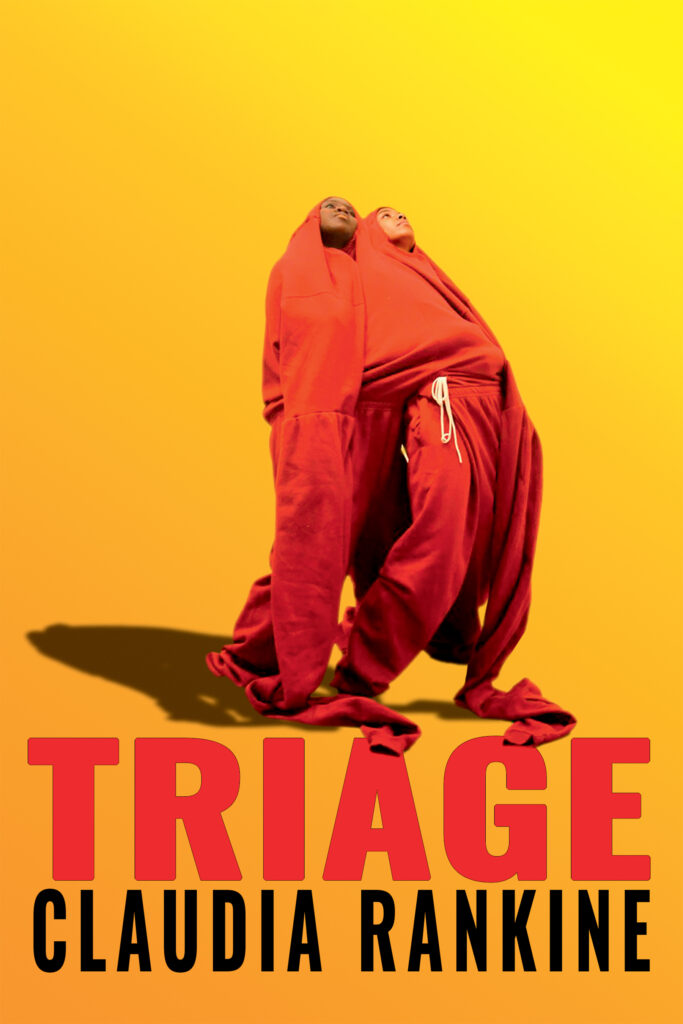
Triage
By Claudia Rankine
Graywolf Press, 192 pp., $39.99 (hardcover)
August 4, 2026
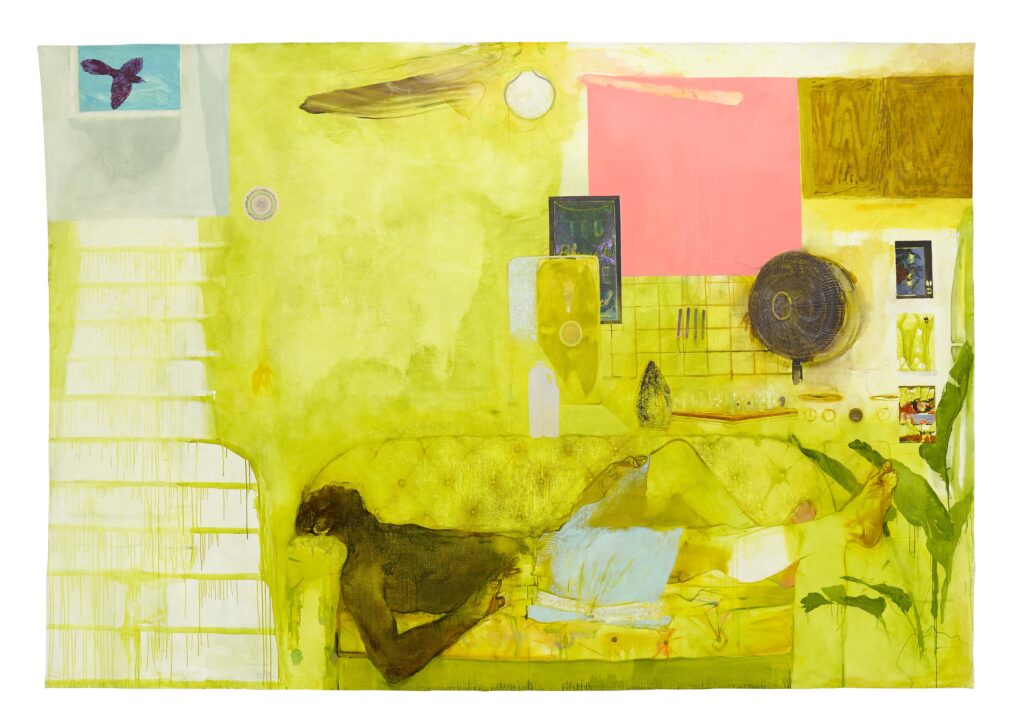
You could begin by opening the book to the middle. What you’d see there is yellow, a man splayed out, two fans spinning, one overhead and the other in the background. His face is upturned, tilted a little to the side. He looks away. A pink square, an iron, a bird in the window. He is lying on a couch, on his back, one leg up and bent at the knee, the other stretching out, his foot sudden and more sharply outlined. His torso is bare. Its skin, unlike the man’s legs and feet, which are only traced against the predominant brightness, is dark brown. The man’s hand is not at rest. Raised away from the plush cushion, his fingers are taut—this is a gesture like no, stay back, so tense in this calm room with its lush houseplant. The expression on his face is pain.
The painting reproduced at the midway point in Claudia Rankine’s new novel Triage—the first for the prolific poet and essayist—is Jennifer Packer’s Blessed Are Those Who Mourn (Breonna! Breonna!). The narrator—we never get her name—stands in the gallery at the Whitney Museum of American Art, viewing it. She sees “this figure collapsed on a couch” and understands “the man’s alert exhaustion, his right hand holding back this world.” “I recognized this physically tense figure,” she tells us. We readers, in turn, recognize her: like the collapsed man, Rankine’s narrator is overwhelmed with a grief that is at once specific and ambient, general. She, too, is reeling at the world’s unending violence, its ubiquitous poverty, its nauseating sexual horrors. She feels the same alert exhaustion as the man in the painting does. She, too, holds back, struggling against the terrors of the world, and struggling to connect with her very old friend. Triage is primarily about their decades-long, and often difficult relationship. The novel reveals that giving in to grief—even very legitimate, unavoidable, important, and necessary grief—can both prompt and constrain our capacity to engage in crucial acts of solidarity.
You’ve probably already begun with Rankine’s other works, which have the unique distinction of being enormously popular, despite also being categorized as poetry.
The posture of the man in the painting lays out the key concerns of Triage. He is just one of many recumbent figures to appear throughout the novel. The spectacle of their humble positioning raises a series of questions for the narrator, and in turn for those of us who read the novel: in what ways can we align ourselves with those who are ground down by violence, poverty, illness? Does a feeling of sympathy, of being on their side, embedded in their struggle, in any way address or ameliorate their condition? These questions are made more acute via the novel’s setting: its pained dialogues and fraught internal ruminations take place in the elite artistic and academic spaces of the global north. The narrator, as her painting-viewing suggests, is an intellectual. She attends art exhibitions and academic lectures in New York City and London; she keeps an apartment—mostly unoccupied—in Berlin. She feels a sincere opposition to the world’s cruelties, its genocides. She feels a sincere desire to do something. But the position through which she imagines this opposition is the lying-down position of the man in the painting: it is a posture of refusal, exhaustion, and protest, as well as being one of retreat, withdrawal, and even relaxation.
Working through a series of dialectical oppositions and dyadic pairs, which take shape as governing concepts, as lightly-sketched characters, and as opposing viewpoints in a series of tense dialogues, Triage turns to collapsed figures like the man in the painting to signify participation in a “movement.” His posture allows us to picture how “one thing touches another, falls with another.” But what is truly surprising is that Triage also uses these same figures’ fallen-down postures to indicate the more disappointing, no doubt more common tendency to be “collapsible,” to fall apart or drift away when the moment demands principle or steadfastness. In using these figures to depict our present moment, Triage offers a devastating portrayal of political constraint, yet what is most disturbingly accurate is how it shows that these constraints are often self-imposed.

Yet one begins a novel, of course, at the beginning. Triage opens with the narrator, on the cusp of her sixtieth birthday, purchasing a ticket and attending a lecture given by her old friend, described throughout the book only as “the theorist.” Although they’ve had many years of close and less-close friendship, the narrator and the theorist have never been able to fully connect. From her position in the audience, the narrator remembers her youthful feeling of being unable “to find the theorist,” which “came with a sense of disappointment. Disappointment.” Even into their sixties, the theorist remains aloof, charismatic, demanding. During the Q&A after their lecture, they bluntly state that with “what’s going on in the world,” they “sometimes want to throw [them]self in front of a speeding car.” “That held everyone’s attention,” the narrator quips, as though seeing through some scholarly façade. And yet, she observes, more sympathetically, “sometimes reality floods our tomorrows and yesterdays. It hemorrhages despair. This gags us and we fall … Nothing else functions but one’s grief.” The narrator, from her position in the audience, entertains a wish: maybe she could offer the theorist some relief, some comfort against this flooded, hemorrhaging, suicidal feeling. But then she considers that the theorist might be right in their analysis of the present. What they are describing, what they are responding to, is “the hardness of now.”
Not having much of a plot, this gagging fall against the hardness of our moment—against the unprecedented destructiveness of its wars, against the unending cruelty borne by the homeless, against the depravities of contemporary policing—is the action that preoccupies Triage. The two friends have been playing with and working through their ideas about falling or collapsing across the many decades of their uncomfortable relationship. Back in their college years, spent ensconced in the low green mountains of the Berkshires at a small liberal arts college, they made up a game: anytime they saw one another, they would both immediately drop to the ground. Playful and provocative, enamoured of their own hyperbolic performance and togetherness, the two friends collapsed in the middle of the quad, the street, wherever. This sudden, paired fall is an expression of the narrator and the theorist’s closeness. They are aligned only with each other; they are positioned against the uprightness of the world. They fall “as if the collapse had been accidental; as if a body moving through space, propelled downward by weightiness, its own, this world’s, was unprecedented, irrational, unnatural.” Sometimes, they go down in dizzy, tumbling laughter, but they pledge to always remember in “those quick seconds” that “all battles, wars, conflicts, rifts in the flow of life remained with us too.” Random witnessing others are pulled into the game—the two friends’ sudden swoon shocks them, but the friends just laugh. “We’re okay, we explained,” sometimes accepting a helping hand to get up again.
Twinned in their falling, the narrator and the theorist insist on describing themselves as “sisters,” although they have many visible and important differences. The narrator, like Rankine, is Jamaican American. In addition to enduring the mundane exhaustions produced by white supremacy, the narrator is living in the wake of childhood sexual violence, an experience intensified by her mother’s failure to protect her from it, even though she, the mother, suffered similar attacks. The theorist, for their part, arrived in the U.S. from Ramallah, Palestine, as an international student. They came out as nonbinary “as soon as” this possibility “presented itself in the language.” Having recently been beaten by German police during a protest, they are undone at the world’s acceptance of Israel’s genocide in Gaza.
As the years progress, the two friends’ youthful alignment diverges. Perhaps in a nod to Nella Larsen’s queer classic Passing, their relationship is made taut by the presence of a letter sent to the narrator by the theorist. Late in the novel, when the full text of the letter finally appears, it turns out to be an oblique declaration of love. The narrator does not respond, but keeps the letter for decades between the pages of a book, Marguerite Yourcenar’s Fires (itself a fragmentary love story). Curiously, the letter reveals that the pair at one point “renamed” the narrator Ismene, after the rule-following and survival-oriented sister of Antigone, great heroine of Greek drama. We don’t learn whether the theorist was correspondingly called Antigone, but the evocation of these famously unaligned sisters from ancient myth shows that the two friends’ earth-oriented game is replete with high-culture associations. Like the mythological sisters who cannot agree on whether to bury the bodies of their brothers, the narrator and the theorist are unable to reconcile their approaches to the situation that they share.
Despite the tension in their relationship, the narrator describes the theorist as “kin,” “akin,” “necessary,” and “essential” to her. The falling game sets an intellectual foundation for them both. “Looking back, I think our falling was a refusal of continuance, a refusal of the illusion of flow, a recognition of injury, ours, everyone’s, as we traveled through time,” the narrator opines. For her, “collapse was more translation than protest”: “Sorrow needed notation.” Falling down with her friend allows the narrator to attune herself to the world she’s living in; it’s a way to perform her unspoken feeling of collective injury. For the theorist’s part, the emphasis is somewhat different. Their theories—which riff on and sometimes even quote from the work of thinkers like Lauren Berlant, Jasbir Puar, and Christina Sharpe—also consider “the ‘toomuchness’ of being in our present reality.” But for them, surrendering to this toomuchness amounts to collapse—and that is a problem. By contrast, the game seems to teach the theorist about commitment, about positioning, about acts of solidarity. Rather than simply being felled, it gives them a way to picture doing something even or especially when doing anything seems impossible.
When the narrator asks the theorist, “How could we not know?,” the theorist, in their infinite capacity to wound, responds with a question that we should also ask ourselves: “But why do you feel protected from being implicated in the worst of it?”
For the narrator, a self-confessed lover of metaphor, the game of collapse sets off something more surprising: a career studying couches in contemporary art. Images of the works that she studies appear in full colour throughout Triage. We see sculptures, photography, paintings, and installations by Kaari Upson, David Hammons, Sarah Lucas, Dozie Kanu, Uta Barth, and about a dozen others. The narrator is obsessed with how these couches evoke the bodies that could sit or lie on them—bodies that the couches seem designed to refuse to hold. As the two friends walk down the street one day, sometime after the sixtieth-birthday-present lecture, the narrator explains her project to the theorist:
I told them about David Hammons’s Hair Relaxer sculpture that, from a distance, appears to be a gold upholstered Récamier fainting couch soiled by dirt. Only when you closely examine the sculpture, looking into the seat of the couch, do you see that the classic symbol for reclining White femininity, its privilege and exhaustion, holds not dirt but black hair. It’s as if Hammons’s couch coughed up repressed Black beauty, while critiquing Black capitulation to White beauty standards.
Pulling up an image of the sculpture on her phone, the narrator shows it to the theorist. They walk distractedly along, debating the narrator’s couch project, until a young woman begins to yell at them: “there’s a man in there!”
The two friends stand on “a lumpy folded carpet.” There is an unhoused man inside of it, on the ground, his body positioned just like the narrator’s and the theorist’s were during their college years game. Even though they both understand the game as a way to take note of inequality and suffering, to register its devastations, to think through how they—or “we,” in the broadest use of that term—are positioned in relation to it, they had no idea that the man was there. When the narrator asks the theorist, “How could we not know?,” the theorist, in their infinite capacity to wound, responds with a question that we should also ask ourselves: “But why do you feel protected from being implicated in the worst of it?” So, they didn’t see the man underfoot. But what does that mean? Is ignorance exculpatory? We all know, and very well, that such men, such people are there.
You’ve probably already begun with Rankine’s other works, which have the unique distinction of being enormously popular, despite also being categorized as poetry. Her American trilogy, which is made up of the recently re-released Don’t Let Me Be Lonely: An American Lyric, Citizen: An American Lyric, and Just Us: An American Conversation, is particularly well known, with Citizen even being listed as a New York Times bestseller in multiple categories. In these and many of Rankine’s other works, the position of someone who collapses to the ground suddenly or lies down is also important: the climax of her play The White Card occurs when its only Black character suddenly drops to the floor while the other characters, who are all white, argue obliviously above her. Citizen begins in bed, its speaker or narrator dissociating between her pillows, felled by the force of an exhaustion she can barely describe. Don’t Let Me Be Lonely also thematizes depressive postures—at one point its speaker recounts telling the operator of a suicide hotline, “I feel like I am already dead … I am in death’s position.”
Perhaps because of this intense attention to physicality and emotion, or perhaps because of its tendency to directly present already-existing artworks, and certainly because of its nature as prose poetry, Rankine’s work, especially Citizen, has recently been maligned as an exemplar of “immediacy.” This is an apparently-problematic trend in the contemporary arts: the term describes how many artworks in all different genres operate through an aesthetic of directness. Tending toward the immersive, and often the bodily, such works are said to turn away from genre and toward formlessness; they thin the medium rather than thickening it; they are inadequately analytical; and they favour untrammeled fluidity over more mediated techniques of representation. In my view, Rankine’s sustained focus on the lying-down posture in Triage and elsewhere complicates this account of her writing. As we see with her inclusion of and commentary on other artworks, her writing performs its analysis through careful, nearly obsessive acts not only of mediation but of remediation. It gathers and repeats a range of seemingly disconnected figures, stacking them up “like cushions on a couch” until we are able to recognize something in their grouping that we couldn’t see before. Narrative and theoretical, it requires that readers navigate, but not reconcile, the opposing forces of rest and unrest, the confrontation between grinding exhaustion and the imperative to do something.
Our question in reading Triage might be the same as the narrator’s: after forty-odd years of falling down, what does it all add up to?
I feel defensive of these texts whose work is to gather, to make links, to do the accretive labour of figuration. Think back to that painting by Packer: as a representation of a lying-down person, it fits into an art-historical genre, the odalisque. As a depiction of a person on a couch, it calls up a very long philosophical history, “from Plato to Freud,” to cite an excellent book by Nathan Kravis. Its title—Blessed Are Those Who Mourn (Breonna! Breonna!)—quotes Jesus’s Sermon on the Mount, and it names a specific victim of police brutality, rooting the painting in a Christian ethical discourse and in relationship to an individual person. In the novel, the narrator views the painting in a show titled The Eye is Not Satisfied with Seeing (a real show of Packer’s work, exhibited at the Whitney in 2022). This title quotes from Ecclesiastes, and the passage in which it appears is commonly recited at funerals. In other words, the painting and the narrator’s experience of it condense a very long history of ideas and images, from ancient eschatology to recent memory, all closely related to the physical position that the narrator and the theorist so dramatically strike in their lying-down game. While it’s certainly true that genre blurs—that Triage draws on the essay and the prose poem and the visual arts as much as it does on the novel—this is not in service of quick-and-easy graspability. Rather, Triage represents the present in its dense complexity. In drawing disparate materials, ideas, and situations together, it brings occluded connections into view, making them available for analysis.
One can, of course, query this accretive process. Our question in reading Triage might be the same as the narrator’s: after forty-odd years of falling down, what does it all add up to? From an optimistic perspective, we can think of the narrator and the theorist lying down together in the grass as an image of solidarity, a kind of showing up since, as the narrator tells us, “the Latin origin of collapse means falling together.” Their game is a miniature die-in, an enactment of a momentary collective. Especially for the theorist, it offers a way of coming down on the side of doing something, even if that something doesn’t look like much. Falling is, in this framing, a way of noting or demonstrating—with other people—that there is something wrong with the world, and it indicates a refusal to align with the way things are. This is why the theorist, who is much more on the side of practice than their identifying term might suggest, offers the narrator one final invitation as the novel comes to its close, “Let’s collapse together; reconstitute our ‘we.’ Come alive for once.”
Maybe what is most surprising about Triage is that ultimately its narrator proves unable to accept this proposal. She is unwilling to “come alive” and participate in a concretely helpful action. Phrased poetically, even nostalgically, the theorist’s request to “collapse together” is not an invitation to revisit the never-realized romantic possibilities that have cast a pall over the two friends’ decades of misconnection. What they want is for the narrator to open her rarely-occupied Berlin apartment to a family of newly-arrived Palestinian refugees who need a temporary place to stay. Unfortunately, the only thing that collapses in this moment is the narrator’s will, her resolve, her morality. Rather than a rousing tale of a developing commitment to the struggle, of ever-deepening solidarity, or even simply of love, Triage tells a more depressing tale of collapsible commitments, of falling down on the job.
We can think back to the hand of the man in Packer’s painting, which the narrator understood as “holding back this world.” When she refuses to help her friend and the refugee family, she seems to perform a similar gesture. She puts her (metaphorical) hands up defensively, feeling that “the collapse … [is] not going to stop.” She explains her reasons for demurring, for withdrawal; indeed, they are sympathetic. Of course they are. And she has all the right feelings, she thinks. Isn’t that enough? As the novel shifts into its closing lament, we know, we recognize, that the narrator is wrong, and that we are too when we adopt the position of inaction. When we lay our bodies alongside someone else’s, we express our alignment with them. What, Triage asks, happens next? Anything at all? How does the “we” that alignment constitutes come alive? What does it do? In taking death’s position, do we sink into mere mourning? Or, when we embed ourselves in these new groupings, might some meaningful, material more arise?
The trick is that rest and unrest often look the same; action and inaction at times lie parallel. As we pick our way through these paired figures, Rankine reminds us to stay grounded in what the moment makes necessary, not to get lost in telling ourselves a story of how we felt at the time, how we were immured by grief. Triage’s title offers a crucial instruction. It tells us that when we look out at the world around us, with its casualties lying here, there, and everywhere, our task is to sort and prioritize. If we are to have any hope of addressing the present and its stunning violence, we must perform an analysis, and then respond first to the most severe cases, directing whatever resources we’ve got to those in greatest need. Dedicated to “all the students who risk everything for everyone,” Triage reminds us that this work is already underway. Its invitation to readers is this: as we fall into despair, we should also fall in line or into place, positioning ourselves within the struggle against the status quo that got us here.
Sarah Dowling is the author of Here Is a Figure, Translingual Poetics, and three poetry collections including Entering Sappho. Sarah teaches in the Centre for Comparative Literature and Victoria College at the University of Toronto.