
Poetics of the Machine
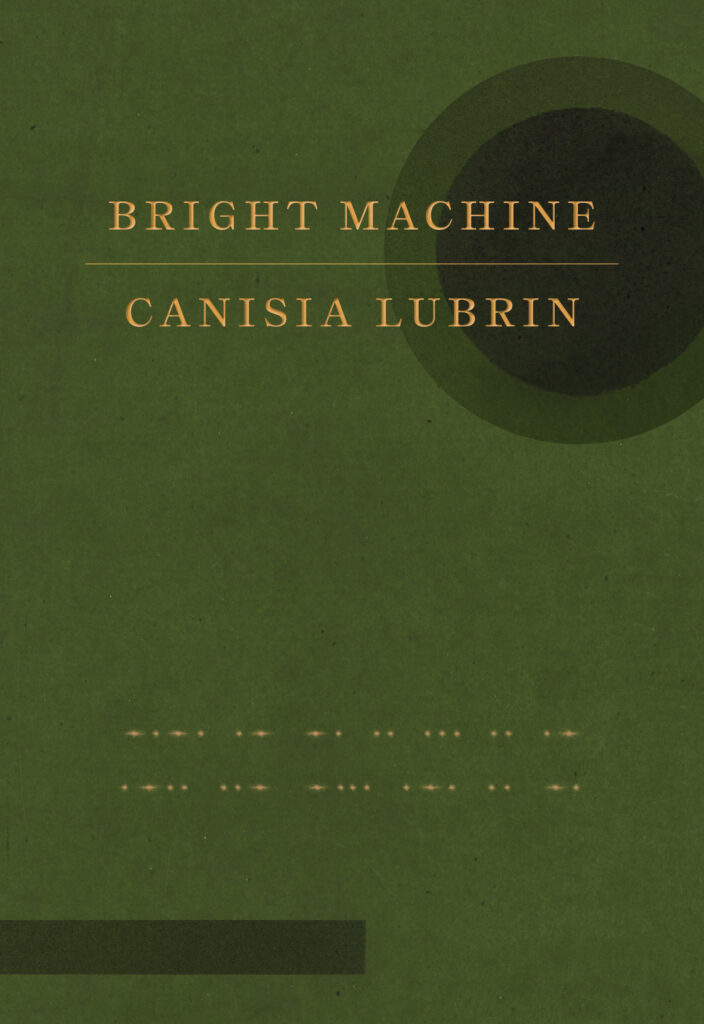
Bright Machine
By Canisia Lubrin
McClelland & Stewart, 104 pp., $25.00 (hardcover)
October 13, 2026
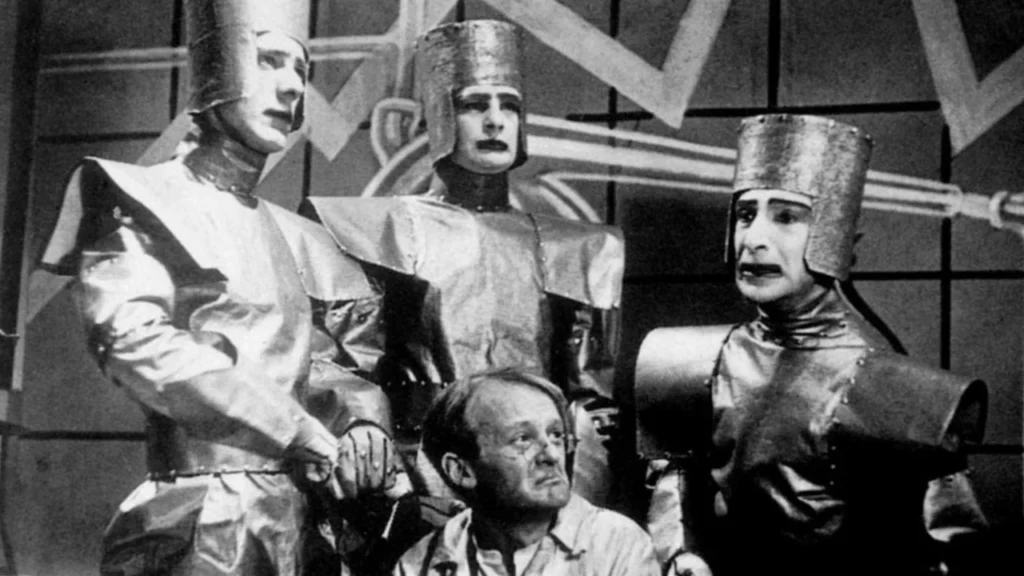
When Czech playwright Karel Čapek first coined the term “robots” in his 1920 science fiction play “Rossum’s Universal Robots,” he imagined a race of beings crafted from artificial biological matter, beings that appeared human except for several key facts: they seemed to have no interiority, to have no culture of their own, and to exist exclusively for human use. Čapek’s robots were smart enough to do as directed, but could be easily discarded and replaced as needed. As the general manager of Robot production declares early on in the play, “a working machine must not play the piano, must not feel happy, must not do a whole lot of other things… Robots are not people. Mechanically they are more perfect than we are, they have an enormously developed intelligence, but they have no soul.”
Forms of slavery structure the very possibility of the robot.
The story of Čapek’s robots is one we have heard before. Time and time again, history has warned us of Man’s greedy attempts to control life. In the play, Man’s exploitation is practised and performed through the creation of machines, robots that exist only for their captor, and so might variously call to mind: the kind of forced labour performed by serfs for aristocrats; by Haitians in a corvée labour system imposed by U.S. occupation, concurrent with Čapek’s play; or today, by incarcerated people in contemporary Canada who are paid less than $7 a day (before deductions) under CORCAN. Forms of slavery structure the very possibility of the robot: the term comes from a Czech word, robota, meaning “forced labour,” and its root derives from rab which means “slave.” Through the etymology of the word, we can see how systems of conquest and greed have long imagined a machinic existence for some populations. But these origins also shine a light on the inverse, as “robot” speaks to the constructedness of power (after all, the term did not exist and had not married machinic bodies to servitude before Čapek crafted it), allowing us to think with how extractive, enslaving, and eradicating violence works in service of another kind of horrifying construct: Man himself.

Today, we carry our machines in our pockets and take them everywhere, hold them close. We stare at them, eyes wide and dry and unblinking. We see visions of the virtual, visions of the real. Our pupils dilate. This is a hit of dopamine and we love it, even when taking it obliterates us. Until then, we ignore the irony in eagerly attaching ourselves to a technology that we know has negative consequences.
Until then, double tap to like; double tap to ruin. Earlier this autumn, an Israeli-developed Mikholit guided air-delivered glide bomb struck Mohammad Abdul Zinati, a schoolboy in Gaza City, when he ran to help an injured Palestinian Civil Defense paramedic, Sharif Shadi Labad. Zinati was 15 at the time of his murder. Double tap: the name for when a bombing is followed by a delayed second strike, a strategy beloved by the Israel Defense Forces to terrorize Palestine and Lebanon. The strategy begins with a densely-populated target: a home, a school, a playground, an office building, a holy site, an olive grove, a road, a refugee camp, an aid vehicle, a hospital, a backyard, a graveyard. Bomb it. Then, when people arrive to help—a mother, a brother, a doctor, a journalist, a revolutionary, a student, a poet, a child—they double tap and bomb it again. This approach maximizes the destruction, the casualties, the injuries, the bodies that must be recovered only to be buried in a graveyard that was bombed yesterday and will be bombed again tomorrow and tomorrow and tomorrow.
How do we envision a future with technology and machines when they are continuously used to wage projects of annihilation? When Canisia Lubrin writes “After Gazas, pyre smoke must break my back,” she renders the crushing weight of holding onto those lives that, under such regimes of annihilation, have disappeared into mere air, lives of those like Zinati and Labad. Her latest book of poetry, Bright Machine, is a history and theory of the technologies created for colonization, genocide, enslavement, and war-making, told through line and verse and a dizzying rearrangement of poetic devices.
Lubrin has always implored her reader to study hard with her work. Her novel Code Noir (2023), which won the Carol Shield Prize for Fiction, explores King Louis XVI’s 59 “Black codes,” decrees that sought to regulate slavery in France and its colonies. Across 59 interconnected fragments, she contends with the ongoingness of enslavement and empire. Her 2020 book of poetry The Dyzgraphxst, for which Lubrin won both the Derek Walcott Poetry Prize and the Griffin Poetry Prize, radically interrogates the limits of subjectivity by way of epigraphs, omissions, footnotes, and graphics. What’s undoubtedly so compelling about Lubrin’s body of work is her unwavering commitment to the poetic as a mode through which the legacies of violence and violation can be interrogated.
Bright Machine opens with a field of signs and symbols—punctuation—spread across the page. Titled “Translation,” this page provides a key for how to read what is to come. The dots and dashes are a Morse code that corresponds to letters and numbers from the “Table of Contents.” Morse code is a language of encoding and decoding, a language designed with the goal of translation. In Bright Machine, the rhythms of each line of poetry echo the meter of Morse code, priming us to understand that this is a book of covert translation. Lubrin opens by prompting us to ask: What exactly is being translated? Who is it being translated for?
How do we envision a future with technology and machines when they are continuously used to wage projects of annihilation?
These questions are tangled up in Morse code’s deployment in the slow creep of militarism and warfare in the late 19th century and throughout the 20th century. From the Crimean War to World War II to the American War in Vietnam, radiotelegraphy, to which Morse code was paramount, enabled tactical communication between armies, navies, and aviation forces. In this way, Morse Code’s translation is always also a question of deciphering militarism’s tactics, tools, and technologies.
Lubrin’s use of Morse code also serves a visual function in that it reflects on how seeing translates into knowing. The dots and dashes, the periods, backslashes, and emdashes on the page work as both language and as a remixing of pointillism—etching, splattering, embossing. The punctuation Lubrin uses to represent Morse code literally punctures the white spread of the page with meaning we cannot easily ‘read,’ yet we feel we know what it means nonetheless. The symbols indicate that the body of the work has been wounded, has been punctured. In this way, Lubrin reckons with the grammars of assault and annihilation that motivate this language of tactical encoding. Morse Code, she seems to argue, is a language of warfare, as is all the language of empire. We, as readers, have work to do: we must decipher these histories of assault and follow the traces left by all these machine-wrought woundings. But how?
In Ishmael Reed’s Mumbo Jumbo (1972), we find another formulation of the human-machine: androids. The novel’s villainous Atonists and Wallflower Order are charged with discovering a “Talking Android” who will spread their word and their history, and prevent the rise of subordinated (Black, decolonial, mad, feminist, Third World) ways of life. This Talking Android will serve as a symbol of modernity and progress, all the while destroying and dismantling the undercommons. The android’s labour is infiltration and obfuscation: it will seduce and captivate, until no one needs to read and study the world around them with critical eyes any longer.
Reed’s postmodern Mumbo Jumbo seems an unlikely text to sit alongside Lubrin’s Bright Machine. But more than anything, Reed’s novel grapples with the making of the world and its history: how we know it, how we learn it, how we carry it in our bodies, how we read it. The novel obsesses—it is indeed dogmatic—about how the world enters its pages. Literary scholar Kinohi Nishikawa calls this Mumbo Jumbo’s “paratextual condition,” commenting on how the novel mobilizes materiality (extradiegetic interviews, photographs, definitions, poems, telegrams, a four-page handwritten letter, Olmec heads, newspaper clippings, and more) to shape a new kind of reading practice. Reed understood that his novel needed a form capacious enough to both represent Blackness and allow Blackness to exceed any representational form. He also needed a form capacious enough to contend with the anti-Blackness that structures aesthetics more broadly, particularly when considering how the form of the novel has itself been a technology used to curtail Black inventiveness, resistance, and imagination. Traditional novelistic form was insufficient to this task, and so Reed had to dream up a new way to get us, the readers, to know history differently.
In the same way, Lubrin’s poems invite us to read in ways machines (or Reed’s Talking Android) cannot, in part because they too take on a new form. In Bright Machine, she constructs a poetic form made of sixteen lines, the first stanza carrying four lines, the second stanza having five, and the third with six, the whole structure concluding in a single line that is left to itself. Quatrain, cinquain, sestet, monostich: she calls this form a tesseract. In geometry, a tesseract is a four-dimensional hypercube, or a cube as it would be rendered if conceived in four-dimensional space. Imagine the difference between a single book of poetry, like an individual point, versus the abundance of a multi-floor bookshop, where one must search across shelves and levels to find the text in question. Finding the book is now complicated by many other qualities of space, qualities that produce four-dimensionality.
Lubrin’s tesseract gives a form to the four-dimensional interconnection of time and space. In her poems, time is overburdened and overflows. Each emphasizes time’s circuitous recursivity, moving across years, centuries, decades, futures, pasts, presents, from the 16th century, 18th-20th centuries, 1983, 9000 BE, 100 CE, 1492, 3020-something, 2020, 6 p.m., 8 a.m., NO HISTORY, to a mere hour ago. Lubrin’s premise is that all things have occurred and continue to occur in relation; the past is not past. Indeed, in the section titled “At Checkpoint 41, Biological Warfare? 16th c.,” we witness the violences of borders and border crossings occurring in 2001 alongside what the 16th century wrought, revealing how time is accretive not because of its passage, but because of the repetitiousness of interconnected tragedies.
This weaving of time, phenomena, intertexts, histories, and theories is necessary to begin the herculean task of critiquing the world as we know it. Lubrin’s tesseract does not capitulate to the delimitations, violences, and violations of Empire, but rather alchemizes these realities into critique. It is for this reason that many poems in Bright Machine are organized under interrogative questions, with titles such as “Organs of Soft Matter, Hoplite Dory? 100 CE,” “In the Middle of Burning, UAV Predator?,” and “Perfecting the World, IED? 21st c.” The titles question various Man-wrought weapons of destruction, from howitzers to UAV predators and hand grenades. They are speculative questions that seek to locate causality and blame, to reckon with the anonymous inhumanity hiding behind machines of destruction, and to name the greed and profit that grease them. Notably, these titular tools are not always the only ones explicitly named in the titles of each suite. Rather, we see how these machines intersect with and undergird the violences of borders, biometric surveillance, settler colonialism, genocide, and securitization.
Bright Machine transforms the language we use to talk and write about the terrorism of the state, of the corporation, of the settler, of the border. Every line, every stanza, of Bright Machine is an interrogation of the problem of Man and his machines. “Man” here refers to the assemblage of the material infrastructures, cultural practices, economic formations, and legal systems that recursively produce—and are a product of—the colonizing, anti-Black, liberal humanist subject of the West. As Sylvia Wynter, a pioneering thinker in Black studies, writes, “Man… overrepresents itself as if it were the human itself.” Man, in brief, at once terrorizes the world and seeks to be the totality of the world. The historical development of Man has naturalized his qualities—domination, accumulation, self-interest, expansionism—as if they were inevitable, and treated as abject or impossible all that threatens this figuration. The cost of Man’s project is, quite plainly, life itself.
Time is accretive not because of its passage, but because of the repetitiousness of interconnected tragedies.
As abolitionist geographer Ruth Wilson Gilmore articulates, “where life is precious, life is precious.” Lubrin’s tesseract is a form that illuminates why, refusing Man’s project. To combat structural violence and the grammars that permit it, we must read differently and think differently. Bright Machine’s poems make us do just that.
That, we might say, is their punctum. Punctum is a now well-trod concept, introduced by Roland Barthes in 1980’s Camera Lucida. “A Latin word exists to designate this wound, this prick, this mark made by a pointed instrument: the word suits me all the better in that it also refers to the notion of punctuation,” writes Barthes. His punctum is a wounding, a bruising, a puncturing of the viewer. If the photograph tells a story, the punctum is its apogee, revealing to us both how we read, how to read, and how reading feels.
Bright Machine is no photograph, and yet it has punctum. Reading Bright Machine, what arrests me is the unflinching Black feminist “poethical” practice that suffuses every word, every stanza. The philosopher Denise Ferreira da Silva defines this mode as a “compositional method that attends to matter not toward comprehending it in the fixed forms of the understanding or subsuming it to the idea(l)s of Reason,” but instead, “presupposes that, beyond space-time, all that happens and exists is deeply implicated.” In other words, it is the critical practice of intervention and irruption that seeks to disturb, unnerve, and puncture the coherence of what has come to be called Man and his time of modernity.
Lubrin thus demands that we stay in the vertiginous cut between the aftermath of ruin and all that fades into a distant history, all that gets bulldozed and built over, all that is obliterated, and all of the ways human and ecological bodies bear these injurious afterlives. “In this century of bones,” she portends, “Imagine such books/ know us better than anything that dies. Of a Heartbreak./ Of bones. The new wars here are bones. The bones you are… La Terre sà là. Already we’re denied its fact of bones.” Here, Lubrin rends apart the bones that wage and make war, and the wars that make and break bones. La Terre sà là: the Earth, the world, is right there, split open. That cut, that gap, that wound asks something of us.
“All deaths,” Lubrin charges, “delight the state.” Whether we double tap to like or double tap to strike, world-ending catastrophes may follow. Reading, knowing, and feeling differently must also lead to doing differently—choosing to do differently. Lubrin entreats us to always choose the side of life, a side where 15-year-old boys who rush to help the injured can return home safe, never having known the word Mikholit. “We petition. The summoners of/ our preventable catastrophes. Whoever claims / to cleanse the village without picking sides / is not believed.”
Choose your side, Lubrin instructs, and reminds us: “What again. / Is a pencil’s. Sharpening if not / a voice.”
Kimberly Bain thinks, writes, and creates at the intersection of Black feminist and queer of colour theory, environmental humanities, and critiques of racial capitalism. Their work interrogates the discursive-material formations of Blackness across historical periods and geographies in order to shed light on its contemporary operations. They are currently at work on two scholarly monographs: one on Blackness and breath, entitled On Black Breath; another on Blackness and the Anthropocene, entitled Black Alchemy: Dirt, Soil, and Other Dark Matter. They are an Assistant Professor in the Department of English Language and Literatures at the University of British Columbia.