
Blue Heron’s Family Secrets
Blue Heron
Directed & written by Sophy Romvari
Starring Eylul Guven, Amy Zimmer, Iringó Réti
90 min.
Canada, Hungary
The term “inner child” belongs to Carl Jung, though his definition and original phrasing was very different from how it’s used today. Jung believed in what he called the “eternal child” living inside every adult, a version of oneself that is always in a state of growth and never done needing care. Developmental psychologists, among many others, have adapted this concept into a form of behavioural therapy, a prompt for better self-awareness or perhaps self-compassion. In the present-day vernacular, it is the recognition that we do not grow out of time, nor do we grow up. We just continue, our bodies a way to see and feel what we are, while our minds constantly replay who we have been.
Adulthood is often spoken of or lived as though it is a static experience, a level of maturity that once achieved might be maintained, and perhaps it is for some people—with time and age we could, in theory, find something that is like peace. But for me, that vision of adulthood only evokes what I thought about it as a child, longing for a faraway time when I would become some future self—a woman complete, permanent and sure, as distinct from who she once was as she is from any other person on earth.
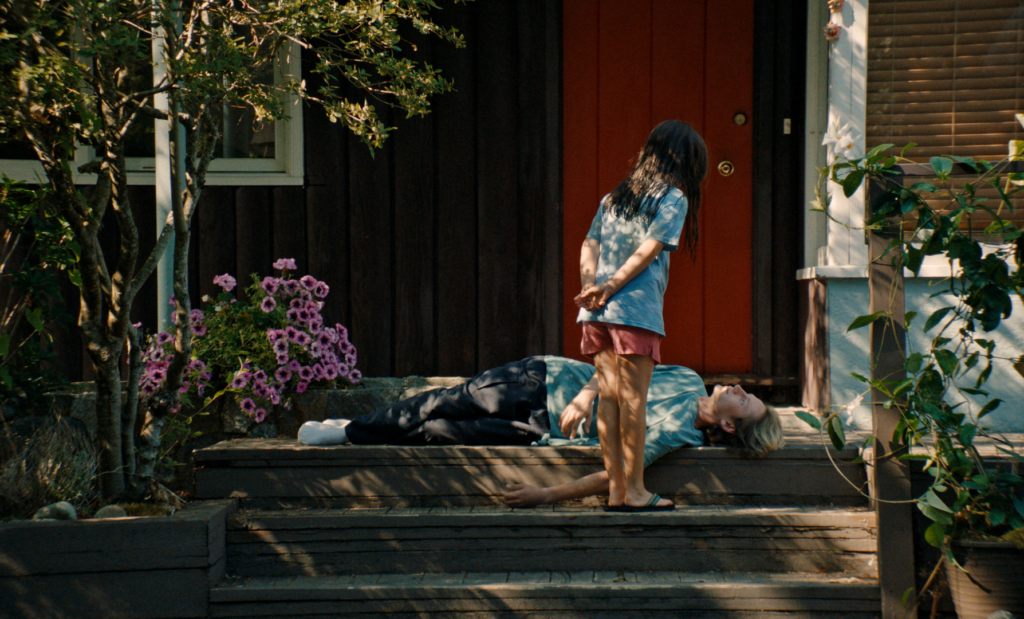
In Canadian writer-director Sophy Romvari’s feature film Blue Heron, we find the protagonist Sasha as both at once: the child in need of knowing, and then later, the woman in need of seeing. Throughout the film, she acts as our partially-obscured eyes and muffled ears to each scene. She is about seven or eight years old when we meet her, the little sister to three older brothers, the beloved daughter of parents who have moved the family to a new home closer to the eldest brother’s school sometime in the mid to late 1990s. They unload boxes and eat their first dinner by candlelight. They paint the front door red. Their unnamed mother tries to occupy the kids so that the unnamed father can work on the desktop computer, and we see them spend their days at museums, the beach, and in backyards.
We do not grow out of time, nor do we grow up. We just continue, our bodies a way to see and feel what we are, while our minds constantly replay who we have been.
Blue Heron has a quieting quality: it is hushed, almost silent, so that meaning carries through exchanges that are practically mute. Everything is slowed, too, each scene having a feeling of significance, even if it’s not yet clear what that is. We realize early on that Jeremy, Sasha’s oldest brother, is a punishing presence, a teenager in such pain that his only recourse seems to be to turn his anger into the atmosphere. Their parents are scared, tired, frustrated, and the family dynamics are strained, to say the least. The little graces of Sasha’s childhood, like sleeping in her mother’s bed and playing on a trampoline, are almost always interrupted by a character who barely speaks: Jeremy utters about three complete sentences in the entire film, one of which is “No.”
I am, in truth, also feeling quiet about Blue Heron. Romvari’s work here has such a delicate feeling alongside a strength of vision that manages to conjure the threadbare memories of childhood. I worry that I could say too much and upset that balance, not properly protect the experience of watching it for yourself. But how can I be afraid of giving away too much when this is a movie that gives nothing away? Blue Heron is a story about secrets; the film even keeps these secrets from itself. Sasha’s younger self can see what was happening but she cannot tell her adult self enough to explain; Sasha as an adult can’t in turn tell that child what happened, but she can look at pieces of the past to see where things broke apart.

The term “problem child” belongs to the 1990s, to talk show therapists and movie franchises and mediums that use slogans and screens to simplify how we see ourselves. It is the kind of vague moniker useful for conversation but useless in real life. Though more precise diagnoses can be flawed or inaccurate, they at least often point to the possibility of a plan, or the knowledge that a person can fit into a group of many while still being entirely themselves.
Without any kind of support, whether from a professional or a dictionary, it is not that a family crisis is inherently impossible to understand: instead, it is impossible to find out where the family is in relation to what is happening. With that comes a tense and punishing monotony, one that wears down the resilience of love and comes up against the limits of family. “I feel like you don’t see we are in a crisis,” the mother in Blue Heron says at one point to the father, but what is seen resists being declared an emergency despite how it feels. It is a quiet and urgent crisis that is always happening, always on the verge of happening, and has always just happened.
Jeremy, in a beautiful performance by Eddik Beddoes, portrays just how quiet anger can be: passive yet unyielding, his rage free-floating yet constantly finding a target. He is an angry teenage boy, that “problem child” archetype well-known and much-studied, but there are no answers, or diagnoses, or help for his parents as they try to address why he sporadically creates small moments of violence towards himself, or others, or the general mood. One afternoon, he is brought home by the police for shoplifting, and the father, a photographer, is interrupted while filming his kids on a camcorder. He hands it to Sasha, who keeps rolling.
Jeremy is an artist too, careful and gentle with precise drawings of large scale maps that are colour-coded with different markers and borders, pencil-drawn and ruler-guided lines. His choice of art form reads as alternately his challenge to the world and what he fears about it: everyone can see him, but no one can find him. A long time ago I heard the phrase the map is not the territory, a reminder that the way terrains are understood as a concept will never match how a traveler finds them. Grids and routes and roads are inadequate—closer to imaginary than they are to analogously representative—when any environment can be made to look flat from a far enough distance.
Much like her documentary short Still Processing (2020), which tells the story of Romvari’s own family (as much as it can be told, with the clear suggestion of its narrative inspiration for Blue Heron), Romvari’s camera is distant: there is much space between the focus of a scene and the eye of the camera, such that the feeling of being able to see everything reveals how little we know. There are details in this movie about the family before we meet them, like about the parents’ immigration from Hungary or the mother’s earlier relationship with another man, who is Jeremy’s father. A second half reveals something like an ending, but by this point, audiences are not watching for anything as simple as plot. We’re watching a little girl watching.
It was telling, in thinking about Blue Heron, to realize that so many of my favourite movies about family are made by, or are about, daughters. The family never knows itself as well as its daughters do. Whether it is the uneasy—queasy, really— domestic secrets depicted in Jane Campion’s Sweetie (1989), or the bittersweetness of the loss sustained by the March family sisters in the many adaptations of Little Women, or the reconstructions of a mother’s private past lives in Sarah Polley’s Stories We Tell (2012), or the half-remembered and half-imagined impressions of a daughter remembering her loving but distant young father in Aftersun (2022), every film about family is the story of where that family fractured. In them, daughters are determined, maybe despite ourselves, to keep capturing any truths we can get our hands on.
In this tradition, the second half of Blue Heron approaches at a speed so quick we arrive before even realizing we’ve moved twenty years into the future. Suddenly an adult, Sasha is a daughter making a movie about her family: she is attempting to use images and interviews to find a way back to that time. In one scene, she interviews social workers about Jeremy’s case files from her childhood and, with a practiced professionalism, asks them to give their expert opinions. There is an obvious comparison to be made to Jafar Panahi and Abbas Kiarostami’s films here, in the meta-textual nature of a filmmaker making a film about a filmmaker making a film, but it is also similar to their approach to childhood and their easygoing and natural respect for allowing kids to be their own main characters. The way children behave reveals the constant tensions between tradition and modernity, their brief time in childhood a living link between a family’s past and a culture’s future. A problem child, as the phrase goes, tests what are already tenuous links.
But then, every child is born into a brand new family, not only the one that they enter but the one they create with their presence. Our siblings know all our secrets even when they are our secret; our parents keep keys that only unlock more questions. The family might change to the point of fracture, but one never really leaves. Watching Blue Heron, we know as much as Sasha does. This is not the idealized narrative of family reunification or a return to wholeness. Instead, this is the family reconstructed imaginatively, both by the character and the filmmaker. No one on any side of the screen could hope for more: a conclusion was never the point. Every return is a chance to be visitors to our own pasts, eavesdroppers on fragments of what was said.
Film is Sasha’s map to keep some kind of contact with her inner child, but in Romvari’s vision, neither being an artist nor an archivist nor a daughter can be the kind of magic trick that will provide something realer or truer to a present day life than what is possible for memory to recall. One of the only other sentences that Jeremy speaks in the film is said to Sasha. “I think there’s a lot you don’t remember,” he tells her. There is a limit to memory, but none to the maps we make of it.
Haley Mlotek is a writer and editor based in Montreal. Her first book, No Fault: A Memoir of Romance and Divorce, was published in 2025.