
We Are on Top of Our Sacred Mountain
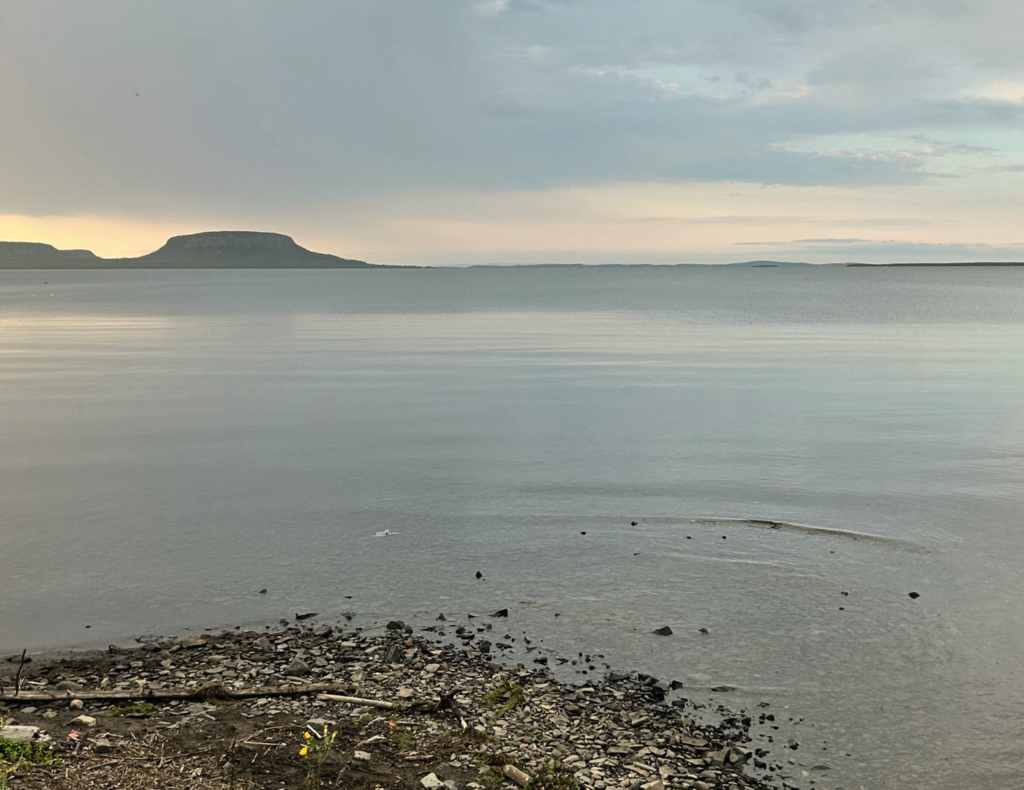
I am driving to the top of our sacred mountain. Animki Wajiw, the place where Anishinaabe people boil sap from the sweet maple while the thunderbirds build their nest. The land is hushed as it waits to greet the sun that lies beyond the horizon. My eyes are dimmed, waiting in gentle anticipation for the glow of a new day just beyond reach. My face is resting, its expressions not yet fulsome on its tender and puffy surface, a small pillow crease on my cheek. Suspended in the air around me is the whisper of my daughter’s warm body in the hotel bed I just left, as I make my way to the top of the still slumbering mountain.
When I was a small child, I would lay in bed half asleep listening for the comforting sounds of my grandparents stirring in the dark morning to make tea. I close my eyes and I am transported into this feeling. Mishomis, grandfather sun, is clanking the kettle, ready to rise. I open my eyes and look out of the car window. The land feels so busy. The witching hour, I think to myself. That sacred time where the animals and spirits ready themselves in reverence for the steady sun that brings light and warmth. I imagine that they too, despite their varied forms, find a moment to close their eyes and return to the feeling of being small children listening for the sounds of their beloved Mishomis beginning his rise.
I am greeting one grandfather while contemplating the loss of another. The sun will always rise, but both of my grandfathers in this life have now departed. My paternal grandfather passed away before I was born, his bones resting at the bottom of a lake not far from here. My maternal grandfather, the one who had made me thousands of cups of tea, chose to slowly fade away from this life. The small child within me waits eternally in muddied confusion: why won’t he rise? for me? for himself? This type of grief is unimaginable, I think to myself. The unsettling type of grief that makes you wonder what else lies on the horizon of the unimaginable. I think of him as we make our way up the mountain. Is he somewhere here in these trees? Has he joined the sun to warm me up? It is so cold without you, my grandpa, in a way that the sun cannot warm.
We are driving to the top of our sacred mountain. Animki Wajiw, the place where my daughter’s placenta is tucked into the bones of our mother. The land waits in anticipation as we reach our destination, that same energy of a hushed surprise party before the special guest makes their unknowing entrance. Everyone is waiting. Everything is waiting for our glorious Mishomis sun. As I kneel in the dewy and cold grass, I feel how solid the earth is below me. I imagine my own umbilical cord tethered to the mountain, fused into the rock and copper that holds our stories, gluing me firmly into my body. I am tethered by this cord but the moments that brought me here are still softly suspended around me. Echoes of our laughter in the car as we travelled up the mountain on the dark roads. The ever-present grief of my grandfather as I search for him in the land.
And Palestine, always Palestine, in my heart and in my throat, as the sun finally rises to greet us.
Come, let our lands know you. Come, let our ceremonies care for you.
We are on top of our sacred mountain to pray for Palestine. We are on top of our sacred mountain because the Anishinaabe people have responsibilities to Palestine that require our prayers and bodies and sweat and tears. We are on top of our sacred mountain because we are human beings who actively construct, and care for, our collective world. We are on top of our sacred mountain because we are Anishinaabe and the ability to love far beyond ourselves is as natural as breathing.
I sit in the wet grass and watch the land wake up. I listen to our beautiful language float softly in the suspended stillness of dawn. The same language that they tried to beat out of my father now dances on his shouldertops and tickles his braids. Lyrical and dancing Anishinaabemowin interspersed with the words, “Palestine,” “Palestinian People,” “Palestinian children.” I look over at my father who is sitting across from me with his hands in the grass, a somber look of contentment and wisdom on his face. I look over at my Elder, vibrating in prayer. What miracles of persistence have delivered my people to this current moment? What blood and horror and loss have we walked through to sit on this mountain now and listen to our language wrap itself around a people not our own. I cannot imagine anything more beautiful in this life than to care so deeply for others outside of ourselves. I cannot imagine anything more transcendent in the human experience than to carry a sense of responsibility that extends far beyond our own children, beyond our own people, beyond the sea. I dance between either side of the coin of the unimaginable—my grief on one side, and on the other, the experience of an existence that makes it all worth it, the kind of existence that I will always rise for.
Make no mistake: our love is material. Our prayers are contracts. We do not travel to our sacred mountain to pray as an expression of empathy for our besieged kin. It is never enough to just feel. To be Anishinaabe and to pray is to enter into cosmic contract, to nurture the genesis of a type of organizing that they simply do not understand in the West—the type of organizing that begins with our ancestors and the spirits that care for our collective world. This is the type of organizing that spiritually resources us as we transform the material conditions of the world that sustain the genocides that touch so many of us. Our prayers do not hope nor yearn. Our prayers are contracts. Our love is material.
When I was a child, many caregivers in my life fluctuated like an unpredictable tide. I would lose my footing and find myself on my hands and knees touching unfamiliar sand and watching the receding waterline in panic. But my grandpa would always be there, arms outstretched to make me a holy cup of tea. In the ruptures of colonialism, the adults ebb and flow with their own surges and breakages of what they can offer in the chaos of it all—they give and they take and they dance with one another, a choreography of persistence. My grandpa, in his own cave of suffering, formed into a glorious wave to carry me through my childhood with steadiness and assurance. He surged and receded, to hold me. When I was an adult, my grandpa decided he wanted to be alone to let himself dissolve into the eternal tide. He passed away only three months ago and I carry in my chest the razor sharp grief of his complicated loss.
We are sitting on top of our sacred mountain. Mishomis smiles at us with radiant affection as his rays start to warm our bodies below. The bugs have woken up and I try to stay as still as I can while they buzz in my ear and bite me through my jeans. They are a good reminder of the balance of life—how a moment so monumental can be punctuated by frivolous human annoyance, an itch, a hum. The smoke from the smudge makes their presence manageable. I think of the time my father and I paddled out on Rainy Lake and he insisted on letting all of the mosquitoes swarm his bare arms for hours, with me incredulously inquiring how he could possibly withstand the sensation. They are just women trying to feed their babies, he said. None of our relations is more important or sacred than another. Our beautiful Anishinaabemowin continues to be carried up into the sky with the smoke. The words, “Palestine,” “Palestinian People,” “Palestinian children” echo off of our sacred mountain, are heard by the maple grove, are received by the rock and copper that hold our cords. I cannot fathom anything more beautiful than to love, and be loved, by everything beyond ourselves.
What we have endured from the settler colonial project should destroy us, yet here we are, ready to love and care and act for a people beyond the sea.
Far down the mountain, in the city of Thunder Bay, Anishinaabe and Palestinian youth slumber in their warm beds. These young people, and some of their parents, have travelled here as part of a delegation that brings Palestinian youth from the Toronto region to Anishinaabe homelands in Treaty 3 to build relationships of joint struggle in practice and in kinship. Moving beyond the abstract or the theoretical, this delegation is a material commitment to the intertwined liberation of Anishinaabe and Palestinian communities sustained through relationships of love and care. Come, let our lands know you. Come, let our ceremonies care for you. Anishinaabe people have persisted through genocide, let us hold you in your grief and agony as you experience yours. Let us share notes. These young people are asleep at a hotel, having stayed up too late with excitement the night prior, ordering endless snacks and chatting in crowded hotel rooms. This is the second year that the Anishinaabeg Palestine Alliance has organized this delegation from the ground up, and today will be our first of seven days together. A smaller group of Anishinaabe Elders and organizers have woken up before dawn and travelled to our sacred mountain to begin the delegation with our prayers.
We finish our ceremony on the mountain as the sun drapes itself over the land. It is now time to drive back into the city and meet the youth who are likely just beginning to wake up. I look out of the car window and enjoy the sensations of pure contentment, purpose, and joy that our ceremonies lend us. I revel in the rare feeling of being a passenger in the backseat of the car, placing my forehead on the glass, the sensation of being a child once again. My face has now awoken and as we chat and laugh, crow’s feet form at the corners of my eyes, the pillow crease has faded from my cheek. It is so beautiful to be alive, I think to myself. My grandpa, I wish you could have delighted in yourself the way you delighted in me. My grandpa, I wish you could have felt life loving you back. As you drank your thousands of cups of tea alone until the bitter end, I wish you could have felt that the sun adores you.
Every single person who has travelled to our sacred mountain on this beautiful August morning holds so many responsibilities. We have responsibilities as caregivers, as helpers, as community builders, as organizers, as survivors, as keepers of the knowledge, the culture, the language, the ceremonies, the medicines, the stories. We move through our lives protecting, defending, building, dreaming and doing, all while surviving the colonial project on Turtle Island. We do this work while we grieve our own people, systematically taken from us from the onslaught of settler colonialism here on Turtle Island. We do this work while we parent our children, just one generation removed from the residential schools that tried to make our love impossible. We do this work while we feel the piercing grief for our grandfathers welling in our hearts and eyes. We do this work while our bodies ache, while our hearts burst, while we bleed. The will of our Anishinaabe existence insists on love that is borderless and rooted, selfless and cosmic—an interconnectedness so totalizing that it can never be understood by the colonial world. What we have endured from the settler colonial project should destroy us, yet here we are, ready to love and care and act for a people beyond the sea.
We arrive at the hotel and I have a couple of minutes in my room before I must greet the youth. I sigh audibly in relief when I enter and realize my mother has taken my four-year-old daughter down to get breakfast, one fewer responsibility to bear, a couple of moments of stillness before I hit the ground running. My mind is already racing—packing the cars up, grocery lists as we head into the bush, communicating with people who will meet with us, head counts, gassing up, mothering, staying on schedule, and of course, showing up as my full, jolly, and self-deprecating self to make these young people feel safe and cared-for. This is not my first rodeo. It has been eight years of doing youth work from the ground up, and four years of taking my daughter along with me. My body is tired. My spirit is tired. It has cost me so much to do this work. It has cost us so much to continue the work. It should always cost us something to do real work. Sacrifice is the currency of our prayer. I cannot imagine a more beautiful existence than one in which we are so wildly loving of others.
Anishinaabe people know how to sacrifice. Sacrifice is nearly synonymous with responsibility in our justice-oriented culture that values life, love, and dignity for all, and responsibility is the glue of our governance systems. People all over the world who live through colonialism and imperialism have sustained generations of sacrifice for the collective. But in the West, we struggle to even imagine a sense of responsibility that extends beyond our immediate selves and families. Even when many of us deeply care about what is happening in Palestine, or Sudan, or Congo, or Grassy Narrows, we feel too removed from our own power to worldbuild, and too scared to walk into the unknown of what happens when liberation costs us something. Sometimes, this is a moral and ethical failing: the dark spirit of colonialism rearing its ugly head as people clutch their privileges even though they are forged in violence. Other times, this is symptomatic of the grand orchestration of imperial power in the strongholds of empire to sustain a worldview wherein collective sacrifice is removed from our collective vocabulary. The settler colonial world does not want us to remember that we can worldbuild, and that changing the current world—sustained through multifaceted violence—inevitably involves sacrifice. They do not want us to remember that sacrifice is an expression of love for the collective, and that the collective will love us back. Sacrifice is not loss, it is love. Responsibility is not burden, it is purpose. Sometimes, when I lie in the dark stillness of night, I fantasize about what it would feel like to approach the work of liberation cyclically—a season of carrying the work on my back punctuated by a season of rest, a different kind of season when my child is a toddler, a different kind of season when my grandfather dies. This fantasy never makes it to the tip of my tongue because of its sheer impossibility. For those of us carrying the work of liberation—the brunt of it emanating from racialized and Indigenous folks—we know that if we stop the work will not continue. The only way out of the global orchestration of genocide and climate catastrophe and pedophilia and violence and rot, is for the people in the West to learn once again how to offer their backs for the children of the world.
When I was a young girl, I sat on my grandmother’s kitchen counter in an oversized t-shirt, long dark hair in my eyes, my legs dangling playfully. My grandpa was making me a cup of tea and teaching me how to butter a piece of toast evenly, with the utmost care. He adored me and I adored him. He was a wave surging with white foam that would keep me afloat until adolescence. To survive my grief, I have to believe that a life is not linear. I cannot live in the imaginary of his dark and painful passing—his suffering does not define the entirety of his life. The way my grandpa would give you the shirt off of his back if you said you liked it. The time I walked out of school to find him having a lone snowball fight with about twenty of my schoolmates, a small trickle of blood streaming from his eye and a huge grin on his face. The long nights of cribbage and rummy, delighting in the small pleasures of life. Pushing me so high on a swing that I thought we might both shoot off into the stars together in laughter. I have to believe that there were days where he felt the sun’s warm rays and knew he was loved, unquestionably, by the universe around him. And I have to believe that he is here with me in these trees.
All of us are now driving through my beautiful homelands in Treaty 3 territory. There are 17 people who are a part of this delegation who have gathered together to build a new world where Palestine will be free. Elders, survivors, mothers carrying children on their backs, youth and their proud parents in loud cars listening to Fairouz (obviously) and Pink Floyd (for my grandpa). We are aching, but we know the sun will warm us. We are tired, but in the best way. Mishomis will rise again tomorrow, with the distant clanking of the kettle, here and in Palestine, warming the faces of children who receive our prayers as lullabies, a contract bound by body and moon, sun and copper. Will you join us? Not at the sacred mountain, but perhaps in the streets or at our kitchen tables, in what you teach your children and what this moment costs you. What kind of world do you yearn for? Sacrifice is prayer made material. Do you understand what they have taken from you when your existence in this violent and bloody world doesn’t cost you something? The cost we bear is also a measure of our honour in this unjust world. I cannot imagine a more transcendent existence than one in which we love far beyond ourselves. Will you join us?
My eyes stay focused on the seemingly endless road ahead of us as we whiz along the highway. I am driving a huge black SUV packed to the brim with Anishinaabe and Palestinian youth who are laughing and talking about their favourite music. My eyes scan the treeline for signs of my grandfather. I think to myself that I hope he can see me in these moments, when I can feel the entire universe loving me, loving us, and me loving it all right back with action and care and purpose and justice. I will always rise. Not just for my people, my daughter, or for Palestine, but also for myself. This will be my grandfather’s legacy.
Prayers for Palestine spoken at our sacred mountain. Palestinian parents passing the knafeh to my father while we camp on the land from which he was displaced. Palestinian hands building Anishinaabe lodges that will care for all of our people. Palestinian and Anishinaabe youth laughing under the stars. Woven prayers of Anishinaabe and Palestinian futures whispered into the cosmos. Grandfathers sighing in relief as they watch their love-filled descendants from the ethereal treeline. Sacred contracts echoing throughout the universe. Prayers for Palestine spoken at our sacred mountain. The sun will always rise, and we will rise to meet it.
Quill Christie-Peters is an Anishinaabe educator and self-taught visual artist from Treaty 3 territory. She is the founder and director of the Indigenous Youth Residency Program, an artist residency for Indigenous youth that engages land-based creative practice through Anishinaabe artistic methodologies. She holds a master’s degree in Indigenous Governance on Anishinaabe art-making as a process of falling in love. She has exhibited her work at the National Arts Centre, Ociciwan Contemporary Art Centre, and Kenderdine Art Gallery. She is the author of her first nonfiction book On Wholeness: Anishinaabe Pathways to Embodiment and Collective Liberation (House of Anansi, 2025). Her visual work can be found at quill-violet.com and @raunchykwe.