
Unbunkering: An Interview with Naomi Klein and Astra Taylor
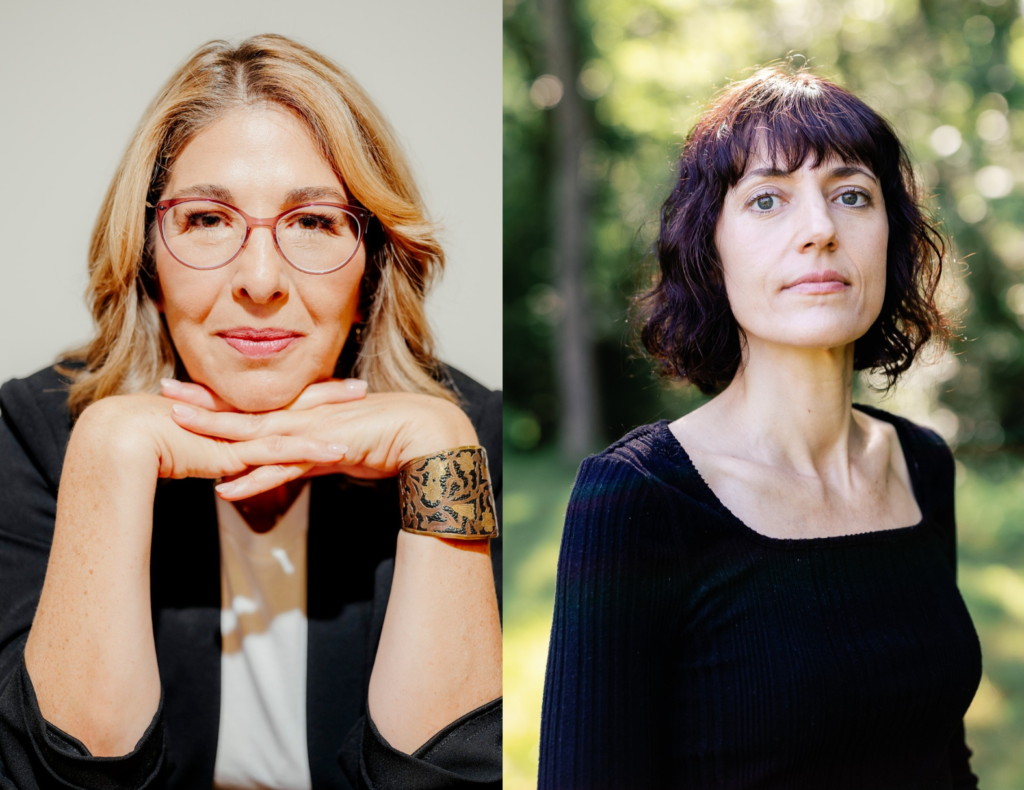
For more than two decades, Naomi Klein and Astra Taylor have inspired audiences to think deeply about the world they inhabit. As a young undergraduate student in the mid-2000s, I recall dog-eared copies of Klein’s No Logo (1999) making the rounds on campus, the marginalia serving as a snapshot of the previous owner’s political awakening. Similarly, group viewings of Taylor’s documentaries Zizek! (2005) and Examined Life (2008) helped me—along with an entire generation of nascent activists, organizers, and scholars—to consider how we might respond to the challenges and existential threats posed by globalization, debt, climate catastrophe, and hyperconsumption, amongst other systemic crises.
In some ways, it is surprising that a book-length collaboration between Klein and Taylor has only recently come to life. Their paths have hovered in proximity to each other, frequently dovetailing in their calls for social and economic justice. Klein, a Professor of Climate Justice and co-director of the Centre for Climate Justice at the University of British Columbia, has devoted much of her career to interrogating the impacts of global economic systems on communities and the environment. She has highlighted the perils of disaster capitalism and “philanthrocapitalism,” for example, positing their fundamental incompatibility with climate justice, and advocated for bold policy changes at the federal level to bolster human rights, Indigenous rights, and environmental stewardship in Canada. Along similar lines, Taylor has focused heavily on income inequality, actively participating in the Occupy movement, and co-founding the Debt Collective, a debtors’ union that has abolished more than $200 billion of debt in the United States. Taylor has written extensively about community organizing, debt, work, and democracy, including in her 2024 Massey Lecture The Age of Insecurity: Coming Together as Things Fall Apart.
Perhaps it is a testament to the urgency of this moment that, amid their myriad commitments, these two thinkers carved out time to pen End Times Fascism: And The Fight for the Living World (Knopf, 2026), an offering which the authors hope will contribute to a movement that “wrests away [fascist] weapons, holds them accountable for their crimes, and defends the paradise of here.”
Much like each of their individual contributions from the past two decades, End Times Fascism arrives at a pivotal moment—an inflection point—in global politics, this time carrying the weight of armageddon. Indeed, we are in a new paradigm, a dark era heralded, as Klein and Taylor observe, by public sadism, the destruction of democracy, and “the apparent arrival of history’s first trillionaire.” It is also, however, a time of new waves of activism, robust solidarities—both emergent and renewed—and ever-growing resistance.

Phillip Dwight Morgan: To start, I’d like to ask about the process of you two collaborating on this book. How did it come to be? What was the genesis of this project?
Naomi Klein: We were hanging out on a Zoom [with our friends Keeanga-Yamahtta Taylor and Chenjerai Kumanyika from Haymarket Books] and ranting about Elon Musk. I was already working on an essay for The Guardian, but I was having trouble getting it done, and Astra observed about Musk that he wants us eking out an existence on two dead orbs, Earth and Mars, after he’s sucked all the life out. That’s what he calls being “multiplanetary.”
We want to live on a multi-species planet here, and that just made me really want to write this with Astra, who has such an incredible way with words. [laughs] I’m even butchering that quote, but that’s when we decided to do the Guardian essay, and then when we decided to expand it into a book.
We see this as a toolkit, as a set of tools, that we hope will help focus people on the threats and the stakes ahead of these midterm elections in the U.S. That’s obviously not the only intervention, but we wanted it out before the midterms. I couldn’t have done it on my own and I don’t think Astra could have. It could only have happened as a collaboration.
Astra Taylor: Both of us have backgrounds as editors, and I think that that means that you see writing in a certain way because there are some writers who hate to be edited or don’t like to collaborate, and part of co-writing is that you always use your editing brain when you’re writing.
In terms of the actual mechanics of collaboration, it’s being able to switch between those two perspectives and tackle your own work with some viciousness when required, and then gently edit your friend.
PDM: Much of the time, this book reads as a singular voice, but then there are these moments of “we believe,” “we assert,” and so on. How did you decide when to introduce the “we” of the book?
AT: There’s always a challenge, especially with political writing, about using “we” because it’s like, well, who is the “we”—the royal “we”—you’re referring to? One thing that’s nice about co-writing is that it’s the two of us sometimes sharing an epiphany or an insight, and then there is the bigger “we.” That “we” is aspirational, the “we” of [a] multiracial, multifaith, democratic coalition that we want to build.
A transformative solidarity aims to bring people together across difference and expand the “we.”
NK: I think you have to kind of earn the “we” more. But our hope is that it has more force because it is a collective voice, and that people feel invited into it.
The project changed a lot as we were writing it because, when we decided to write the book, there really was not a very strong resistance movement against what we were writing about; it emerged as we were writing. As the movements started to find their voice, we felt more confident in speaking in that “we” because it wasn’t notional, it was concrete. This is happening in Memphis, and in Venice, and in the Mamdani campaign. I think a real turning point was when Minneapolis mobilized in the way that it did to kick out ICE—or do their best to do so. It started to feel like there was a real chorus with us.
PDM: I’ve picked up on certain things that you have said in conversation, and I’m wondering: Is this book, in part, gothic? Have you ever thought of it in that way?
I ask because you’ve described AI as vampiric and, at your Toronto book launch, you mentioned a sort of “Frankenstein’s monster” of an alliance between Christian Zionism and Israel. I’m picking up on the presence of monstrous creations that are half-human, half-not, obsessive and ambitious, in a crumbling world…
NK: I’ve never thought of it as gothic but we’ve definitely thought of it as witchy! In the subtitle, it is not “a fight for humanity,” it’s “a fight for the living world.” It’s not only the human and the non-human, it’s the living systems. It’s a conjuring.
We feel there’s a lot of force there, and we want that force on our side. [For] the story that we’re telling—the long arc of fascism—it’s always controversial to decide when you start the clock. What’s the first cleansing? What’s the first genocide you’re going to count as the beginning of this annihilatory impulse? There’s a fairly persuasive argument that it’s witch burnings in Europe and the threat to the connection to nature that a more animist worldview represents.
The book is not anti-religion, in part because we want to build a broad coalition, and in the real world, some of the most important pushback that the people we’re writing about [religious end-timers, ethno-nationalists, and tech billionaires] have received is from people of faith who are fighting for their own interpretations of theology.
We’ve been persuaded that organized religion has a real role, but we maintain a critique that there is a tension in a lot of these monotheistic religions between the heavenly and the earthly, and that we need to protect the earthly, and that it needs to be reenchanted.
PDM: In some cases, you’re calling on people to stand shoulder-to-shoulder with others who have actively been complicit in their oppression. How do we build these solidarities absent the truth, accountability, or reconciliation processes that often accompany restorative or transformative justice frameworks?
AT: Yeah, it’s a great question. I’m curious what Naomi thinks about this. In my book Solidarity (2023)—that was also co-authored [with Leah Hunt-Hendrix]—we distinguish between what we call transformative and reactionary solidarity. A transformative solidarity aims to bring people together across difference and expand the “we.” Reactionary solidarity shrinks that and is exclusive. The “us-versus-them” expels vulnerable groups, but still creates a powerful sense of belonging, right? It still creates solidarity, it’s just that it is a reactionary and even fascistic form of it.
I think we’ll never get to that transformation and reconciliation you’re talking about without real solidarity, because otherwise it’s retribution.
In the book, we talk about the people in the end times fascist alliance. I don’t think we need to build community with Elon Musk. I don’t think we need to build community with Pete Hegseth. But there are people who are voting for the far right, many of whom are not committed far right ideologues. They voted because they feel like their lives are hard and, maybe they take some pleasure in the supremacy on offer, but ultimately, they wanted affordability and they haven’t been offered a real alternative.
We can be more resilient by being just more universalist—which doesn’t mean erasing difference—and being more strategic, welcoming, and irresistible.
Those are the people I think we can bring on board, and only by doing that can we create the conditions for the kind of real accountability and transformation. It’s a tricky process, but there are lots of people who are open to being brought into a different political coalition right now, and that’s the hopeful part of the book. We’re in a moment when new forms of alliance can be built.
NK: The historical record shows that fascism always rises, in part, out of failures of solidarity. I think we feel a lot of urgency to find broad, even strategic coalitions with people who we may have big, big disagreements with because the alternative feels so frightening.
I don’t feel like I have the confidence to say what the right path is; I think it depends how much harm has been done. But I feel strongly [that] we need politics that give people off-ramps.
I’m involved in organizing against Zionism within the Jewish community, and I’m looking for ways to give people off-ramps that let people change. It’s really urgent: we need an exodus from Zionism, we need to disentangle our faith from Zionism. It’s a pretty salient example because there are a lot of people who want to start with, “You have to denounce Zionism right away before I can have a conversation with you,” and I think if you’re Palestinian, I get that. But there are lots of [situations] where there should be space for people to change and not already be at the conclusion, even though that’s frustrating and maddening for a lot of people.
PDM: It’s not an easy question, so I appreciate you just grappling with it with me. I was thinking about the way that bunkering exists, both practically but also metaphorically within the book. Tech billionaires are doomsday prepping by building elaborate bunkers in places like Kauai and Argentina, while religious end-timers see an afterlife as a bunker of sorts, a safeguard from a dying world. Is organizing the antithesis of bunkering?
AT: I love that. I think so, and it’s a way of prepping too. We say in the book that we’re not against prepping, but we think we need to collectively prep, and prep in a way that is about caring for each other and figuring out how we’re going to survive an unstable future without turning on each other. If solidarity is about building bonds across difference, it’s also an un-bunkering of the self, because you’re trying to find things that you have in common with other people.
NK: Yeah, becoming porous, and feeling like that is worth the parts of it that are really hard and uncomfortable, right? We don’t want to gloss over the fact that other people are a pain in the ass a lot of the time. But when there is a common goal that’s tangible—like, at the end of this there could be a raise and more family leave—that makes the discomfort and the trouble of other people worth it. If it’s just a theoretical debate, it’s rarely worth it.
AT: We’re for book groups—read End Times Fascism with your friends—but I think there is a temptation to mistake being on the left for being in a debate society or something like that, and there’s just so much empirical evidence and sociological research that shows that people are transformed in community with other people and more transformed by doing things.
NK: The group that Astra founded, the Debt Collective, has been one of the few groups to have survived all of the sort of falling-aparts on the left. I think it’s because it’s clear what’s in it for folks, and, also, you’re an amazing organizer.
AT: I think having the material stakes is really essential to holding [together] people who are different.
PDM: This actually segues perfectly into my next question: how do we safeguard gains? Many of the movements that you’re drawing on, whether it be BLM, Occupy, or the civil rights movement, made huge steps forward, but within the last 20 to 50 years have also had many of the gains that they made stripped away. So how do we safeguard those?
AT: There’s always backlash—and often at the moment of most profound gains. That’s what happened after Reconstruction in the American South, and then suddenly you have the rise of Jim Crow politics and just an incredibly proto-fascist reaction. We know backlash has come and we have to be prepared for that. I think one thing is having durable infrastructure.
I also think there were tendencies on the left that did not help us, the kind of purity politics and focus on certain words instead of deeds. There’s some people who think that the sign of a movement’s bravery or value is actually in how righteous and isolated it is. I come from 90s indie rock, and I’m like, I don’t want a subculture, I want to build a mass movement. If I wanted a subculture, I would have stayed in Athens, Georgia, and been a hipster, you know?
I don’t think you can separate identity and economics, but [we can be] more strategic about how those are intertwined. When we’re doing feminism, it’s not just about having an oligarchy that’s half women. How do we create an egalitarian society and present a vision where everyone’s included, from trans kids to cis men? We need to do better at presenting a vision where people can see themselves. We can be more resilient by being just more universalist—which doesn’t mean erasing difference—and being more strategic, welcoming, and irresistible. End times fascism is so repulsive that it should actually be a pretty low bar to make ourselves more appealing than what [the] far right is offering.
Phillip Dwight Morgan is a Toronto-based essayist, playwright, and journalist of Jamaican heritage. His work has appeared in The Walrus, Brick Literary Journal, BESIDE, Maisonneuve, The Grind, and CBC News among others. He is the 2025 winner of the RBC Bronwen Wallace Award for Emerging Writers (nonfiction) and was cited by the jury as “a vital voice in the urgent work of witness and truth-telling today.”