
I Love Vega
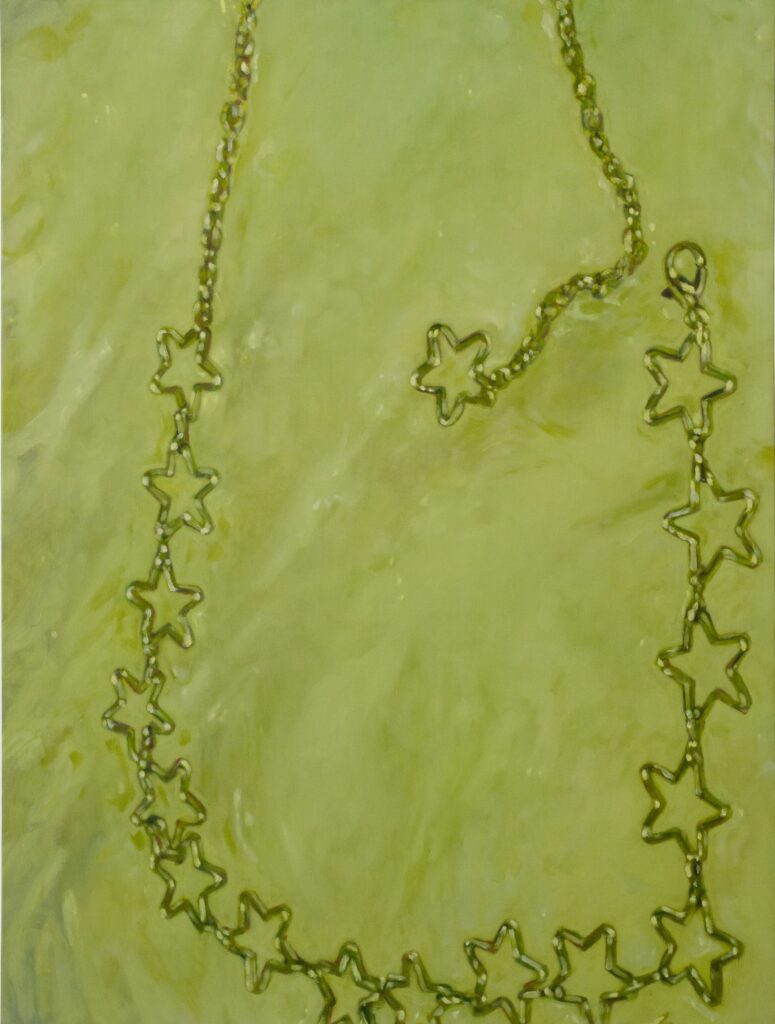
That morning on her way to work, Miriam’s hair clip broke.
It was a torrid July and Toronto had been smoky with wildfires all month. The most recent wave affected the air quality so badly that almost everyone on the subway wore a mask. Heaving metal tubes grinded beneath the earth, filled with tired glinting eyes peeking atop hospital blues. Outside, the early sun, spectral and indifferent, was a deep orange-red against a backdrop of grey.
Miriam exited Bloor Station and stepped out onto Yonge Street, holding the pieces of the broken clip in her hands. It was a simple, ordinary accessory but it had been Tatiana’s, and so she felt that, once again, something had been taken from her. The part that held the metal spring together had disintegrated completely. Silver and clawed, made of zinc alloy and plastic, now split in two. In the street, Miriam’s hair tumbled behind her ears, brushing her shoulders, fine and wispy, kissing her cheeks. The thick brume of distant fires hung in the air.
As she stepped through the rotating doors of the Reference Library and trudged her way to the fifth floor, she found herself humming a nameless song, one that Tatiana used to hum in the mornings, while the coffee brewed. The scent of freshly ground beans would stir Miriam from sleep and she would tiptoe past the door of her bedroom, peek into the kitchen, and watch Tatiana spoon sugar into her cup. Tatiana would always be staring blank-faced out the windows, into the twinkling shafts of morning light, a restless and impatient whirring in her throat. This morning, like many recent ones, the apartment had been silent.
His small talk was sorcerous, his compliments laced with a covert mendacity.
At this very moment, it would be 5:45AM in San Francisco and it was quite possible that Tatiana would be up, probably getting ready for her day or heading to the gym or groggily answering emails she hadn’t had a chance to get to the night before. Or she would still be asleep, maybe in that slouchy white Kotn t-shirt she loved to wear, or perhaps the striped navy pajama set from Uniqlo.
Miriam knew Tatiana couldn’t be sleeping in the grey, thrifted Monopoly logo tee because she had left it behind when she moved out. Miriam had found it, cowering within the couch cushions, a week to the day after Tatiana had left. It still lived there but now—Miriam knew where it was. Making her way to her work desk, she thumbed the broken clip in her pocket.
“We have lost everything!” Socrates’ voice boomed and carried itself across the open air.
Turning in her chair, Miriam watched him stomp his way up the spiral staircase and past the security guards, the rows of shelves, the study tables, the wax-coloured columns. He was a bobbing head of cropped copper brown hair above a tasteful Banana Republic chemise and smart black slacks. When he got to the desk, he smiled at her—friendly and hifalutin. He reached over and dropped a cerulean Telfar shopping bag behind the birch wood counter where it landed with a thud.
“What, are you not enjoying the apocalypse?” Miriam asked, gesturing towards the slanted ceiling windows, the ashen slate of sky.
Socrates cocked his head to the side and crossed his arms, one hand holding his cheek. His brow furrowed. Originally a theatre major who switched to Information Sciences out of a fear of unemployment, he was dramatic and worldly and queer, much like his namesake.
Miriam liked him for many reasons, one of them being that he always took over any interactions with patrons. She would sit and watch him bludgeon and impress. His small talk was sorcerous, his compliments laced with a covert mendacity. He had an excellent memory and when he wanted it to, his homosexuality appeared sexless and ludic—perfect for customer service. He possessed the kind of social dynamism that could move through all manner of contexts, all manner of odd and off-kilter and demanding and annoying library clientele. He was enough of a personality for both of them, and Miriam was happy to disappear beside him. She did the filing and the cataloguing and the tech support, and he did the talking.
Recently, out of a desire for “more drama” and to test his encyclopedic recall, he had taken to speaking to her almost entirely in quotations from dead philosophers of the interwar period. Last week, it had been Wittgenstein. This week, it was Simone Weil. When he couldn’t think of a quote that fit what he wanted to say, he would write his reply in his own words on a piece of paper and fold it up and hand it to her, defeated, serious, and soundless.
Yes, she liked Socrates for this and for other reasons, ones more shrouded, even to herself. Sometimes she would notice, in a blink, an instant, a fleeting moment, that he moved his wrists just like Tatiana. The two of them had only ever met once, years ago, and they looked nothing alike, but she had always seen glimpses of her in his mannerisms and gestures. Long, slender neck vibrating with words and quips and laughter. Delicate fingers tracing a deep, jugular notch out of habit and forgetfulness. Lithe body in willowing chemise. Wet lips iridescent with droplets of sparkling water. Tatiana’s face now. Wind blowing in a windowless room.
Miriam gently pressed on the broken clip from the outside of her pocket. A tinny ringing sound had started in her ears, but she could not tell where it was coming from. She could not tell how much time had gone by and how much there was left in the day.
On the couch in their living room, she had shown her a photo of a woman with a star for a head, topless and wearing studded silver hotpants that read ESOTERIC in bright red across the backside.
“The destruction of the past is perhaps the greatest of all crimes,” Socrates said finally, interrupting her fugue. His dark eyes bored into her. Another quirk of his interpersonal prowess was that, when he wanted to, he had an ability to see past your polite personal fences and innermost vizards, straight into you. This was the only thing about him that bothered Miriam, when she could feel him digging, piercing, trying to hollow her out, bring her to the light. She had made it a habit not to look him in the eyes for too long. She purposefully sat on the shaded side of their work desk. Blinking and glancing away, she shook her head.
“It’s a crazy world,” she said.
“The beauty of the world is the mouth of a labyrinth.” Socrates beamed, pleased with himself.
Miriam fluttered her eyes, rolled them. He blew her a kiss. She blew one back. In the tottering quiet, they both settled into their respective chairs and waited for the library to open.

By one o’clock, Socrates had shown Miriam the new Vega music video three times. A whiff of stale smoke now hung in the air, AC-resistant and wafting its way through the rows of books and study tables. She watched a patron trudge up the stairs, masked, two identical totebags over their shoulders.
The video was for Vega’s latest single, “In The Morning.” Beautiful and filmic, it was set in an industrial-looking dance studio with muddy walls and flickering lights. Vega looked svelte and graceful and sexy, covered in a skintight midnight blue patent leather outfit. Dusty pink ropes traced the outlines of her breasts, her pelvis, her elbows, her ankles. Her head, a mask in the shape of a star, sliced through the air, points jutting from the crown, sharp and knife-like.
I wake up in a cold light
I wake up in the dead of night
I’m lonely and my hands are tied
And that’s why I need you by my side
“You gotta love her schtick,” as Tatiana used to say.
It was Tatiana who had first introduced Miriam to the world of Vega. She was her favourite artist and was almost all she would listen to. On the couch in their living room, she had shown her a photo of a woman with a star for a head, topless and wearing studded silver hotpants that read ESOTERIC in bright red across the backside. When Miriam thought about that night, she thought about the way Tatiana’s eyes opened wide like saucers when she was excited. The squeeze of her hand. The delicate lines at the corner of her smile.
“Attention is the rarest and purest form of generosity,” Socrates snipped, tapping the desk beside his phone. Miriam let out an exasperated huff, but again, she looked. Vega was spinning and writhing and jeté-ing around, star points whipping through the air. The line of rope that ran along her thighs hugged her frame tightly and made her ass look incredible. It loomed on the screen, Vega’s dewy open mouth, singing, arching, reaching, closer, touching, almost. Miriam cleared her throat. A flutter in her belly. Heat on her cheeks. Quickly, she looked away.
“So cool,” she whispered back. “I love Vega.”
Socrates gave her a quizzical glance, a quick one, a squint, imperceptibly perceptive. She had seen this look before, once, when he had come over to their place for a party. Tatiana had been the one to insist that they throw the party after the new living room couch had arrived. It was bouclé and the colour of rust.
“We have to celebrate becoming real adults with real furniture!” she had exclaimed, pouring herself a glass of twelve-dollar sauvignon blanc.
Hours later, the apartment had filled with bodies, mostly Tatiana’s friends, and there was no place to sit. The couch was packed and so Miriam stood, with her back pressed against the cool wall, sipping and ennuied and getting drunk. A Vega album had been playing on repeat all night. And she had been watching Tatiana from across the room, following the slope of her shoulders in her black scoop-neck summer dress, noticing the way her hair had begun to loosen from the grip of her silver claw clip when her eyes suddenly fell on Socrates. He was leaning against the opposite wall and he had been watching her. He had given her a look, the same quick, curious squint. She watched his gaze dash over to Tatiana. She watched the two of them make eye contact. She watched a sly, clever grimace of a smile spread from his lips to hers. And in that brutal and alive moment, she knew that she had been seen and she was afraid. She had looked away, despising him. Much like now.
“What?” she hissed, shoving his phone back towards him with her elbow.
He paused, his eyes taking her in, head to toe. Then he shrugged and shook his head. He pulled a piece of paper from the stack by his monitor and began to scribble. She could hear the sloshes of ink leaving his pen, pressing and dribbling and leaking and adjudicating. There was the feeling of an animal, rabid and confined. There was the sound of the photocopier machine, echoing. The tinny sound in her ears had returned. She reached into her pocket and felt for the sharp edge of the broken clip.
Socrates slid the piece of paper across the table, his gaze opaque, his smile menacing and fruity.
Have you found a new roommate yet?
As she held the note in her hands, right then, before she could even exhale, before the mounting magmatic hatred and anguish in her body could boil over, there was the sound of heavy books crashing to the floor. Miriam and Socrates jumped in unison and they looked across the walkway, towards the noise. A disheveled man with wild eyes was toppling the heavy green volumes from the World of Interiors section. He was shirtless and bearded, streaked with sweat and dirt, wearing forest green sweatpants with yellow Onitsuka Tigers. He grunted as he tore the books from the shelves and flung them to the floor.
“No one ever wants to help me! I bet you don’t want to help me, you fuckers. All I’m asking for is some help and nobody wants to help me! Not the government! Not that cunt nurse at the hospital! Not the schools! My schoolteacher was a bitch! Did you know that? I bet you knew that! We live in a world of illusions!”
Miriam marvelled at the way his forearms glided through the air, strong and sinewy, flexing with every word, with the effort of every hardcover and glossy print hurled at the patterned orange carpet. She watched him try to topple a large black shelving unit, one of the ones bolted to the floor. By then, security had surrounded him. Three men and one woman in chunky black shoes and ill-fitting safety vests grabbed him by his arms and brought him to his knees. She watched him squirm and bleat, his face torqued in a deep mysterious pain, his eyes frantic and remote. They took him away, howling.
“They took everything from me! And now nobody wants to help me! That’s the world! Just take, take, take! Take everything, you fuckers! Erase me! Take my life! Take my life! I dare you to erase me! I dare you to take my goddamn life!”
Socrates tapped Miriam on the hand and she looked up. Eniola, their boss, was walking briskly towards them, passing by the shouting shirtless man and security guards without a second glance. Eniola was a terse, short woman with thin eyebrows and circular metal-framed glasses. She had very large breasts and wore deepcut blouses but no jewelry. She rarely smiled, even when her voice conveyed cheerfulness. Someone once told Miriam that, moons ago, Eniola had had an affair with another librarian who no longer worked there. A woman named Clotilde.
“A lot of excitement,” Eniola said placidly as she reached their work desk. Today, she was wearing a burgundy silk blouse with a straight collar that clung to her cleavage. The chains on her glasses, small black pearls swaying by the side of her head, wrapped around her diminutive, fleshy neck.
Socrates sighed and fluttered a hand in the air.
“Imaginary evil is romantic and varied. Real evil is gloomy, monotonous, barren, boring,” he said.
“Sure,” Eniola nodded distractedly. She pursed her lips, looking from the two of them to the messy wake of books and magazines scattered across the floor.
“One of you clean this up and one of you go on break, I don’t care who does what but make it quick,” she said finally, walking away. Miriam, roused by a pressing sense that she needed to get out of there immediately lest the previous conversation be continued, jumped up from her chair.
“I’m going on break!” she declared and in an impressive flourish, picked up her purse and her phone, her keycard, and her papers, and scurried towards the stairs before Socrates could object. She took them two at a time, flying downwards in a spiral of terracotta-coloured concrete steps.
Maskless, Miriam walked into the begrimed downtown haze and towards the sushi restaurant down the block. She grabbed a spot by the window and leaned into the cushions of the side booth. The new Vega song filtered through the speakers and she watched delivery drivers dash inside, scooters and mini motorcycles still running.
Baby, I don’t know which way to turn
Every day I feel the fire burning
I guess that’s why they say that love hurts
But I just wanna see you in the morning
Pulling out her phone, she scrolled—aimlessly, ruminating, circling. A headache had started brewing and she had the urge to cry but she pressed it down. A fog of unreality surrounded her and she felt that time and space had ceased to function appropriately. The tinny sound had intensified and taken on a surround sound quality: no matter which way she turned her head, she could still hear it. She didn’t know what day it was. She didn’t know how long it would take to drive from Yorkville to San Francisco. Her teeth ached. The air was thick and dirty everywhere.
She had a sad, latent quality about her—like a polaroid, sifting in developer.
An image of Tatiana lit up the screen. Her turned back, bare and taut beneath white bikini strings. A beach. Blue water and blue sky. Pale sand and sunken foot prints. A plastic glass of cool yellow in one hand. Sunglasses. Chic and nonchalant. Miriam thought she must be smirking so she zoomed in, but it was impossible to tell in this photo.
Another image of Tatiana. In a vivid green windbreaker and dark grey bike shorts. Running. A marathon of some sort. #57026. One foot in front of the other. A wrinkle between her brows. A line of sweat down the side of her face. A spotlight in a field of people.
Last year, there had been dewy wind on late summer skin and High Park at night. There had been the sound of crickets prowling through blankets of grass and the subtle but definitive perfume of thistle and Jerusalem artichokes in the air. Miriam had surreptitiously scooted closer, splayed across the same blue crocheted picnic blanket. Tatiana had laid on her back, heart open, fingers tracing her collarbone, eyes scanning the nubilous sky.
“Look, that’s you,” she had said, pointing. Miriam followed the long arrow of Tatiana’s finger and looked up. The sky was covered in night-shining clouds that appeared to glow from within, dotted with a smattering of weakly sparkling stars. And there had been one, off to the side of the moon, tucked between sheafs of growing darkness. A wavering glimmer. A flicker and falter. A dim and intermittent twinkle but a twinkle nonetheless. Miriam looked at her star and felt a pit open up within her. A deep hunger, a deeper ache. A pressing need. A desire to confess, to profess, to kneel, to pray.
“And that’s me,” Tatiana had murmured.
“I think that one’s a plane,” Miriam replied.
Tatiana said nothing and Miriam was afraid.
Sliding deeper into the booth, Miriam continued to scroll. And again, there was Tatiana. Her image, smiling and sun-kissed, on a lopsided street in San Francisco. The houses in the background were slanted, chromatic, kitsch. The caption read that she was excited to be starting her new job next week with her good friend, @lucylovett87. Lucy had left a string of yellow hearts in the comments. Posted eleven minutes ago. Tatiana had already liked the comment.
Dulled, Miriam’s gaze drifted and scuttled beyond her, flitting towards the grey light of the day. A mouthful of chewed salmon roe and soy sauce, spit up into a napkin. A double tap filled with acid. She reached into her pocket and pressed her fingers against the broken edge of the clip. The sky was an impenetrable curtain of lurid light and her headache had only intensified. The new Vega song droned on.
Like a dream, I close my eyes
See the starry sky on the horizon
Every time you stay, I’m alive
Every time you go, babe, I’m dying
Time stretched and hollowed and the rest of her shift passed by uneventfully. At first, Socrates sulked about being left to clean up the mess on his own, resorting to pained, pointed looks and an even more pained and pointed selection of quotes.
“It is an eternal obligation toward the human being not to let him suffer from hunger when one has a chance of coming to his assistance.”
“The afflicted are not listened to.”
“The ones who do the crushing feel nothing; it is the person crushed who feels what is happening.”
Miriam brushed them away playfully and complimented his slacks. Soon, as the afternoon waned, he relented.
At closing, as the two of them packed up, Socrates passed her a note, asking if she wanted to go to the show at The Baby G later that night. A local band, Paradise Lost, was playing. Miriam had seen the lead singer, Benji, at the library a few times. When he was not hitting on the 22-year-old pages, he would pick up a slim, attractive younger woman she presumed was his girlfriend. The girlfriend had long black hair, doll lips, and wore knee-high black leather boots. She would sit by the windows on the second floor leafing through thick picture books on video art, experimental photography, and Eastern European architecture. She had a sad, latent quality about her—like a polaroid, sifting in developer. Miriam didn’t understand what she saw in him. At closing, she would watch them walk out of the library and into the muddle of downtown, hand in hand, her trailing after him. Miriam realized she hadn’t seen them in a while.
“Sorry, I can’t tonight. I have to…plans, I have plans,” she murmured, looking every which way but in his direction. She could feel the questions in his eyes, heat seeking, unbelieving, looking for a way in. She stared at his nose as she waved goodbye.
On her commute home, Miriam watched absentmindedly the opening and closing of the train car doors. Inside, it was a furnace and smelled like piss and moldy tobacco. Her headache had congealed between her temples. The tinny sound harmonized with the announcer’s voice at each stop. She stood between a bald Buddhist monk in an orange robe and Yeezy slides, and a teenage girl in a cream blouse and wool skirt, dozing off and on, her long hair hiding her face, swaying to the bouncing of the train car.
It was still light outside and so she walked home.
She passed through Christie Pitts and thought about the time the power had gone out at their place and so she and Tatiana had spent a lazy afternoon playing a silly mirror game. Tatiana clapped her hands and Miriam stomped her feet. Tatiana spun in place clockwise and Miriam spun counterclockwise. Tatiana scrunched her face in mock horror and screamed and Miriam had smiled, giddy and euphoric.
She walked past the A&W on Dupont and thought about the time Tatiana’s phone had died and she had left her keys at home. Miriam had woken up in the middle of the night to the sound of banging on the front door. Moments later, they stood in the kitchen together, holding hands, giggling, whispering, close. Tatiana was drunk. She held Miriam’s fingers tight and pressed them against her lips as she spoke. Miriam guided her to her bedroom, a hand on the small of her back.
She walked around the tennis court, the streetcars, the budding crowd with their gelato cups outside Bar Ape and up her block. She thought about how sometimes, after a long day, she used to walk in on Tatiana in the living room, eyes closed, spinning around, one Vega song or another playing through the speakers beneath the projector. Her swaying hips, her swiveling torso, the slow and moony movements of her body in the gentle lustre of late afternoon light. Miriam would watch as her eyes gradually opened. She would go to her.
The sky had darkened by the time Miriam opened the door to the empty apartment and stepped inside. In the hushed silence, she felt her loneliness oozing from her—a gaussian spring, free-floating foam and fizz and haze. It circled the apartment and perched itself atop every surface, it spread its wings over everything. A brassy cacophony played in her head now. Her limbs were heavy and lethargic. Her head pounded. Her gaze drifted to a closed door, to what used to be Tatiana’s bedroom. She felt putrid and dirty. There was the sound of a car driving down the street and a song, booming as it rounded the corner.
And baby, I don’t know what else to do
You know that you’re beautiful and true
Can you see my heart, you see me yearning
I just wanna see you in the morning
Miriam floated across the living room and settled into her favourite nook on the couch. She couldn’t be sure what year it was or that the bounds of her human form had not been rearranged without her knowing. She couldn’t be sure that up was up and down was down or that her entire apartment building was not levitating into the air, buoyed by the charcoal fug. She couldn’t be sure that she still had a head or two eyes and two feet and two lungs but she was sure of a silver, broken clip, which she held in one hand.
And her phone in the other.
In the near-darkness of the living room, she scrolled. She found Vega’s seven-pointed head, her painted black eyes bobbing and weaving across her screen. Vega’s body, soft and stretchy, wrapped in pink ropes, a secret, a key, a wish upon a wandering star.
Looping. Flickering. Heat. A tightening. A squeeze. Swollen. Miriam’s hand that held the clip snaked its way down her chest, her waist, the velvet hair beneath her bellybutton. Her breath came out in ragged incantatory exhales. Vega’s face. Tatiana’s face. Spilling and multiplied. A night sky. Patent leather cleavage. Dainty fingers and decolletage. Gyrating and circling and swaying and vibrating. Looping. More heat. Sticky. Pressing. Pinching. Again. Looping. Squeezing. Wet. Gasping. Seeing. Seen. Looping. Shame. Breathing. Again. Looping. Again. Looping. Again. Looping. Looping.
With one final, extraordinary exhale, Miriam let out a soft cry. The tinny sound exploded into complete silence and a heaviness lifted itself from her entire body. Blinking and spent, she reached into the cushions and felt for Tatiana’s t-shirt as her eyes slowly regained focus. Grasping the hem of the garment as her vision snapped into place, she gasped. There, in the corner of the living room, was a shimmering spectral vision of glittering star tips. There, standing still, in the shadows of the evening, was Vega.
Miriam could not shut her eyes. She could not breathe. She could not move. She could not say a word. And she was afraid.
Debby Friday is an artist, writer and philosopher living in Toronto, Canada. Her work has been screened and exhibited at Western Front, Das Weisse Haus, Ottawa Art Gallery, MUTEK Montreal and elsewhere. She holds an MFA in Interdisciplinary Studies from Simon Fraser University. Her debut LP, GOOD LUCK, won the 2023 Polaris Music Prize. In 2026, she won her first JUNO Award. She runs the blog and podcast Diaries with Debby Friday and is working on her third LP and a super secret project.