
A Machine for Writing
Introduction by Abby Lacelle, Essays Editor:
no. 366
Start a literary magazine and commission writing from smart and talented writers—so smart and talented that it shocks you a little when they respond to your cold emails.
Solicit an excerpt from a writer who has generated a new book of “prompts, acts, divinations” that inspire writing.
Introduce the excerpt to your readership in a creative fashion which opines on the meta collaboration of writing and publishing in the first place.
___
“I’m thinking in your head,” writes Lucy Ives. Language transmits and transforms, almost uncontrollably, irrespective of psychic or bodily boundaries, so that other peoples’ language gets inside you and works you out. Reading and writing are forms of telepathy, communication across distance and time and difference.
I’ve been a fan of Ives’ for a while, and a full-on devotee since reading her essay on Barbara Johnson, from the collection An Image of My Name Enters America. Or, maybe the piece is about aesthetics and linguistics; about the nervousness of a young woman starting her university studies; about 9/11; about, as the piece is titled, “The End.” If you’ve read her work, you’ll know that Ives often starts with a mystery, moves toward demystification, and then decides to go deeper still several layers in search of something mystical. The point isn’t really to clarify, it’s just to keep going.
Ives once believed she was a machine for writing, that her sole purpose was graphomania. While it aggrieved her at times and alienated her at others, something about her devotion to writing seems to have served her too, to have provided sense-making structure. This mechanization may seem mentally distressing, yet I have to confess that I have often wished it upon myself. I want to write with such fervour that I wouldn’t mind if I never stopped, if only I could begin.
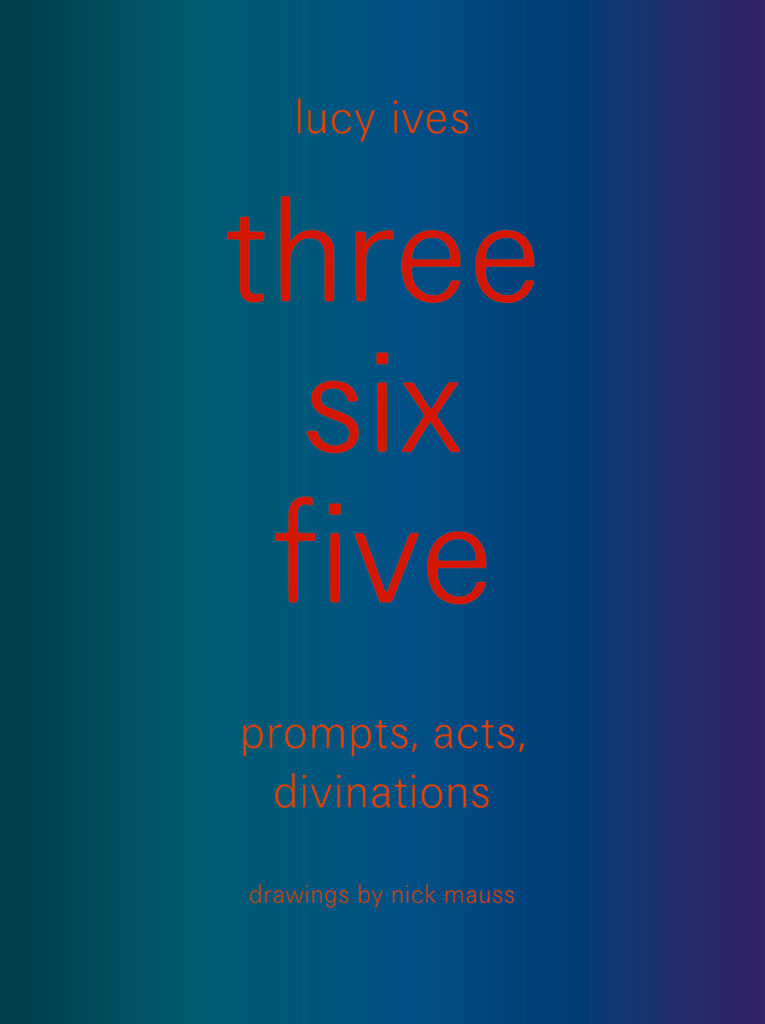
Sure enough, Ives has found a way to help me start. Her latest book, three, six, five (siglio 2026), offers 365 original prompts to spark thoughtful, fresh, and embodied writing projects. It has magenta tassels, a l’aisse inside a powdery indigo-gradient hardcover, interspersed with illustrations by Nick Mauss. Its prettiness is matched by its functionality: each page has a new entry in an “inexhaustible compendium for writing,” one of which had me recounting, over no fewer than 15 pages, the not-so-epic trek from my living room to my back patio (no further than 15 paces) as though it were epic. Repetitious focus on time (rhythm, duration) and milieu (space, social interaction) invites the reader-writer (importantly, when engaging with this book, you are always both) back to the basics: what is it, exactly? What is the ephemeral thing that one tries to distill by touching fingers to keyboard and ink to paper? What untold ways can one can manage to do it? How does it make me a unique link in a long chain?
Writing necessitates the cultivation and re-cultivation of one’s intuition, inclinations, and imagination. That’s why this is, nominally and verbally, an exercise book: the same prompts will draw out different styles and qualities in each reader, strengthening those characteristics of their craft on which they focus. In the end, this new book compels me to compel myself to write, in the way only I can. “I’m thinking in your head.” “Me too.”
Below are a few excerpted prompts from tsf. For more, join Toronto Review and Lucy Ives on October 2, 2026 for a virtual writing workshop moderated by Claire Battershill. Tickets are available here.

exercise for writing from memory
no. 72
This is an exercise for writing from memory with five instructions:
- Describe your earliest memory.
- Describe something that happened yesterday.
- Describe something that happened a week ago yesterday.
- Describe something that happened five years ago yesterday.
- Describe something you have completely forgotten.
A note about the spirit in which you may wish to respond to the five instructions: If you don’t quite recall something, that’s just fine. Stick with that feeling rather than reaching for fact. Linger with each instruction (say, for a page or more). You may discover something unexpected. If you are asking, “But how can I describe something I’ve completely forgotten?!” you are on the right track.
on the museum’s ruins
no. 111
When I was a teenager, I went to museums and galleries after school on Fridays and made pencil sketches of works of art (I had seen people do this in movies set in the 19th century). After a while, I stopped making these line drawings and started using words to reproduce paintings and other things. (Strangers commented on my early sketches, not always kindly. Words are easier to hide.)
It interested me that during these exercises I would inevitably stop writing about the work of art and start writing about something else. I became obsessed with this moment of transition.
Here are two prompts for repurposing the space of the museum.
- Museum-as-clock: Someone recently told me a story about an individual they know who goes to visit the same work of art at the same museum at the same time on the same day every week. This person has done this every week for more than a decade. Straightforward and yet somehow terrifying! I imagine this practice holds a few possibilities for writing, including writing a single episodic, diaristic, or epistolary book that will only be completed at the end of one’s life. Or maybe a year of visits would be enough. Or a month.
- Add an object to the museum.
snail’s story
no. 362
Here is an exercise for people who don’t have any time to write, as well as for people who do. It is also an exercise for people who want to experiment with writing slowly.
Make a pact with yourself that over the course of a long period—a year, five years—you will write a short story, making very small amounts of progress each day (the “each day” part is very important).
Constraint: You may not write more than twenty words of the story on any given day.
If you write twenty words per day, in one year you can write a 7,000-word story. If you write five words per day, in five years you can write a 9,000-word story.
Decide how long you would like your story to be and how long you would like to work on it, and adjust the words per day (i.e., the snail’s step) accordingly.
under erasure
no. 5
Have a question in mind. Ask about the future or something you are having difficulty understanding.
Now find a text someone is attempting to discard. You could look in the recycling bin or find a book abandoned on a stoop.
You might xerox this item, tear out a page, etc.
Use a pen or something else to cross letters and words out until new sense emerges, perhaps in response to your original question or to another question, as you continue to bear your first question in mind.
exercise for recovery of joy
no. 167
Draw up a list of mistakes, large and small, that you have made across the duration of your life. Try to write about each mistake in a careful and exhaustive way. Give them names, if you like. This may take a while. It’s OK if the mistakes start to resemble one another and you must start over, describing a single mistake, or if each mistake fragments into multiples. Gather them as best you can.
When you are done with your list, you won’t be able to go back in time. Sorry about that.
But you can save your list as a resource, write about one or more of the mistakes, give them to a character to hold for you while you do something else, bury the list, drown it, or set it on fire. You could share it with a trusted friend.
Lucy Ives is a novelist and critic. She has received a Warhol Foundation Arts Writers Grant, the Vermont Book Award in Creative Nonfiction, and a Guggenheim Fellowship in Fiction. Her work has appeared in Granta, The Paris Review, Vogue, and elsewhere. She lives in Vermont.