
Fairytales of Mothering
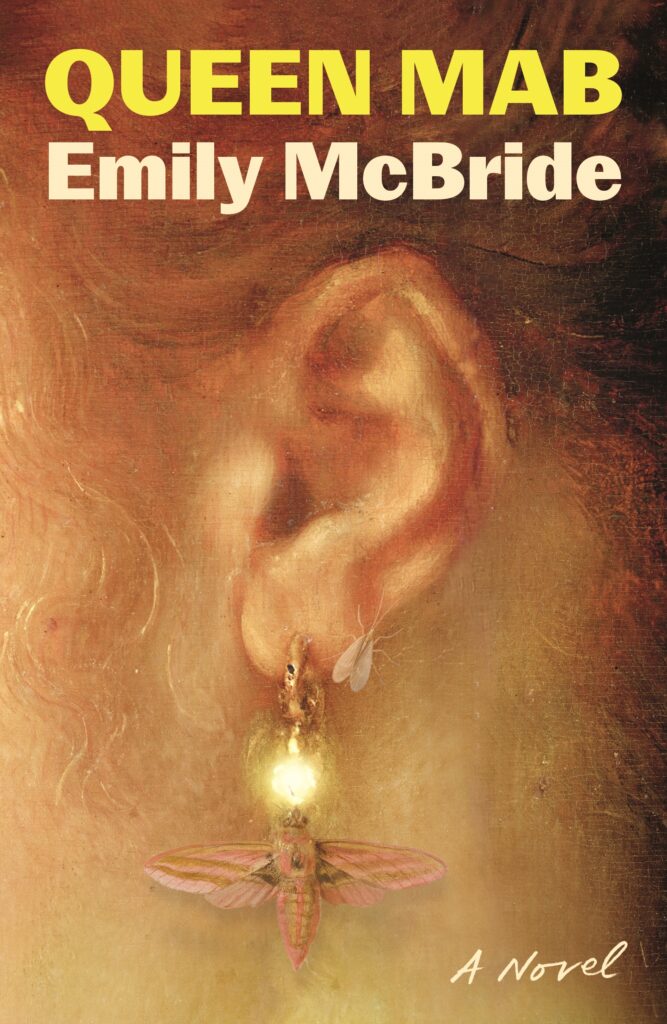
Queen Mab
By Emily McBride
Farrar Straus & Giroux, 304 pp., $39 (hardcover)
August 4, 2026
In the running for creepiest Victorian poem (and the competition, I know, is stiff) is Christina Rossetti’s “Goblin Market.” I defy anyone to read it carefully and patiently in full and not suffer peculiar dreams about “rat-faced,” “parrot-voiced,” and “snail-paced” goblins making their dystopian capitalist, “sugar-baited” refrain: “Come buy, come buy.” Poor Laura, the poem’s protagonist, is enthralled by the goblins and their alluring fruit. At first, she “stared but did not stir, / Long’d but had no money.” Eventually Laura cuts a lock of her golden hair and exchanges it for tastes of their glorious produce. She eats and eats (well, “sucks and sucks,” in the poem’s parlance). Bad things ensue, obviously: an enchanted fruit addiction with its associated deep well of unquenchable desire. Stuff also gets really weird with her sister Lizzie.
But then at the end—and this for me is the part it’s hard to let go of—the poem leaps forward to a time when Laura and Lizzie are mothers: “their mother-hearts beset with fears / Their lives bound up in tender lives.” They tell the goblin story to their children as a moral parable. This tidy ending undercuts the extreme messiness of the poem with all of its haunted fruit juices indecorously spilling everywhere, a chaos that seems to be the real story of living with a “mother-heart.” The poem is, for sure, a vivid and disturbing ride.
The same might be said of Emily McBride’s formidable debut novel, Queen Mab (Farrar Straus & Giroux), which, though named for a Percy Bysshe Shelley poem of the same title, directly invokes “Goblin Market.” It also shares one of the poem’s central themes: longing for nourishment, sensuous pleasure, and a kind of care that is elusive, otherworldly even, and not readily visited upon new mothers, “bound up” as they are in both the unpredictable rhythms of the vulnerable new babies in their care and with the market forces around them.
McBride’s frequent and detailed depictions of eating and drinking convey the ravenous, extreme physical hunger and accompanying nourishment fantasies of nursing parents.
Like “Goblin Market,” Queen Mab has a gripping, hypnotic cadence. I read it in a single, harrowing sitting. Early in the novel, McBride’s protagonist Madeline, a PhD student in English literature, feels a fluttering sensation alerting her to her pregnancy. In a characteristically delicate and imagistic moment, McBride compares the earliest moments of Madeline’s gestation to the wings of a moth. Little moth, flickering, almost but not quite yet a fully alive or real thing. It’s a perfect description—Virginia Woolf allusion and all—of the fluttery anticipation of a life to come.
Throughout the novel, McBride uses real literary quotations (and the protagonist’s analysis of them) for foreshadowing and character development. More than inert epigraphs or subtle allusions, the quotations are deeply enmeshed both in the novel’s fabric and in the protagonist’s way of thinking. Early on Madeline describes her approach to teaching “The Lady of Shalott” by Tennyson: “The Lady Elaine abandons her tower, mirror, and loom to go after Lancelot in search of love and colour; and yes, she dies, but she has still chosen life over shadow half-life.” Here, we see the first hint that Madeline’s pregnancy and eventual motherhood—“choosing life”—might potentially lead to danger and distress.
Fast forward a little from those early mothbeating wings and Madeline’s baby, who has grown through a hopeful and mostly happy pregnancy, has a lot of trouble being born. McBride renders the early stages of the devastating birth scene through richly figurative language, in part to attempt to communicate impossible pain but also to highlight the enormous gulf between Madeline’s expectation of what labour will be like and the actuality of the experience. The hours and hours of back labour (“like being eaten alive by a famished wolf that couldn’t be bothered to kill me properly”) only to arrive at the hospital and be told she is just two centimetres dilated, drive Madeline to a place where even the most intense poetic comparisons no longer suffice. “Damn the similes,” she declares, many more hours into the ordeal, “why had I thought that labour could be compared to dramatic structure or the Fibonacci sequence?”
McBride invokes here a long line of poets who convey the inadequacy of language in the face of the terrifying sublime. This failure of poetic language does not prevent the intrusion of literary quotations, and even the topic of Madeline’s PhD thesis—“machines and cyborgs and the alienation of the modern landscape”—from weaving in and out of her pain-addled consciousness throughout the birth. Madeline rather absurdly finds herself constructing academic arguments right before her baby is born, and her confusion of pain and intellect reflects the unbridled, untameable way in which the entirety of one’s own consciousness can somehow suddenly surface, unbidden, during experiences too dramatic for words.
The labour and delivery end in a traumatic emergency C-section, and Madeline is separated from the baby, Maud, as they both become gravely ill. The brush with death changes everything. At first, Madeline is enraptured by the baby. In a shift from the first person narration McBride has employed to that point, a gorgeous, Woolfian third-person vignette depicts “a mother and child in a quiet room.” Madeline falls in love, quotes Yeats to the newborn, adoring her “glimmering girl.” But then “time passed”—a direct allusion to the “Time Passes” section of To the Lighthouse —and an ellipsis in the narrative skips over an unnarratable trauma. When the child is returned to Madeline after a stay in the NICU, she seems different.
This is when Madeline becomes convinced that Maud has been stolen by evil fairies who slipped in through a hospital window (which Madeline is quick to blame herself for having left open) and replaced her with a changeling, like in a Victorian fairytale. Madeline’s belief is mediated, as her labour was, through a series of insistent literary passages that continue to dominate her thinking after the birth. She attempts to use her academic research skills, in fragments of time between feedings and in thin slices of wakefulness, to solve the problem of the stolen baby. Like the futile similes which will never, no matter how intense or how graphic, describe the pain of back labour to anyone’s satisfaction, literary research shows its limitations quite quickly when it comes to the matter of the mysterious changeling.

Any reader who has brought a baby home and been handed educational pamphlets from the hospital will likely recognize the signs of postpartum depression, anxiety, and eventually psychosis in Madeline, but this never seems to occur to her as an explanation for her difficulties. What might appear under other circumstances to be implausible magical realism is, in this context, paradoxically just straight-up realism. It is so much easier to recognize signs of distress and disconnection from reality in another person or in fiction than to see them in oneself, in the moment. Madeline is earnestly convinced of the changeling theory, so much so that she humiliatingly says it out loud to her horrified, child-free academic friends over coffee (and then attempts to pass her misstep off as an unsuccessful joke). She also airs her theory obliquely to her intimidating thesis supervisor Angela, as a literary argument about “Goblin Market”: Lizzie and Laura “go to the market and come back changed,” she insists. “That makes them changelings, doesn’t it?” Even Angela, oblivious as she generally seems to be about non-academic matters, can see that something is very wrong.
Readers (and their proxies in the novel, like Angela) know something important that Madeline does not: that she will never find the answers she seeks using the methods she has chosen. McBride shifts in and out of the first-person voice, and often relies only on direct dialogue to interrupt Madeline’s frantic stream of consciousness and reveal how she appears to others. Her play with narration is slippery and repays close attention, allowing us intimacy with Madeline, but also holding us at a level of remove. Madeline selectively uses the baby’s actual name, a poignant inconsistency that highlights her attempts to both conceal her struggles and to force an intimacy with her child that she does not actually feel. Through this narrative play, McBride marshals dramatic irony in order to intensify Madeline’s isolation: we understand both the structural conditions oppressing her—the gender politics of her highly conventional marriage, the financial constraints she faces as a Canadian international student living in England—and her medical circumstances better than she understands them herself. Her attempts to make sense of these ambient conditions through meticulous research are fruitless precisely because they are attempts at individual intellectual control over societal and structural problems that she has no power to change. With every messy, complicated thought, McBride’s unreliable narrator conveys all this tension: she individualizes and feels the pressure to personally solve problems that are far beyond her own capacity to manage.
Though Queen Mab could not be described as a campus novel, McBride offers something quite unusual in her portrayal of an academic woman’s life. More accurate than a staid image of a tweedy, privileged professor, Madeline’s wayward and searching condition reflects the new realities of academia, which can include long periods of financial precarity—often in the child-having years—and deeply uncertain futures. There are, as McBride points out, significantly fewer secure university positions than qualified applicants to hold them. The dire state of the contemporary academic job market combined with loving and making sense of the world through literature is a stressful condition that hums in the background of the whole novel, churning the air like the beating wings of impossible fairies.
Her attempts to make sense of these ambient conditions through meticulous research are fruitless precisely because they are attempts at individual intellectual control over societal and structural problems that she has no power to change.
Queen Mab’s view of motherhood is necessarily an economic one, then, foregrounding the humiliating obstacles of late capitalist city life amid increasing costs of living both within and beyond the academic realm. These economic realities have specific and well-documented effects on mothers, who are often out of the workforce (sometimes temporarily) and yet also subject to the newly intensified consumer pressures of shopping for products that make life livable not only for oneself, but for the baby too. Having turned away from the mother and baby groups that might have provided her with low-cost support (a small, in-the-moment decision, seemingly, but an enormously important plot point in the novel), Madeline spends a great deal of time grimly wandering the streets with baby Maud, attempting to use only the smallest possible amount of daily spending money while attempting to run errands. The merchant goblins—literal, in the form of shopkeepers and cafe owners, and metaphorical, in the form of, well, goblins and fairies—suffuse Madeline’s imagination (“Come buy, come buy!”). They are for sure rat-faced and terrifying, and everywhere she looks they are hawking some small luxury that she cannot afford, but for which she would trade anything in that moment.
One such thing is cake. As with the descriptions of back labour, I felt a strong stirring of recognition reading about Madeline’s preoccupation with food in this novel; McBride’s frequent and detailed depictions of eating and drinking convey the ravenous, extreme physical hunger and accompanying nourishment fantasies of nursing parents. I vividly remember that pure and seemingly unfillable hunger from when my own babies were small—“I ate and ate and ate my fill,” writes Rossetti of Laura’s fruit-lust, “yet my mouth waters still.”
Like so many starving literary heroines before her, Madeline’s hunger is literal, but it is also metaphorical: she longs for a life beyond the baby that she knows she might never have. She is also, in good literary company, the victim of idealizing and overrelying on a controlling man: Madeline’s initially charismatic but increasingly unforgivable husband Tom is frequently absent working extra hours seeking a promotion that never materializes, and remains oblivious to Madeline’s struggle. He is smitten with a baby he understands to be his own. “I don’t know why you don’t love her,” Tom says, confronting Madeline late one night in this accusatory way, stating a problem and offering no solutions. He resurfaces to complain about Madeline spending too much money on tea and cakes, or about the annoyance of having to drive out of his way to pick up her and Maud on a rainy day. Emotionally abandoned by the husband in whom she had placed all her trust, Madeline becomes increasingly unhinged, until Tom finally clues in that he should stop being annoyed that she hasn’t picked up the baby photos from the corner store and should instead start to organize some support.
Tom’s ineptitude is frustrating to read, but the novel regularly demands its readers’ discomfort: I confess that I also found myself in the unflattering position of wincing (as other characters also do) at moments when Madeline struggles to connect with Maud, and in particular when she neglects or treats her poorly. But McBride is not soliciting a judgment—what I experienced was, I think, a visceral affective response to a well-drawn portrait of someone who is not well enough to love her baby (a testament to McBride’s skill in crafting character—well, that, and my own abundant adoration for newborns, even, it turns out, when they are fictional). These kinds of distraught feelings, as McBride’s novel so thoughtfully shows, carry a weight of shame and silence that renders them as strange as the goblins, as wild and untameable as mythic creatures. Where else but in a novel can one be at once so truthful and so extremely offkilter about the particularity of early motherhood, with all its death-defying illogics and medical traumas that no one on the outside can seem to perceive through all the apparatus of strollers and breast pumps and tiny little socks? How else to talk about these experiences, which are so fragile, so private, and often so, so sad?
There is, of course, a flourishing school of writing about motherhood into which McBride’s book enters, such as Rachel Yoder’s Nightbitch (2021), or Miranda July’s The First Bad Man (2015), which contrastingly leans into some of the sensual and instinctive pleasures of bonding with a newborn (July writes: “maybe that was the point of love: not to think”), or candid memoirs by Megan O’Connell, Rachel Cusk, and many others. There’s no shortage of stories that try to spool out in words what so often remains tidied away or quieted down about the altered realities of mothering a small baby. This proliferation of novels and memoirs about caring for babies is, I think, to be celebrated in part because birth stories often don’t make sense no matter how many ways you tell them, so it seems to be reasonable to keep trying over and over again in many different voices and styles. I will devour anything that rushes headlong into the subject of birthing babies for precisely this reason: even in the best of circumstances, there’s a lot to process.
McBride’s control of novelistic form is not entirely as steady as some of her literary precursors (this is, after all, a debut). While the tangly web of literary reference, introspection, and fantasy works well formally and stylistically, certain subplots distract from the core of the book or feel implausibly coincidental. The novel truly takes flight, though, in an exquisite chapter that depicts Madeline’s breakdown as a fragmentary, dissociated interior monologue. In this chapter, the fairies are real, everything mythical is true, and there is no longer any separation for the reader between what is actually happening and the fairy world of Madeline’s episode. It is a wild, rapid, dreamlike sequence, and it is stunning.
At the beginning of the book, Madeline notes that one of the things she likes about Tom is his love of complexity (though, tellingly, this too is leaden with irony since the more complex things become for Madeline, the more Tom seems to become increasingly and problematically straightforward). This novel, too, is adamantly in favour of complexity and does not want a simple answer for anything; though the reading experience is propelled by a desire to know what happens to Madeline and Maud in the end, there is nothing neat or settled about the plot, and that is just as it should be.
Motherhood demands its own language, which is constantly being rewritten, and which will never be enough to fully articulate what has shifted when a whole new person emerges from your body.
Early parenthood requires a poetics and a mythos to even begin to be understood, and this is what McBride offers: neither an overanalyzed nor simplistically pathological story of postpartum psychosis, but a novel-length acknowledgement that early motherhood demands its own language, which is constantly being rewritten, and which will never be enough to fully articulate what has shifted when a whole new person emerges from your body.
For McBride, the closest we seem to get to an adequate literary account of these more ethereal feelings is in the work of poets who came before, including Shelley, whose excessive fairy-worlds, “radiant with million constellations, tinged / With shades of infinite color,” come close to the right level of power and hyperbole to capture some of these otherwise unnameable experiences. Even when the similes and metaphors fail to adequately convey the full complexity of life with a newborn, they continue to surface, insisting on trying and trying again to use past texts in the service of understanding the present.
Perhaps one of the most affecting central lessons of the book, then, is the notion that even proficient researchers and voracious readers cannot think or imagine their way out of their own actual life circumstances. Tennyson and Rossetti can only take us so far—sometimes, despite all of our hard human trying, the fairies take over.
At the request of the author, we have included further information with resources for new mothers and those struggling with postpartum mental health, available through the City of Toronto and Women’s College Hospital.
Claire Battershill is an Associate Professor at the University of Toronto and the Wendy M. Cecil Professor in VicOne at Victoria College. Her most recent book projects are the monograph, Women and Letterpress 1920-2020: Gendered Impressions (Cambridge University Press, 2022) and the collaborative and co-edited volume, The Edinburgh Companion Women in Publishing 1900-2020 (Edinburgh University Press, 2024).