
Ambivalence: An Interview with Brian Dillon
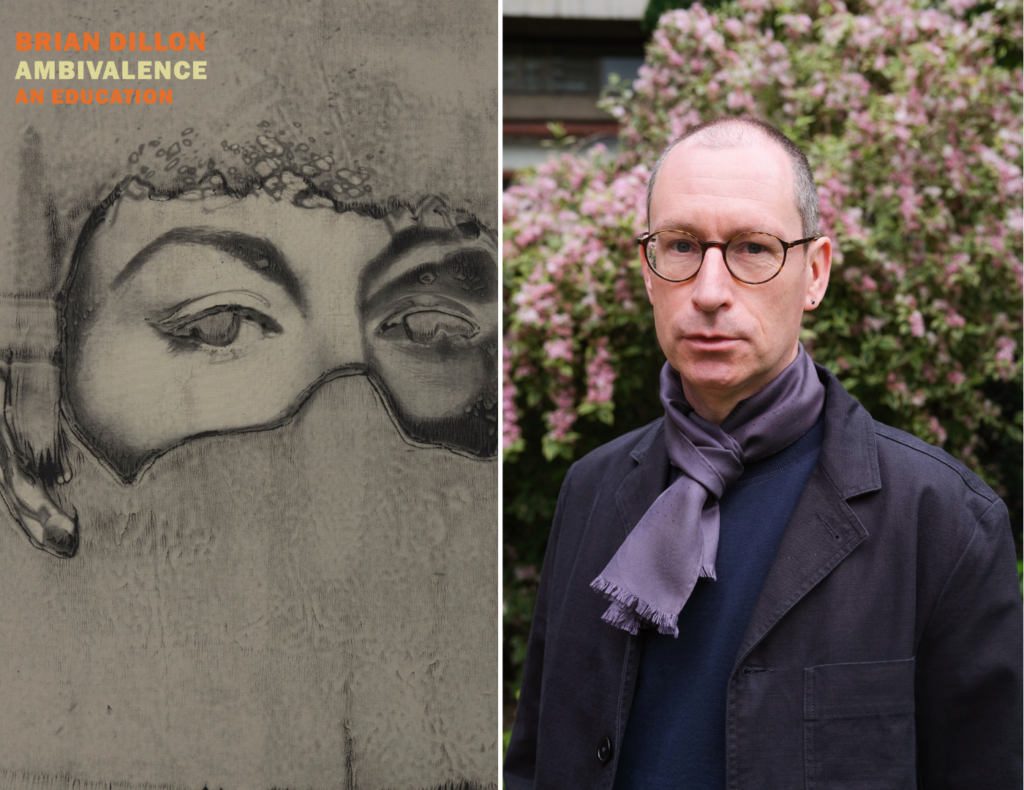
Among the many striking arguments found in Brian Dillon’s new memoir Ambivalence: An Education (NYRB, 2026), there is one that has floated on the surface of my mind over the weeks since my first reading. Recalling some early experiences of teaching tutorials during his PhD, Dillon briefly notes that the university was instructing students in how to be academics, but not how to be intellectuals. Little more is said to exfoliate the distinction, but to my mind it emerged as one of the book’s central offerings about reading, education, and knowledge more broadly.
An academic needs to know the history and tradition in which they conduct research and be conversant in the vocabulary of their specialist cohort. Though it is not a hard-and-fast binary, the life of the intellectual might instead be one motivated most importantly not by knowing but by thinking—by questioning and probing and tarrying with ideas not for the purpose of advancing facts about a subject, but for advancing the practice of thought itself. Not to master the text with a closed interpretation, but to make it come alive.
This is something like the ambivalence that titles Dillon’s new work of life-writing, an affect he describes as like “equivocation, paradox,” and androgyny, “which would render the world somehow more subtle, less sure of itself, but also irradiated with style, an affront to settled states of being.” What reading Roland Barthes or Walter Benjamin offered to him—or to his third-person narrator “B”—in his late teens and 20s was an opening to possibilities for what literature could be and who its reader might become. Through a history of his own aesthetic education, both formal and informal, in late-century Dublin, Ambivalence maps the assembly of a personal canon that stimulates the malleable, mutable, infinite project of becoming oneself, even (or perhaps especially) as “the self” is an unstable construct, not a timeless essence.
Toward the book’s middle, Dillon shares an incantatory, extended reading of Virginia Woolf’s The Waves, quoting the author’s credo “never to be yourself and always,” and delighting in the sense that the novel “does not teach but confirms that everything is also something else.” Like Dillon, The Waves is my favourite of Woolf’s novels, though while he finds himself returning to it often over many years, I have felt precious about preserving the trance of my first encounter. I remember The Waves less in terms of its plot and more through the marks made on me by its style: looping and recursive circles or parabolas of time; the swing of mood, love, and loss; the liquid quality of bodies that slosh against their limits. Reading Dillon’s account of the novel revives these impressions. When he describes it as a “book of images” that “sink from one character’s soliloquy only to resurface elsewhere… a richness of substitution, conjuring one thing out of another,” I am pulled into the dizzying vortex of reading at its most aesthetically and intellectually pleasurable. Dillon’s work here reinforces that good, lively criticism can assume the same effect as reading a novel—it twinges every imaginative faculty and reupholsters the room of the mind.
I spoke with Dillon over Zoom this summer: we discussed Ambivalence, its youthful outlook and its relationship to the critical project of his previous works, among them the unofficial trilogy of Essayism (2018), Suppose a Sentence (2020), and Affinities (2023). The transcript has rewarded re-reading: in it, I light upon language that undoes itself, ideas that dance, swerve, and flutter.

Tia Glista: In a conversation you had earlier this year at the London Review Bookshop, Olivia Laing said that this is a book “about being young.” I’m wondering what that means to you, how the search for origins is informative or interesting as a kind of critical or reflective project, and perhaps, by extension, what you hope a younger readership might find in Ambivalence?
Brian Dillon: This book popped into my head maybe five years ago or so, when I was teaching. I’ve subsequently given up my academic post for the moment, and I was, as I think we all were and remain, extremely anxious and enraged by the assaults on arts and humanities in the UK, where I live, and elsewhere, and infuriated by various attacks—economic, administrative, managerial, political, and so on—on that kind of education. I had this idea that I wanted to write a much more polemical book, and it was probably borne out of my experience seeing more than the conditions under which teachers worked, but from seeing the conditions under which my students operated and were made to work.
I quickly realized that I wasn’t really the person to write a kind of “state of the university” book. I figured that I would actually bore myself to tears if I did that, and I also thought that it was perhaps presumptuous on my part to write from the point of view of the contemporary student, to try and argue on behalf of people who were actually already doing their own arguing. I thought the best way to approach this was to try to describe what it was like for me to be inside the head of somebody aged 16 to 25, with a great deal invested—perhaps overinvested—in an idea of literature, an idea of art, of philosophy, of culture. It felt, I suppose, like the most authentic way of doing justice to what I saw students half my age and younger going through. I didn’t want to write a book that was kind of buttonholing the younger reader, but rather simply to say, here’s what it felt like to think like this at that moment.
“It’s hard to find a language for this. It’s not that hard to find a language for this.”
TG: I’ve been thinking a lot about the relationship you briefly mention between training your students to be academics as opposed to training them to be intellectuals. I have my own interpretations, but I am curious what a pedagogy that is inclined toward the intellectual life looks like for you, especially since leaving the academy?
BD: I was educated about a particular moment in Ireland, in a specific institution: University College Dublin. The English department at the end of the 80s was kind of fighting its theory wars later than might have happened elsewhere in North America or in the UK. And that meant, I think, that it was impressed upon us by certain teachers—not by all of them—that what was happening in the classroom or in the lecture hall somehow mattered more outside of the institution even than it did inside. We were being taught to think about literature, to think about culture, in ways that attached to politics and to a wider sense of the world. We were also, I think, being taught to be generalists, and, in retrospect, I now realize that most of my best teachers were people who could teach anything within the discipline, and did.
When I got to start a PhD, the whole discipline of literary studies was moving, or perhaps returning, to something much more locked down into specialisms that were very strictly historical; this isn’t to disparage scholars working with that degree of precision in the slightest, but that wasn’t what some of us had signed up for. There was a much broader sense of what was at stake in the discipline, and what was at stake in the discipline was what was out in the world. In the book, this has to do most obviously with my interest in postmodernism and poststructuralism as a student, but much more practically, it had to do with the place of feminism in the ways we studied and what we studied, and the beginnings of postcolonial studies as a presence in the Irish context.
It also has to do with the kind of writing that was made to seem possible by that kind of education. And for me, the excitement of that was the notion that you could produce a kind of writing that would do something in the world. At the most extreme, you know, I think I believed—maybe I still believe—that the kind of theoretical writing or criticism that I was interested in would somehow poetically, in a way, in itself change the world.
TG: Yes, and to that end, B has a very assured belief in style, its importance, its potentials. I’m wondering how this belief has lived on for you or how it may have come to inform your criticism. Do you think that all critics are motivated by a belief or faith in style? Or, what particular kind of critical lens or aptitude does this affinity produce?
BD: It’s easy, I think, to fetishize style. Susan Sontag says the problem with thinking about style is that you automatically start thinking about stylization. You automatically want to think about it, despite yourself, as a kind of polish or pose, or you think about style as a kind of achievement. Whereas, I think the thing that was really exciting to me as a student in the critics I was reading—certainly in people like Barthes and Derrida and so on—was the complete explosion of that. A disintegration of that kind of polish and mastery, and so I suppose that, as a critic, I want something to be happening at the level of language that is undoing itself.
It’s hard to find a language for this. It’s not that hard to find a language for this.
It’s partly what I’ve been writing about for years, but somehow, right now, I think of it in terms of a kind of texture, a sort of friable, brittle kind of texture-ality, if that’s a word. As is obvious in the book, because there’s a whole chapter given over to it, I was almost secretly obsessed with Woolf’s The Waves, and I suppose I do still have this sense that what I want from from fiction, for example, is for something bewildering or disintegrating, but also somehow in control of itself, to be happening at the level of language.
That’s a kind of phase that is at an end in some way. The thing I’m writing now is stylistically utterly different. So that’s a surprise for me.
TG: I wonder if this tug of disintegration has something to do, at least in part, with what is happening with the pronouns of this book—it’s not a first-person memoir, but a third-person perspective and sometimes second-person address. Of course I want to hear about why you made these choices, but I’m also interested in what kind of work you think they do; I’m reminded, for instance, of Woolf’s interrogation in A Room of One’s Own of the capital “I” and the grandiose sovereignty or authority associated with a certain kind of first-person that she charges with being patriarchal and imperial. So I wonder what the stakes of different kinds of narration of the self might be?
BG: I did try writing this in the first-person to begin with. I wrote an essay about teaching in the first-person, and at some point I realized that if I carried on like this for the whole book, I was in danger of writing one of those books—and maybe this is unfair—one of those books in which the middle-aged, usually male, author recounts ruefully his own youthful pretensions, ambitions, and embarrassments, and so on. And I felt it a little bit as if the book would then either become absurdly pompous or it would need to be comic. You know, that the first-person would need somehow to undercut itself. I would be looking back and far too tempted to judge this person that I have been.
I started writing it in the third-person, and immediately kind of felt, at least for me, that I was able to avoid that sense of a slightly simpering knowingness about one’s younger self. I wanted to take this person who [I name] B as seriously as he takes himself. If the reader finds him ridiculous at times, then that’s fine.
And once I’d done that, I thought of other examples where people have given up on the memoiristic or autobiographical “I,” the most obvious example being Annie Ernaux. I’m not claiming any aspiration to be Annie Ernaux, but I was encouraged by the fact that there are precedents for doing that. There is strictly speaking no reason why the first-person should be thought of as more intimate than the third—for example, sometimes a student will say to me, “I’ve written this in the first-person because I want it to feel more personal or intimate.” That’s not the case—we can think of countless examples of omniscient third-person narrating that get us extremely, intimately, deliciously close to the mind or body of a character.
TG: For me, the third-person also allowed for a potentially more expansive or elastic sense of subjectivity, a sort of porousness as opposed to claiming a coherent “I” outright. This seems like one of the big tensions in the book—the desire to consolidate a self that is felt by so many young people, especially the young aesthete or creative or intellectual, but also the freedom of exploration, of not deciding, not having to be one thing. The matter of how to be a person meets here the matter also of how to be a writer, and I’m wondering if you could speak about how those things are—or are not—coincident for you?
BD: The book is partly about somebody attempting to imagine in advance and therefore also kind of control a version of themselves. It’s not just a simple question of aspiration—you know, wanting to be a writer, a critic, an academic, an intellectual. It’s also an act of imagination, possibly more imagination than it is ambition. I don’t trust anybody who doesn’t feel this kind of vast debilitating anxiety about one’s actual ability to become that thing. So there is this act of imagination on B’s part: at one point in the book it says that he’s always imagining what he will be like in six months’ time, right? You know, what will he have read? How will he dress? What cigarettes will he be smoking? Which cafés will he be sitting in with which books? That’s very much a controlled imagining of what you could be as a person. He wants to make a milieu for himself. He wants some version of love.
And then, on the other hand, the book is also about an absolute openness and freedom that he imagines through these things, and especially through what he’s reading, because through what he’s reading, he imagines. As a late adolescent, he’s not open to the world, but he has this glimpse of it in writing, and that’s the other side of his ambition. He wants to fix who he will be, and, at the same time, in doing that, he somehow wants to absolutely open himself to all possibility.
I think the interesting thing about that point in one’s life—certainly in my life—was that the writing you really want to be doing, the writing that you can’t yet imagine but you know you need to do… you’re not doing it. You can’t do it because you’re 21, or something. It’s impossible, and the impossibility is both incredibly frustrating, and it’s also what allows you to imagine the thing that’s to come.
You’re trying to set in place the conditions in which this writer can come into being. In one way, that’s what the bildungsroman does: it narrates the process by which you can become the artist that you were always supposed to be. And so I think the absence of writing, or the failure of writing, is the really interesting thing in that period and in that person. That in itself is doing something.
“It’s possible to be a really, really close reader and still get everything wrong. I don’t think that closeness, slowness, or even detail, or attentiveness, or concentration—that the things we now fetishise against the world of distraction and so on—are values in themselves.”
TG: This makes me think about the importance not just of writing in Ambivalence, but also the not-writing that is reading. The attention to detail in your treatment of The Waves, or to short snippets of text in previous books like Suppose a Sentence, offers something that can feel strangely absent in a lot of contemporary criticism which can be more of a gloss or somehow at-a-distance from its object.
First, can you tell me about the mechanics of this practice for you? What are you looking for and how do you assemble it? But, more importantly, I’d like to know what you think the uses of close-reading—if that’s a term to which you subscribe—are: what does this deep and slow attention to particularity offer to the reader of criticism?
BD: I feel very conflicted and indeed ambivalent these days on this subject, and it was interesting going back to thinking about this period where, to some degree, I was trained in a kind of close reading. It was at a time, however, when I would certainly have been very dismissive of the idea that the job of the critic is to attend in this precise and admiring fashion to the details of the literary object. That didn’t seem enough, and it seemed to imply all kinds of blindnesses about the production of texts and the reception of texts and the place of the critic who’s doing that reading in the first place.
I think that there is a tendency to imagine that a return to close reading will somehow save us from what people think of as the great aesthetic and political impasse of the post-theoretical decades, and I think that among some proponents of a return to close reading, there is a hankering for a pre-theoretical world and a dismissal of the more obviously political movements of the last 30 or more years. What does it leave us with then, except a kind of empty aestheticism?
Although my training is in literature and in that kind of close attention, I no longer really know how to answer the question, as you put it: what’s the process? Where do I start? With a book like Suppose a Sentence, I thought of it more in the way that I would think about it as an art critic, what it feels like and what the challenges are in writing about a single object or a single image. What that means is that the place that I would start with each of those readings was in a way arbitrary: it might be a turn of phrase, it might be an item in the sentence’s punctuation. It might be a real or imaginary context for that sentence. It might be just a question of tone. It might be a single word and what that word means.
In other words, I think that what I have practiced is a fairly unmethodical version of close reading, and, to me, that has more to do with a challenge and experiment about where that might take me than it has to do with a kind of programmatic sense that close reading is the good reading.
I also think, to put it in the most crude terms, it’s possible to be a really, really close reader and still get everything wrong. I don’t think that closeness, slowness, or even detail, or attentiveness, or concentration—that the things we now fetishise against the world of distraction and so on—are values in themselves. I think what I’ve been doing is something different, and it’s a lot less clear to me what it is, to be honest.
Tia Glista is a writer, critic, and PhD candidate in Toronto. She researches the feminist politics of bodily movement in 20th-century American literature, film, and art. Her criticism and interviews have appeared in The Guardian, the Toronto Star, Literary Hub, LA Review of Books, and elsewhere. She is co-editor of the Reviews section and a founding editor of Toronto Review.