
Watchlist
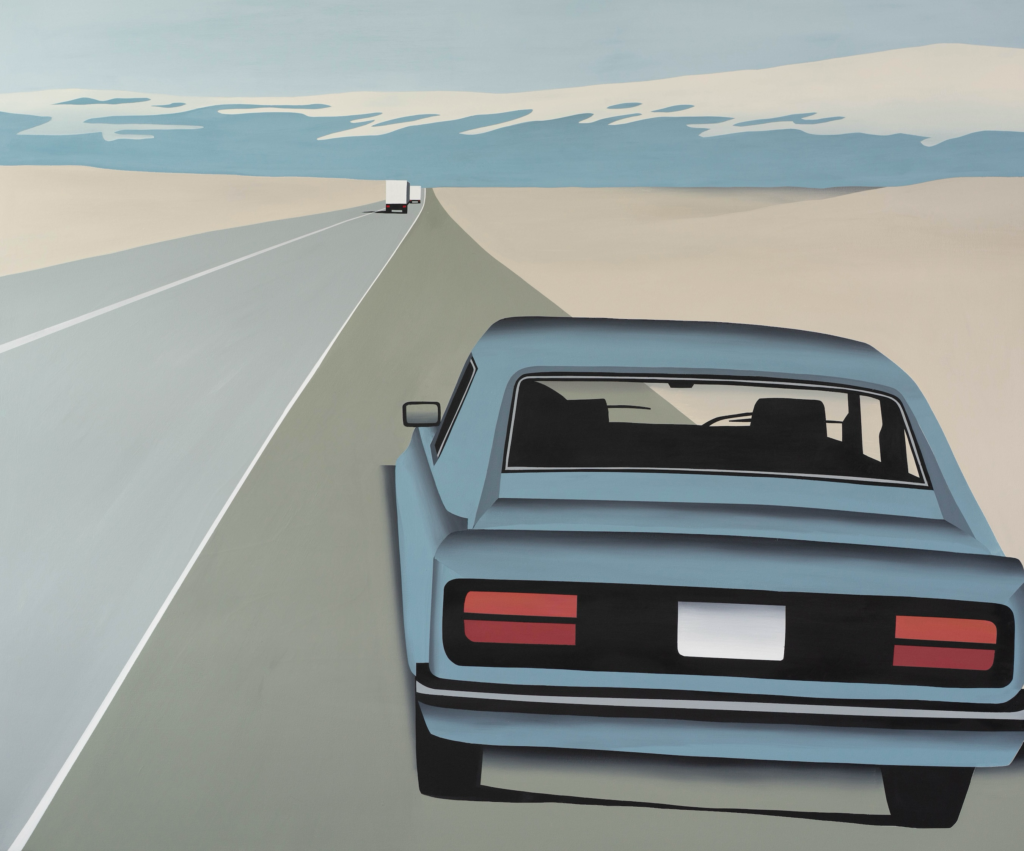
The aux cord remained coiled in the cupholder; no one wanted to ruin a good song by playing it now. In the silence, the low buzz of the passenger-side mirror was conspicuous as it panned away from the car. Madeleine watched as her elbow was replaced in the reflected image by Garth’s head, dangling out the window behind her like a traitor on the block. Madeleine turned to look at Chuck just in time to see his left hand skip from the mirror controls back to the wheel. He didn’t look back at her but she could tell he saw her shrug, like: Yes, thank you, I see him, only she wasn’t sure what she was meant to do about it. Did Chuck think Garth was going to throw himself from the car? Madeleine was pretty sure he was unconscious; he’d taken enough pulls from his sleek little CBD pen at the gas station in Springfield that he kept exhaling vapour even after he’d slotted it behind his ear and reentered the car.
They were moving fast, the absence of their usual thousand pounds of equipment from the trunk granting them the uncanny velocity of the first strides off a treadmill. Looking at the digital clock on the dash, Madeleine noted that they should have been starting soundcheck by now, then amended the thought to would have been starting soundcheck, then wished she hadn’t shrugged at Chuck. From the backseat, Lydia leaned forward and tapped her phone on Madeleine’s shoulder. Madeleine took it in one hand and pinched her bottom lip with the other as she processed what was on the screen: a post from the headliner’s manager-run social media account announcing tonight’s change in opener. Oh, what? Madeleine said. I know, Lydia said, retrieving her phone. Bit of a swerve. Madeleine looked out the window at the mirror again, watched the woods smear green behind Garth’s head. She spent a good while comparing herself physically to the lead singer of the new act, wondering if she was as tall as she appeared in photos or if the long cloaks she wore on stage created this illusion of height. Twenty miles later, as Madeleine was estimating how long it would take for her hair to reach the small of her back, someone took a needle to the cloud cover; the rain seemed less to fall from the sky than erupt out of the hidden pores in the windshield itself, fat droplets popping on the glass. Madeleine twisted in her seat, looked back at Lydia, and nodded towards Garth, whose face was already shiny. Lydia leaned over and placed the back of her hand against his neck, sweetly, then grabbed him by the collar, pulled him back into the car.
Everything was very still but for the slow sway of Garth and his mother, her hands smoothing his sleep-scuffed hair, and the dog’s wagging tail.
The houses on Garth’s street reminded Madeleine of a crop of turnips growing in a row, squat and beige and uniform. His mother was at the door before their feet landed on the driveway, arms in the air like they were a plane passing her deserted beach, frantically drawing their attention to her sign made of stones. She began to weep the very instant she put her hands on her son, first on his wrists and then climbing up his limp arms to his neck, his cheeks. Chuck squinted up at the sky while Lydia dragged a finger across her eyebrow again and again, something she’d learned from the internet about quelling anxious thoughts. Garth’s father knelt in the open door, restraining a golden retriever. Everything was very still but for the slow sway of Garth and his mother, her hands smoothing his sleep-scuffed hair, and the dog’s wagging tail.
Madeleine and Chuck sat on the back porch and shucked corn while Lydia lay on the lawn, spooning the dog. The sky looked grey and swollen. Inside the house, Garth and his parents were in the living room, pressing gently at the silence like gloved hands working to form a perfect sphere of snow. Occasionally voices would rise, usually his mother’s, usually speaking something to the effect of: I didn’t know! I didn’t know that! Madeleine lifted a fine blonde fibre from her lap and asked: What do you call these? Chuck Googled it. Corn silk, he said. The dog began to pant and Lydia soothed him with a hand along his pale stomach. My beautiful boy, she said. My corny, silky boy.
Garth came in from his walk to find Madeleine and Lydia in the kitchen wearing floral aprons. He said: This is just like my sex dreams! Lydia had him try bolognese sauce from her wooden spoon and Madeleine said: Wine, daddy? He took their photo with his phone. Madeleine was posed suggestively with the wine bottle when Garth’s mother walked in, asking what smelled so good. Lydia asked if she could set a table but Maureen said they would just eat there, so they did, standing around the kitchen island and discussing sleeping arrangements. Jim offered to put them up for the night in a motel, but Chuck suggested the tent the label had provided for the festival outside of Portland. Maureen protested, said they had the pullout and Darcy’s–
No one wants to sleep in Darcy’s room, Mom, Garth said.
In the end it was decided that Madeleine and Lydia would share the living room pullout while Chuck used the tent, which he and Garth went out to the backyard to set up. Jim refused anyone’s help with dishes, said they must be exhausted from their long drive, that they surely wanted to hit the hay, though it was not yet eight o’clock. Madeleine and Lydia made up the pullout, which squealed like an animal being restrained for some veterinary operation. Over the sink, Jim worked at the charred bottom of a ceramic pot with steel wool. Madeleine had been anxious about making conversation, worried she wouldn’t know with what to fill the quiet, but it quickly became apparent that the silence was a unanimous decision, a way to spare each other. Still, she had yet to tell anyone she was sorry.
In the basement, Chuck taught them a card game he’d learned from a lighting technician in San Francisco, which they played until midnight, blurred in vape smoke and lilac air freshener. Lydia asked Garth if they could see his teenage bedroom and Garth nodded, got up from the carpet. Garth’s L.A. apartment’s sole furnishings were a mattress on the floor, an acoustic guitar propped against the wall, dried eucalyptus hanging upside down from a hook and the wooden coffee table that he used as a desk, cross-legged on the hardwood; his bedroom in Columbus had the visual cohesion of a ransom note. Madeleine and Lydia sat on his bed while Garth slumped into the rolling desk chair and Chuck leaned in the doorframe. A gaming computer hummed, emitting a low orange glow. The boys talked for a bit about technical specifications, gameplay and graphics chips, a conversation which became increasingly nostalgic in tone, while Madeleine looked at her social media feed with her phone close to her chest and read the comments under the post by the headliner. Someone had asked if anyone knew why the band had pulled out of the tour, and someone else replied: Garth’s sister died on Thursday :(((((. The original commenter asked how they knew this and they explained: I’m from their hometown, our moms are friends on Facebook. The ensuing comments were scattered with gentle emojis and heartfelt condolences, some question marks. Then the thoughts—not prayers, as per their demographic—disappeared, replaced by the headliner’s name and a photo of him wearing the shuttered sunglasses she’d bought him in a novelty shop in Salt Lake. Madeleine slid from the bed, stepped out into the hall and swiped to answer. Hi, she said. The headliner asked how Garth was doing—How’s Gartholomew?—and she replied by sighing, to which he said: Yeah, yeah. I know. I’m so sorry. As they spoke, she made her way quietly up the stairs and out into the backyard, sliding the door shut behind her and walking onto the lawn, the grass cold on her bare feet. He reminded her that the team had sent along some options for the next few shows, then how he was hoping they could join them in Nashville, what a shame it would be if they couldn’t play Nashville. She started losing feeling in the soles of her feet, so she unzipped the tent and lay down on Chuck’s sleeping mat, put her hand up under her shirt and held her stomach. We just need to talk to Garth, she said. He said of course, to take their time, and, again, how sorry he was. There was a pause, and then he said he missed her.
Madeleine couldn’t recall the exact events that had gotten her to this place, but did recall at one time being desperate to get here, having heard the headliner’s voice for so many years before he knew hers, this same voice that was now telling her that he missed her, the same voice that had, only two nights ago, shuddered expletives into her neck. And so she reciprocated out of instinct, saying: Yeah, I miss you too, knowing all the while it was a lie. But why was it a lie? Nothing had transpired within their relationship to make it so—nothing had transpired between them at all since Garth stepped offstage last night to all the missed calls. She sensed that, had the headliner said this yesterday, it might have been received as the natural escalation that it was—but then he never would have said it, had they not had to leave the tour and bring Garth home.
He told me that watching me onstage was like watching a glass of water spill in slow-motion.
The headliner was quiet—perhaps having these same thoughts. She heard the porch door open and told him she’d get back to the team soon about Nashville. He said: Sleep well, and she ended the call. Chuck appeared in the opening to the tent, carrying his toiletries in a cloudy ziplock bag. She made room for him and he crawled in, removing his ballcap and rubbing at the red line it left on his forehead. Garth wants us to rejoin the tour tomorrow, he said. Madeleine smoothed her shirt back down over her stomach, then asked if he wanted to split a cigarette. He said he had already brushed his teeth, but she could still have one.
I only want half.
Then only smoke half.
She put both hands over her face and started crying. I know, he said, and he did.
Garth was building a Sim at the computer, her face smooth, eyes bright, bobbing contentedly as he selected swimwear for her. She had red hair and green skin. Is that the shape-shifting one? Madeleine asked.
Mystique’s blue, Garth said.
I thought she could shape-shift.
He pressed the button on the desktop and extinguished the screen, then swivelled in his chair to face her. Madeleine sat on the bed and tucked her hair behind her ears, asked if it would feel nice or if it wasn’t a good idea.
She found the headliner’s bulk alienating in bed, unable to feel his organs sliding around beneath his armoured torso like she could with Garth. When she had Garth horizontal, on a plush surface, she could watch his architecture transform, relax, his body a lit candle. Atop him, she stacked her hands and pushed down into his sternum like he required resuscitation, like it was her keeping him alive. After a while they stopped and lay with the patch of damp bedsheet between them, Madeleine sliding strands of Garth’s hair around his shiny forehead while he kept his eyes closed, breathing slowly.
We haven’t been alone yet, she said. He nodded, then was silent for a while. Madeleine knew she should get up to pee but had a suspicion he would speak soon and felt that she could not remove her eyes from this moment without losing it. After a few minutes he said: I don’t want to do anything, because anything I do I’m doing in the timeline where she’s dead, and all the things that happen from now on are only happening because she died. Like this, just now, that was so nice–thank you–but it wouldn’t have happened if we hadn’t come here, or if you didn’t have a reason to feel sorry for me. So everything, even the nice things, they feel cursed.
Madeleine said nothing. She was thinking of his apartment in California, of the warm breeze that poured through the window, wishing for it now to dry the sweat on her back. They’d lived there together for a year, years ago, watching each other eat breakfast, napping in the middle of the day, writing the album at night after shifts at the yoga studio, the occult bookshop, the place that repaired phones and sold vape cartridges, the specialty grocer’s. Darcy visited, once; Garth had wanted to introduce her to their friend Wallace, who was further along in the process Darcy was just then beginning, who Garth had thought might be able to help. Madeleine knew that Garth was thinking things would be different, had he not done that. She wanted to pull at that thought in one strong motion so its roots came with it, but it wasn’t untrue: things would, realistically, be different. Madeleine remembered the four of them in that apartment, the warm breeze, Wallace playing the melodica while Darcy strummed at the eucalyptus on the wall like it too could make sound. Dragon scales, she’d said. No one had told Wallace yet. No one had his number anymore.
Turning to face her now, Garth asked about the headliner, the first time they’d addressed it, and Madeleine said she wasn’t sure what was going on there, or even why. Then she said: He told me that watching me onstage was like watching a glass of water spill in slow-motion. Garth made a face. I know, she said, and they laughed. Eventually Garth confessed he didn’t think he could sleep with her next to him, so she went upstairs. Lydia curled around her on the pullout, the springs squeaking so they both dreamt of mice, scientists, snow.
In the morning they walked around the neighbourhood with open mugs of coffee and decided they would rejoin the tour. Garth, twisting the chain of a playground swing, dragging his feet through damp woodchips, said he’d meet them later, he couldn’t leave just yet, and Chuck promptly phoned his old drummer Martin who lived in Nashville and now did something with software. He’s a titan, though, Chuck assured them on the road. Madeleine wanted to see how long she could go without speaking, until Lydia said: Last night felt like community theatre, and Madeleine told her, voice flat, to shut the fuck up. Chuck said: Hey, come on. The yell gurgled up from the drain before it had words, let alone thought, attached to it, so she ended up screaming: I’m so fucking hungry! then apologised to Lydia properly outside the McDonald’s in Jamestown. Lydia also apologised, and hugged her for a length of time Madeleine found embarrassing. A man eating a Junior Chicken watched them through the window, shredded lettuce jutting from the corner of his mouth.
In the green room Martin, the substitute drummer, asked them each in turn whether or not he should shave his beard. What’s the vision? he kept asking, and eventually Lydia silenced him with a: Dude. The headliner poked his head in to say hello and how happy he was that they were back. Madeleine’s face was half-buried in the nozzle of her steamer so she only raised her eyebrows at him in acknowledgment. She couldn’t picture sleeping with him again, just like she couldn’t picture standing onstage and singing to the inky mass beyond the footlights—but sing she did, to an audience enthusiastic with sympathy, for now the news had spread. At home, Garth ate microwaved bolognese in bed and looked at his phone. A few people had uploaded the same moment, videos taken not from the floor but from the stalls, the gallery. He watched the one filmed from the furthest away, Madeleine’s body on that big black stage like a babytooth, backing away from the microphone, from the thousands of mouths screaming Darcy’s name, screaming it at her. He left his phone on his pillow and went upstairs, slipped quietly out the back door. He lay down in the square of grass flattened by Chuck’s tent. The dog found him in the morning, blue-lipped and still.
Four years from then, they speak about Darcy on a balcony, somewhere in the South of France. Madeleine is on a short break from her European tour, visiting Garth and his partner Sara at Sara’s family home. The sunrises seem to last forever but the sunsets go quickly, and soon it is dark and Sara is lighting the citronella candles while Chuck plucks at a guitar, melodies that spill into each other and never repeat. Charred skewers are scattered on the table before them, the pale blood of tomatoes pooling at the edges of their plates. Madeleine asks about his parents and Garth tells her that Maureen has finally convinced Jim to get a new dog, another golden, named Yodel. And it’s funny, he says, it made me notice something. My dad, he’s never been a really affectionate guy, not super warm, but he did have this goofy side with Darcy. At the mention of her name, Chuck draws his phrase to an organic close. Garth sips his ginger ale then carries on: And I didn’t realise that when she died, that part of him had nowhere to go, so I never saw it again. But you should see him with Yodel, man, it’s hilarious. He loves that thing so much. Sara stretches her arm along the back of the couch but doesn’t touch him. Madeleine feels that familiar torsion, the slither of envy, but she ascribes it to Sara’s comfort, her ability to stare into the bulb without squinting. Chuck, too, putting the guitar down and leaning forward, elbows on his knees, employing the listening skills he talks about so often. But then, neither of them had known Darcy, so for them it is easier.
For a brief moment they watch the silence seize in the air before them, and then Chuck asks: Is there something she brought out in you? A muscle you don’t get to use with anyone else? Garth lifts his chin to show he is thinking about this, yet another curious affect Madeleine hadn’t recognised at first. She feels affronted sometimes, when he assumes his performance works on her, but she forgives him anything, indebted somehow by his continuing existence. She would do sick things, sexual things, acts of unspeakable degradation, if they were certain to keep him alive. Sometimes she wishes he would let her, just so there would be some contract in place, some mutual oath instead of this long-distance trust exercise. Madeleine likes Sara, but she wants to know the extent of her willing, what she is prepared to do. Sara, self-possessed and European, using the terms accountability and holistic to describe her legal job, taking a photo of her breakfast bowl; Sara’s body would not know how to prostrate itself. And Garth, with the healthy new skin and little gold hoop in his ear, knowing Madeleine would give everything away and asking for none of it, as if she had nothing to give him, as if she never had.
Yeah, Garth says, but if I’m honest, it’s not really nice stuff, like what I mean with my dad. Darcy and I would fight a lot, no one made me angry like her. And no one has, since. So that anger I had with her, it’s gone too.
Sara makes a humming sound of agreement, like she would know, and Madeleine says: What, you’re not still angry with her? The quality of her own voice informs her that, at some point in her silence, she has slid from buzzed to drunk. They all look at her, and Madeleine forces her face into something bright and inquisitive and sober, while Garth’s opens to her like a sympathy card. He tilts his head and says: Are you angry, Mads? Madeleine’s face shatters into a laugh, a spiked thing, and she says: Asked you first!
And Garth, with the healthy new skin and little gold hoop in his ear, knowing Madeleine would give everything away and asking for none of it, as if she had nothing to give him, as if she never had.
They leave early the next morning to catch their flight to Munich. In the driveway she tells Garth not to get any more tattoos, that he is beginning to look like a barista, and he laughs but she can tell he doesn’t really get the joke. Sara hugs her, tells her to come back soon, tells her to promise. In the rearview mirror Madeleine watches them walk back to the house, Sara landing her hand on the small of Garth’s back.
Chuck knows standard and so he drives while Madeleine stares out the sunroof, the tint rendering the punched hole of the sun powerless against her corneas. They are having an argument that began with her apologising for making last night weird, to which he said: That’s alright.
So you think I made it weird?
Later he tells her: You insist on carrying things for people, even after they’ve dropped it.
‘Dropped it’? she spits.
You’re focusing on my words so that you can ignore what I’m saying.
That doesn’t make sense. I’m not being annoying, that literally doesn’t make sense.
It’s the following November when Garth calls her from a hospital in Des Moines, January by the time she is able to visit him at a facility in Montreal. At the airport electronics store she buys a Nintendo Switch and a few games, then opens it on the plane and plays until landing so it doesn’t seem new.
Montreal winter changes her prescription; the air is so cold and crisp that everything is in perfect focus and she can appreciate all the architectural detail of the buildings around her in the old quarter, where she sits, drinks a decaf cappuccino, and listens to Chuck’s voicemails again. Visiting hours end soon, so finally she stands and brushes small crystals of brown sugar from her lap. The facility is halfway up a steep, icy hill. She tries, as she climbs, to remember the name of the ice planet in Star Wars, Googles it while the nurse at the desk prepares her visitor credentials. She enters Garth’s room pulling at her collar and saying: Damn, it’s Hoth out there! but Garth is asleep on the bed and doesn’t stir. Madeleine slings her coat on the back of a padded blue chair then sits, pries her feet from her boots and forms herself into a compact parcel of limb, looks out the window. The facility faces a church, or a synagogue, where scrums of pigeons vie for space in the various alcoves and on the ledge below a great round window in a pattern like a flower, or maybe a star. The sun’s reflection in the glass is distorted so it looks like a coin at the bottom of a fountain. She pulls the Nintendo out of her bag and plays some more; it really is addictive. Every once in a while she turns the volume up by a degree so that Garth will wake to the sounds of her small alien avatar inhaling stars whole, but he never does, and soon the sun has set, her thumbs are sore, and visiting hours are over. She waits past the hour, sitting very still in the dark room with no company but his slow breath, waiting for a nurse, a doctor, anyone to come and tell her to go.
Thom Nyhuus is an actor and writer living in Toronto. He has worked as a bookseller at BookBar in London, UK, and at Flying Books in Toronto. His first play, Cannibal, sold out at the 2019 Next Stage Festival, and his new play, Boy Friends, is in development at the Vault Creation Lab. His short story “Cuck Chair” will be published in Dive Bar’s second issue in Autumn 2026.