
Indigiqueer. Reparative. Writing.
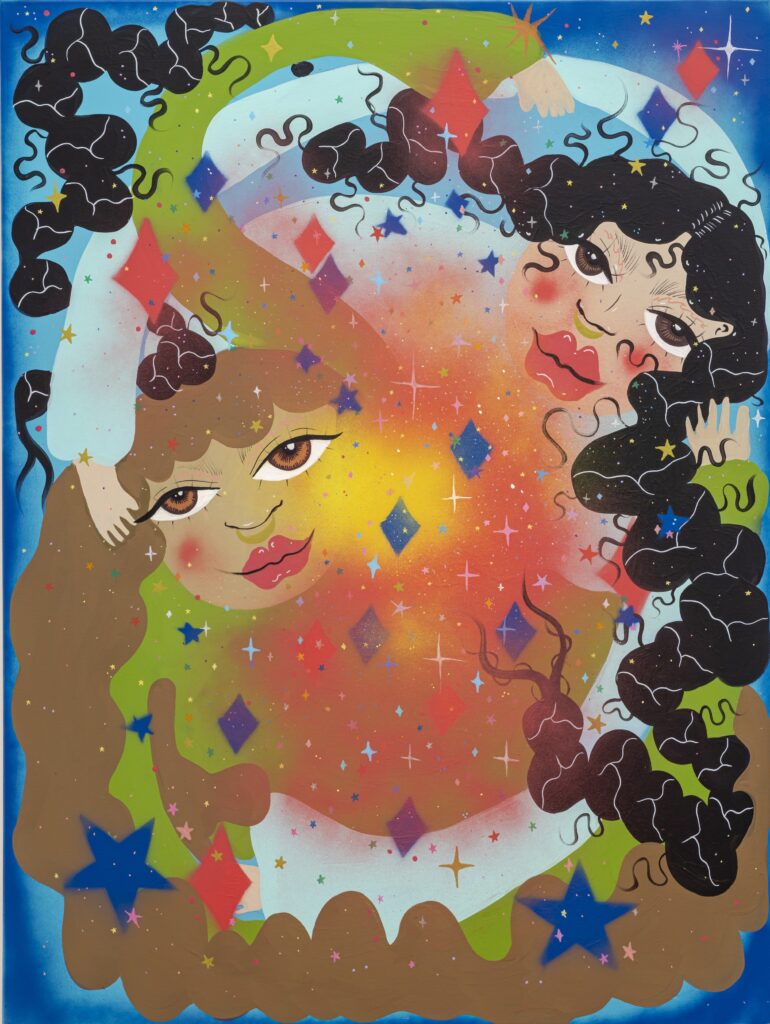
This essay is part of Toronto Review’s ongoing column on 2SLBTQIA+ aesthetics, funding for which has been generously provided through the Queer & Trans Research Lab Emerging Projects Fund at the Mark S. Bonham Centre for Sexual Diversity Studies.
In the dedication to her seminal memoir Halfbreed, Maria Campbell gives thanks to Stan Daniels “for making [her] angry enough to write it.” In the opening pages, Campbell writes that “a close friend of [hers] said, ‘Maria, make it a happy book. It couldn’t have been so bad. We know we are guilty so don’t be too harsh.’” Campbell responds, “I am not bitter. I have passed that stage. I only want to say: this is what it was like; this is what it is still like. I know that poverty is not ours alone. Your people have it too, but in those earlier days you at least had dreams, you had a tomorrow.”
Published in 1973, it goes without saying that Campbell’s Halfbreed is one of the most foundational pieces of Indigenous literature, alongside the works of Lee Maracle, Tomson Highway, Gregory Scofield, Beth Brant, Basil Johnston, Daniel David Moses, Beatrice Mosionier, Mini Aodla Freeman, and Ruby Slipperjack, among others. Prior, we of course had Indigenous storytellers, such as Tekahionwake (Pauline Johnson), but it wasn’t until the 1970s and 80s that we began to see a blooming field of published Indigenous literatures in Canada. What does literature mean to peoples disbarred from their own storytelling histories? “‘Indigenous literature,’” Daniel Heath Justice writes, “two powerful words in a powerful relationship—but not a neutral one…for some readers, these two words together are an oxymoron.” These writers paved the way for what we know as the arena of Indigenous literatures today, popularizing and voicing concerns of Indigenous peoples’ survival in the wake of residential schools and ongoing state-sanctioned cultural and actual genocide. Life Among the Qallunaat (1978), In Search of April Raintree (1983), Kiss of the Fur Queen (1998), Indian School Days (1988), Bobbie Lee Indian Rebel (1990), and Thunder Through My Veins (1999), to name a few.
We expend too much of ourselves in paranoid writing that responds to our paranoid readers, some of whom are real and some of whom are imagined.
Because of the fierce literary accomplishments of this wave of Indigenous writers, we who work in this current literary wave—a fourth wave perhaps, often called the Indigenous Renaissance but not to be confused with the Native American Renaissance, nomenclature that is itself a form of erasure—are able to freely reposition form, genre, and subjecthood in our writings. But it would be inappropriate to say that this previous wave of Indigenous literatures was bound to genre and/or form in a way that future waves transcended—they were what some might call “experimental” only because Indigenous literatures draw on our peoplehood specific epistemologies and therefore are in and of themselves transgressive. They were all genres and no genre simultaneously; operating against settler ideologies of linear time, on what we call NDN time, being late to our own becomings; fantastic and literal; and outlaws to parochial forms of Western literature. I’ve come to read them, as Campbell and kin discuss in the opening of Halfbreed, as a literature of anger. Righteous and rightfully. For so long, Indigenous literatures have been disallowed from the capital “L” of literature for being primitive, premature, or not yet developed enough to actualize their “experiments” in form, genre, or aesthetics—and yet we are, and have forever been, storytelling in all forms as a means of proclaiming, testifying, and orating that we are, were, and will be here.

I am an incredibly paranoid person. If you were to ask my parents what I gravitated towards as a child, they would be sure to tell you: doom. I have a deep reverence for The Terminator series, especially Terminator 2: Judgement Day (1991). I could watch this film on repeat. There is something deeply compelling to me in watching Sarah Connor (Linda Hamilton) become a final girl and take on the shapeshifting, indestructible, liquid-metal-amorphous T-1000 (Robert Patrick) who relentlessly hunts her and her son, John Connor (Edward Furlong), throughout the film. Sarah Connor is paranoia’s embodiment. She has to be.
Nowadays, at age thirty-four, I am frantically paranoid about nuclear war; about rising tensions with Russia, India, and China; the ongoing genocide of Palestine by Israel; the unearthing of Indigenous children from former residential schools in Canada and the United States; the unending pandemic and residual fear from the two-year lockdown; the 1 Million Marches and rampant anti-Indigenous sentiment (I think here specifically of how residential schools return as a motif for conservative ideology to combat the perceived “indoctrination” of gender and critical race theory in public education. Irony is not lost on me as an Indigenous person indoctrinated with settler ideologies of binary forms of gender, sex, and sexuality). More personally, I wrestle my body on the daily, mentally, physically, spiritually. I am paranoid of the harm I know myself capable of doing. I am paranoid of the harm I know others capable of inflicting on me. I am paranoid about my precarity as a Two-Spirit/Indigiqueer person in a climate of continuing settler colonization. Sarah Connor, I have lived in a wasteland too.
Etymologically, paranoia comes from Greek. It derives from para—meaning alongside, beyond—and nous—meaning mind. It is defined by OED as “a delirium, dementia, or other disorder affecting the function of the mind.” Then, as “mental illness characterized by a persistent delusional system, usually on the theme of persecution, exaggerated personal importance, or sexual fantasy or jealousy, often as a manifestation of schizophrenia.” What a wonderfully queer sentiment. What an embodied term for being a colonized subject. I find joy in the deployment of the abnormal, beyond, alongside, and in the workings of the contrary. Because of course, I/we are paranoid peoples when disempowerment and disjunction are normalized. How could I not be paranoid about a state that can kill or disappear me? How can I not be paranoid about the self-destructive habits of queer life and cultures? How can I not be paranoid about how these ideologies inform and enhance me?
One of the late Eve Kosofsky Sedgwick’s most well-known books, Touching Feeling: Affect, Pedagogy, Performativity (2003), is a wondrous dive into the realm of affect theory as it relates to queer lives, literatures, and reading practices. It’s here she pens her popular essay “Paranoid Reading and Reparative Reading, or, You’re So Paranoid, You Probably Think This Essay is About You” (which parodies Carly Simon’s 1972 song “You’re So Vain”). Sedgwick, speaking with her activist/scholar friend Cindy Patton during the first decade of the HIV/AIDS epidemic, inquires about theories regarding the then-ongoing crisis: if it was deliberately engineered and spread, if it was a plot by the U.S. military, if people in power disregarded global environment and population changes. Sound familiar? If so, “what would we know then that we don’t already know?” Sedgwick makes the case that confirmation of systemic oppression, of the nefarious volition behind it, does not “necessarily enjoin [a] person to any specific train of epistemological or narrative consequence.” Yet we are fundamentally trained, socially and culturally, as modern enlightened subjects to move, think, and read the world suspiciously, as paranoid surveyors. Sedgwick directs us toward what she calls “paranoid reading,” and while she is talking of it in the form of the HIV/AIDS epidemic and LGBTQ lives in the 80s, she goes on to highlight the contours of paranoid reading writ large.
Drawing a connection between paranoia and phobia, Sedgwick notes that antihomophobic work—queer theory avant la lettre—would necessarily rely on paranoid reading practices. Seeking to expose wrongdoing, error, and conservatism, to address those who would deny their existence and enforce death (slow and fast modes of it), queer writers from the 70s to the 90s produced, again and again, paranoid writing models. It becomes a closed circuit, a continual shouting match, a scrying, future-anticipating form of criticism and reply—a waste of worldbuilding energies. It is a sanctioned, symmetrical, and contagious methodology.
Then there’s us: embroiled in this current era of ecological and economic destruction; transphobia and queer fatalism; the denouncement of critical race theory and gender-affirming care in schools; the adoption of MAGA rhetoric in Alberta’s book bans and separatist “sovereignty” (the irony, I know); the denialism of residential school and the unmarked graves of our children in these places. We aggravate, daily, against political paranoia. We expend too much of ourselves in paranoid writing that responds to our paranoid readers, some of whom are real and some of whom are imagined.
I think this of Indigenous literatures writ large and especially of Indigiqueer/Two-Spirit stories: when we craft paranoid writing as a rejoinder to the war-crying doom anthem of settler colonialism and heteropatriarchy (both within and without Indigenous communities and literatures), we muddle our energies, shrink, emaciate. We leverage the work of sensing, approximating a future horizon of possibilities, in lieu of screaming back, collectively, “How dare you?” This world we inhabit—one dying from resource extraction, genocide, late-stage capitalism, heteropatriarchy—has no time to wait. She cries for regeneration now. We must call for literary and literal emancipation through the animacy of our joy and become untranslatable to settler colonial ideologies. In the zeitgeist, I have seen Sedgwick’s work return in allied fashions across critical race theory, intersectional queer theory, genocide studies, and decolonial rhetorics because of its generative potentials. Though, her theories tend to stunt their praxes due in part to institutions or instructors being unable to move beyond paranoia, as if, like the donning of pins on the chemise of a celebrity, or the Canadian land acknowledgement (which has now become simply a link on syllabi), the performance of knowledge forecloses the praxis of it. The “mastery” of it. An inability to see that the call is coming from inside your house. This is not sufficient for repair.
Indigenous literatures, unmoored from the colonial borders of generic boundaries and formulaic structures, allow for us to inhabit a linguistic hinterland, a wherefore, whereas, whereto.
Indigenous storytelling deploys all genres and no genres. It envelops past, present, and future seamlessly. What does realism mean to Indigenous literatures when what it wholly regards as real—dreams, tricksters, ancestors, visions, anthropomorphism, little people, star people, wendigo, ceremony—is disregarded as speculative or fantastical by other readers, publishers, and academia? When I write of maskwa and Nanabush in Jonny Appleseed (2018), for example, they are most often read by non-Indigenous audiences as a reinforcement of settler colonial visions of Indigeneity as flora and fauna, the romance of it all. I suppose I mean to ask: what is the use of realism in Indigenous literatures when its realities are misinterpreted as fodder for idyllic frontier fantasies? How can our stories become “literature”—assuming we even want them to be—under the colonial, classed, and heteropatriarchal gatekeeping of form and genre?
Let me offer a contemporary reading: Billy-Ray Belcourt’s novel, A Minor Chorus (2022), enters the fray of the CBC Canada Reads literary arena in 2026. It is defended by Elle-Máijá Tailfeathers of Kainai First Nation. Canada Reads is a Survivor-style literary game where five defendants, often Canadian celebrities, select the “one novel that all of Canada should read.” This particular show is rich with paranoid reading, in that, over the course of one week, each of the defendants are tasked with pulling apart the texts of their peers—they are tasked with finding holes.
On day two, A Minor Chorus is, unfortunately, voted out of the running. Belcourt’s novel follows a queer Indigenous doctoral student who renounces his academic work to return home and draft his novel. A Minor Chorus follows its protagonist through a series of vignettes which comprise the research-creation that will undoubtedly enter his forthcoming novel: memories of his imprisoned cousin Jack, the Indigenous women in his life, a fellow graduate student, and a closeted man in rural Alberta. It is not only a love letter, but a testament to the idea of home, the reservation, Indigenous rurality, and the unliveable that is deemed to be unspeakable. A fellow panelist of Tailfeathers’ is “turned off” by its “existential crisis,” by which I believe he means the state of being both queer and Indigenous, and reconciling those two at times unfortunately disparate states of being, while under active occupation in Canada. Instead, the panelist turns to education, to the lavish and decadent spectacle of pain that is expected from Indigenous literatures, to the narrative arc for overcoming such “existential crises”: the sobriety story, the residential school story, the rags-to-riches story, or the queer NDN bildungsroman (provided it follows the blueprint for settler sexualities). These are all acceptable as “good NDN literature.” The expectation of not only survival but quantifiable resilience is built into the structuring of the Indigenous novel: inciting action, rising action, climax, denouement, and resolution (within the colonial frame, survival implies education). Safe. Scripted. Siloed. But the joyful translation of pain, the theorization of being NDN and in love—not only with others, but, more importantly, with one’s self—and the use of story for emancipation bewilders settler expectations of this amalgamated oeuvre called Indigenous literatures.
Another defendant begins her critique of A Minor Chorus, this time focusing on two facets: the removal of speech tags in dialogue and what she reads as its rampant casual sex which detracts from the emotional depth of the novel. She calls it “surface level.” She wanted “to take away a lot more from the book” for it “to have more of an impact on” her. This desire certainly traffics in the erasure of Indigenous—here, Cree—forms of grammar (Cree linguistics don’t rely on Western conventions like quotation marks, proper nouns, or even linear sentence structures) and in homophobia; yet, I am more interested in the surface-level function of Indigenous literatures for settlers, the vocabulary of “take away” and “impact me.” To paraphrase Daniel Heath Justice in Why Indigenous Literatures Matter, Indigenous stories are a cornucopia for settler education. Feed me your pain and I will be changed. Hearing this in the era of the Truth and Reconciliation Commission (TRC), the popularization and proliferation of residential school narratives for white audiences discounts any form of Indigenous storytelling that isn’t confessional or voyeuristic.
Much of this defendant’s argument against the syntax of A Minor Chorus can easily be explained by a lack of readerly skill: if a reader cannot tell, without quotation marks, whether the prose is exterior or interior speech or a device for worldbuilding, this demonstrates nothing so much as a need for further literary training. But I digress. Tailfeathers rebuts the statement, asking why this critique of grammar does not apply to another one of the five books, which also does away with speech attributions, Iain Reid’s Foe (let’s say nothing of canonical works by James Joyce, Virginia Woolf, Gertrude Stein, or William Faulkner, which deploy similar tactics, or contemporary writers who do away with grammatical conventions, specifically speech marks, like Sally Rooney, Ian Williams, Miriam Toews, or José Saramago). The defendant answers that there was a plot-related reason for Foe’s lack of quotations, whereas the “average reader” will struggle against the lack of quotations in Belcourt’s book and so fail to be fully immersed in it. I wonder: does grammar only serve plot, rather than literary aesthetics?
Tailfeathers asks this defendant who she thinks the “average reader” is, which brings about the most apropos defence of paranoid reading. The defendant goes on to try and sidestep the question: “I think quotations are the grammar we have grown up with… I’m just thinking on behalf of myself who is reading a lot of books. And maybe ‘average reader’ wasn’t the correct terminology to use—it’s just, I find it very hard to understand the character and the story with a lack of quotations.” Here the “I” of the defendant becomes “we,” the universalized “us,” positioned on the side of institutional power. The reader isn’t average in the universal sense, then, but dichotomized between we who have grown up with grammar, we who read many books, and you who did not, you who do not. In other words, the “average reader” is a smoke screen for the white, middle-class consumer. Her romanticized claim about “the grammar we have grown up with” invokes the Canadian educational system—with its assimilation, its censorship, and its authoritarian imperialism (especially in Alberta, with its ongoing book bans).
This is the grammar, the education, the indoctrination we have “grown up” with and that you should have, by now, been assimilated into. In my creative writing workshops at the University of Calgary, the idiom of the “average reader” constantly comes up. The average reader wants this. The average reader needs this. The average reader expects this. We are perpetually in service of the average reader, confirming what they think they already know.
As a partner to paranoid reading, Sedgwick offers us “reparative reading.” She defines reparative reading as a highly personalized form of being, one that “wants to assemble and confer plenitude on an object that will then have resources to offer an inchoate self.” This methodology is interested in elaboration on the one hand, and a deep need to interpolate the marginal and fragmentary on the other; it allows for pleasurable possibilities, for surprise (which the paranoid reader is wholly against), and for openness where paranoid reading closes its circuit. Paranoid reading is always dismissive of the reparative, finding it incomplete, emotional, even selfish. Reparative reading, however, doesn’t mean denying the existence of oppression: it seeks pleasure because it recognizes that the environment is hostile and will not provide that pleasure on its own. Reparative reading is also empathetic, in that it recognizes others (not only human others) as worthy of love and care.
I see a lot of contemporary Indigenous writers branching off into what are called “wonderworking” literatures, which Heath Justice denotes as being “neither strictly ‘fantasy’ nor ‘realism,’ but maybe both at once, or something else entirely…they generally push against the expectations of rational materialism.” Think of Belcourt’s A Minor Chorus (2022), Cherie Dimaline’s VenCo (2023), Alicia Elliott’s And Then She Fell (2023), Jordan Abel’s Empty Spaces (2023), Jessica Johns’ Bad Cree (2023), Michelle Porter’s A Glacier’s Guide to Dying (2026), or Louise Erdrich’s Python’s Kiss (2026). Too often this work exceeds the curated image of what Indigenous literatures was, is, and can be to the “average reader.” It exceeds too the distinction between what you might know as commercial fiction versus literary fiction within the publishing industry. This cohort, of which I am a part, doesn’t abide by the paranoid reading of a colonial audience and so chooses not to spotlight trauma, residential school, and intergenerational pains. Because we forgo paranoia for reparative reading and writing, we are—at least in the purview of Canadian publishing, criticism, and its readerships—usurped of our identifications, of our rightful place within Indigenous literatures. To a paranoid settler colonial reader, our joy is withering, insufficient, and subjectless, due in part to the fact that pain is not the motor of our stories. When our joy is backgrounded rather than foregrounded, our stories are lauded as “wounded,” “ruinous,” and “devastating” and in those signifiers lie such paranoid hypotheses as of that dreadful descriptor attached to Indigeneity: resilience. We are, of course, resilient, but this has become an overdetermined quality for our stories, a synecdoche and synonym for Indigenous literatures and, by extension, peoples. If not resilient, our art is read as macabre, abject, laced with negative affectation, difficult, inaccessible. We are pedagogical, pathological, tautological, disembodied, taxidermized, deterministic curios of study. We are wounded beyond repair and are victims to our own tragic nostalgia—there is no refuge in the paranoid fugue of living and being a colonized subject. The endless call and response heightened post-TRC: witness me, see me, represent me, learn from my tapestry of pain.
Without Indigenous epistemologies or interpretive methods, Indigenous literatures are reduced to either a simplistic aesthetic of idyllic romance, or deeply moving testimonies that thus confirm the dominant narrative: see, I told you so. They’re sad and I’ve paid my due through consumption. Our literatures become a lens, a perch from which settlers can say to themselves therefore, therefore, therefore, instead of seeding ground for the potentiality of whereas, whereas, whereas.
What I’m calling reparative writing embraces and enhances vulnerability, requires the emotive, is animated by sensuality, and weaves the personal as political, the political as personal. It avers the poetics of relationship. That, to me, is reparative writing. Selfish—by which I mean celebratory—for the polyamory of the living, which, again, is not only human. How can one write about the mountains without having sat with them, talked to them, felt their anger, been eased by their joys? How can one write about themself without theorizing, intellectualizing, or appreciating the pleasures, minute and grand, that translate through the sensorium of our bodies? How can we exteriorize without interiorizing? This reparative work is the very core of what is now called Indigenous futurisms. It includes literature, but is not solely about literature. It is about the treasure trove of meaning packed into the noun–verb story. It is both a methodology and an aesthetic form. Consider that, with A Minor Chorus, the sundials of our collective and individual sovereign futures become richer and more practiced.
The numbers of our clockface collapse like knots upon the table, they spell out the celebratory greeting—happy birthday—in chocolate like ampersands, like colons, like ellipses, and we are starved for this language.
Indigenous literatures, unmoored from the colonial borders of generic boundaries and formulaic structures, allow for us to inhabit a linguistic hinterland, a wherefore, whereas, whereto. I house an anger like Campbell did, one that is mitigated and fed in such a way that I become a firekeeper to my affects, paranoid and reparative, as best as I can manage.
Sedgwick argues that “the reparative reading position undertakes a different range of affects, ambitions, and risks. What we can best learn from such practices are, perhaps, the many ways selves and communities succeed in extracting sustenance from the objects of a culture—even of a culture whose avowed desire has often been not to sustain them.” I wouldn’t exactly call a reparative model extractive as an Indigenous writer; rather, I call reparative reading and writing the revitalization of cultural practices that empower us as Indigenous peoples and which, by extension, invigorate our stories. The braiding of our epistemologies with our ontologies—without respite and without the need for translation. We move towards a methodology of storytelling that is uninhibited by colonial reading, writing, and publishing (that precarious, vicious, and paranoid settler Eye of Sauron). We leech—like our kin, medicinally and not vampirically—from the cultural praxes that have nourished us. We do not dismember the literary body, but rather, mutate it—Gilgameshian, or perhaps I should say, tricksterian: cosmological, star-peopled, and land-informed. Hybridized flora on the peduncle, richly petalled on the stalk.
Of reparative writing, let me offer my own inchoate Indigiqueer futurism:
I am out for a birthday dinner at Chili’s with friends. We are celebrating Jason Purcell, a queer amiskwacîwâskahikan writer and academic. We order Triple Dippers. Ginger ales. I ask our waitress if this establishment is versed in birthday celebrations. It is a privilege to age as queer people. In rurality. In the barren, anti-queer, anti-trans, anti-Indigenous, book-banning, separatist province of Alberta. We all relish one another’s company. When the cake comes we each get a spoon and sing “Happy Birthday.” I have a photo from that moment: Jason is shy, bashful, staring at the camera with half of their face covered by their hand in elated embarrassment. In another photo taken shortly after, they are staring at this mound of chocolate cake, caramel, and ice cream. Their eyes are wide, eyebrows cocked, filled with hunger at the sight of the cake which is, yes, a cake, and yet, so much more than cake—so much more than hunger. It is what the noun and verb hold. The berth of its signing. The cake that is a cake and yet not a cake frosts with meaning. Our childhoods, the prairie, it is a bildungsroman, a kunstlerroman, a travel narrative, a historical biography, a speculative fiction, a utopian poetics, an “acicular ice,” ekphrastic. It is, to quote Purcell, a simulacrum of “mending in ways that draw attention to the wound,” but it is more than wound. It is a winding of time, unwound and unspooled. The numbers of our clockface collapse like knots upon the table, they spell out the celebratory greeting—happy birthday—in chocolate like ampersands, like colons, like ellipses, and we are starved for this language. And yet, the embarrassment in the photo is joyful. As if to say: feast, fill yourself, smear me like silt upon your tongue, decadent, ravishing, and vicious, and rallied of this being. No cake has ever tasted so good. The calorie of queerness is anything but rationed. At once we are boys at one another’s birthday party. We are adults at Chili’s. We are queer elders looking backwards at this moment and saying to our younger selves: be pansy, be chard, be mint of mind and delicious, but god, oh god, please stay faggots in this gardening.
Joshua Whitehead (he/him) is an Oji-nêhiyaw, Two-Spirit member of Peguis First Nation (Treaty 1). He is the author of full-metal indigiqueer (2017), Jonny Appleseed (2018), and Making Love with the Land (2022) as well as the editor of Love After the End: an Anthology of Two-Spirit and Indigiqueer Speculative Fiction (2020). Currently, Whitehead is an Associate Professor at the University of Calgary (Treaty 7).
Natalie King is a queer interdisciplinary Anishinaabe (Algonquin) artist, facilitator, and member of Timiskaming First Nation. Working across painting, sculpture, installation, and community-engaged practice, her work explores cultural survival, memory, kinship, and the radiant cycles of life and death. Depicting queer and Two-Spirit kin, King embraces the multiplicities of Anishinaabe experience through frameworks of desire, survivance, and Indigenous futurity. Her paintings bridge land and body, holding joy, grief, protection, and transformation in equal measure. King has exhibited across Turtle Island, and her work is held in public collections including the Doris McCarthy Gallery, McMaster University, and the Ojibwe Cultural Foundation.