
Styles of Grief: An Interview with Patrick Cottrell
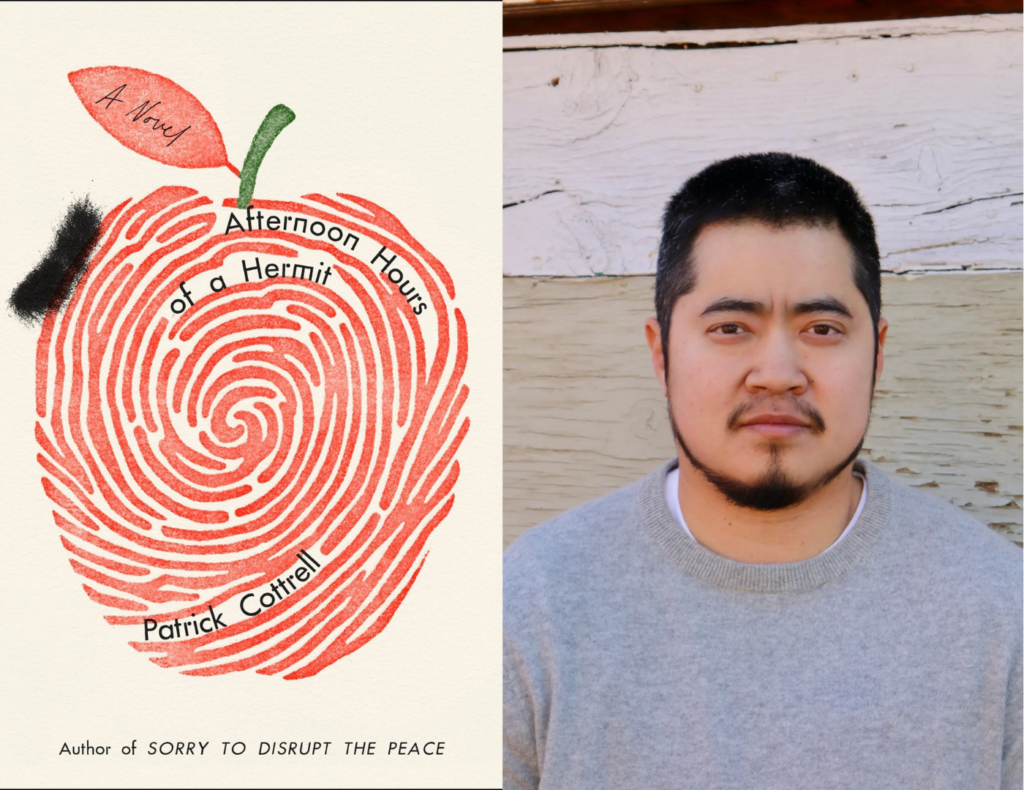
Patrick Cottrell’s new novel, Afternoon Hours of a Hermit (Ecco), is an existential detective story that makes authorship one of its mysteries. It begins when a photograph is mailed to the book’s narrator, Dan Moran, addressed to his deadname. In the picture, his dead younger brother, appearing to be eight or nine years old, is dressed like an old-school investigator, raising a magnifying glass to what Dan calls his “eye of inquiry.” Dan has no idea who took or sent the picture. A cropped facsimile of the image is reproduced on the first page, courtesy of the author. No photo of the author himself appears on the jacket.
A portrait emerges anyway, though whose is hard to say. Dan is a Korean adoptee nearing forty, like Cottrell, who is also the author of Sorry to Disrupt the Peace (McSweeney’s, 2017), a novel about the same brother’s suicide. Reviewing Afternoon Hours for Bookforum, the novelist Deb Olin Unferth points to how Cottrell enfolds author, narrator, and reader into one figure, giving me the image of three raconteurs in a trench coat. What unites is a sensibility: deadpan, ruminative, aggrieved. Dan is a constant victim of misrecognition. He is sometimes estranged from reality. His only companions are dead writers, chief among them his mentor, “Thomas Bernhard,” who wisely says “a suicide is never over.”
I came to Cottrell’s writing by an accident of shared fate. I found his first book on Fire Island, in the summer of 2023, a few weeks after the suicide of my own younger brother, as I was looking for something to read in the free library inside the post office on the boardwalk. I picked it up because the cover was bright enough to see through a mist of tears and sunscreen, and when I realized what it was about I almost threw it in the ocean, only to be very glad I didn’t.
We spoke on the phone in May. (I first offered video, knowing the answer would be ‘no.’) Cottrell was in his office at the University of Denver, where he teaches creative writing; I was at home in Montréal. We talked about noir and justice, secrets and withholding, his brother and mine. At the beginning of the call, Cottrell remarked that an interview, too, is like fiction because of how it gets shaped. I think this one is shaped like a helix, double or not.

Sarah Nicole Prickett: You write about or against the obligation to radically reinvent yourself with each book. Your narrator thinks he’s doing something less defensible than reinvention: repetition, compulsion. But I think the less defensible thing is using your imagination—if you have one, go into cinema. That’s where images live. Writers should do what film cannot: obsessive rumination, dwelling endlessly inside the psyche. Which is a long way of asking: why noir?
Patrick Cottrell: I’ve always been drawn to the structure of the mystery/crime/noir novel because the form itself is so repetitive and familiar. There’s always an invitation or inciting incident, a phone call or a letter or a meeting. Once that’s set, as a writer I’m generally discovering how the world works at the same rate as the narrator, or at least that’s how I wrote my book. I seem to know what he knows and he doesn’t know much. So I open the door and see what’s behind it. The rest of the book is about obsession and processing information. Each revelation moves the story forward. And in the world of my book, it seems like everyone knows more than the narrator. The most painful things in my life have come from secrets and withholding. You realize how defenseless and easily manipulated we can be—we’re naturally inclined to trust and believe what people tell us.
SNP: But withholding is what makes novels tick. Is it possible that the most painful things in your life are also the most instructive as regards, I guess, craft?
PC: Pain can be a guide because it illuminates what I need to look at but would prefer not to. I’m fairly avoidant in my own life, but in writing it’s really hard to be. I do have doubts about what I’ve done because I think that people always want a new thing. And I’ve always been illegible as a writer; in some ways, I think it’s my superpower. It fuels my writing. Many people don’t realize I’m Asian American because of my name. I just keep coming back to this feeling—we all want something new, so what have I done? I don’t mind if people think this is the same book but with a trans narrator. I can understand why they would think this. The fact is, I wanted to go back, I wanted to return to the world from my first book, I wanted to revisit my brother. If you can’t do what you want in your own book, then what’s the point of writing it?
The first book had more of that awkward, heightened awareness of itself as a book—I felt the weight of I am writing my first book. This one is a direct document.
SNP: I moved to Montréal in November, back from New York. My brother loved it here, and I told him if I would return to anywhere in Canada, it would be this city in which we could both live. But I took too long to decide. He died. I think about him more now than when he was alive. It’s like that’s where he’d gone to live, inside my head.
All to say, I really understand why you had to write two books.
PC: I mean, the noir genre that I’ve used in both books—usually that’s angled toward justice, or attempting to restore some kind of order.
SNP: Restoration is the order of the day. Several summers ago I had a bit going—which I had to retire when I accidentally offended a novelist friend who wasn’t, it turned out, writing autofiction—about how it’s irresponsible to invent new situations when we can’t make sense of the one we’re in. The world is ending, we’re drowning in information, don’t make me learn new names and fates.
PC: Isn’t that what Rachel Cusk argued? That’s why she wrote Outline.
SNP: I thought she wrote Outline because people didn’t like her persona.
PC: There was a lot of backlash to some of her earlier books, or to her nonfiction. But she’s said things, too, about how she doesn’t want to make up characters anymore.
SNP: She’s right about that, even if she’s wrong about other things. Didn’t you have a dream about her that you wrote about in The Paris Review?
PC: As a figure, perhaps as a figure in my imagination, I have a lot of admiration and respect for her. I think she’s really smart and precise. The Outline trilogy is important to me in the way that it sidesteps plot, character development, and narrative. But like others, I have questions about gender, sex, and biology [for her]. I think her new novels are good, like the one about the painter and the marriage.
SNP: She’s on another level when it comes to a kind of vision that’s purely novelistic, not translatable to the picture plane.
PC: I think she loves D. H. Lawrence, which I find really weird and kind of fascinating.
SNP: Why weird, because he’s so Christian? Or so repressed-homosexual?
PC: Earthy, sensual. Yes, the repression. I think Rachel Cusk has said in so many words, I wish I were a man. Obviously, I don’t think she means biologically. I think she means she has some anxieties about, for lack of better phrasing, motherhood and being an artist and a writer. That’s what I get from reading her work and her interviews. I don’t know if that’s true.
SNP: It makes sense. There’s a Kristeva essay on the Bellini Madonna and Child where she says the artist speaks from the place where the mother is not. Making art is self; mothering means the obliteration of ego. Though people have children for selfish reasons too.
Could you write a book for an unselfish reason? You said you wrote this for yourself, but wouldn’t a book you wrote for yourself be a diary, not a hardcover for—let me check the price—$36.99.
PC: Wow. Sorry about that.
SNP: Don’t apologize. Your publisher gave it to me.
PC: Yeah, I guess I just mean, the experience of writing is so private, but then of course publishing is not.
I think with people’s impressions of your books, it’s like seeing a photo of yourself, like oh, that’s what I look like. When someone tells you about their experience of reading your work, it always feels like “I didn’t realize that’s what I was doing, interesting.” I kind of take it in. But I don’t fully metabolize it. I hear it, and it’s interesting to hear, but it feels at a remove for me.
I don’t know what to think about this question. What do you think?
SNP: I’ve tried, but I can’t write fiction for fear it would be too revealing. A novel is a kind of glass closet. What I really want is to be a dead author. Not to know what people are saying. Unlike your narrator, who’s always lurking around a corner or behind a stack of chairs, listening—waiting to hear things that I assume in real life you don’t try…
PC: No, thankfully no.
I remember feeling this way about my first book too. I was very depressed then. I felt as if it was met with total silence. Looking back, I bet it actually wasn’t, but it felt that way. I don’t understand the people who are so happy and excited about their books coming out, but I envy them. I wish I could access those feelings more!
Something that’s different about this book is that it’s more direct. There’s no real posturing. The first book had more of that awkward, heightened awareness of itself as a book—I felt the weight of I am writing my first book. This one is a direct document. A plain document, very clear. And in that way it does feel defenseless.
SNP: Your narrator seems anxious about personal gain, like in the kitchen scene where the middle brother accuses him of profiting from the youngest’s death. I fear the same accusation, even though I promised my brother years ago I would write his life, and even though my siblings would never…
PC: He was the youngest? And you’re the oldest?
SNP: Yes. He wanted me to explain him to him. I said for a while that I would do his biography. But I was worried about the ethics, so I shifted to a more sociological book on the figure of the little brother in contemporary life. This was right before Trump term one, and everyone was talking about incels and losers. I was thinking the relationship between feminists and incels is very big-sister-little-brother, like on a semiotic square. Do you know what I mean?
PC: I don’t know what that is.
SNP: You need to read Fredric Jameson. Sorry, that was rude. I’m sure you have read Jameson, you teach literature; I meant reread.
PC: That’s good, I’m going to start saying that. “You need to reread,” instead of “you need to read.”
People who are good storytellers seem to be very charismatic, and I’m suspicious of charisma.
SNP: Why was I talking about Jameson? Oh, the semiotic square. In my writing, I try to complicate things. But in arguments with him, I’d get cornered and sound like the most shrill basic lib-fem version of myself. I think a lot of the time, all he wanted was to hear the truth about himself. You know, that’s what provocateurs do—make someone mad enough, and maybe they’ll snap and say what they really think of you, or what you fear they think.
What’s the age difference between you and your youngest brother?
PC: It was six years. He still felt far away, though, because he never really grew up in terms of the traditional heteronormative adulthood markers. He always lived at home. He lied and invented an alternative adult life for himself, but he never lived through it. He mostly lived at home with my parents or stayed in hotel rooms when he needed a break. He did invent a lot of different jobs for himself that required travel and secrecy and extended periods of going out of contact. When I found out about all his lies, I was horrified. Over time, I’ve come to think it was kind of cool, even though it hurt me that he never felt he could share the truth of what he was living through.
SNP: Interesting that what he did was lying, and what you do is writing.
PC: Yeah. [laughs]
SNP: Okay, maybe it’s not interesting.
PC: I mean, it’s all fabrication and invention, to an extent. I don’t think that I’m lying in the sense of creating and mapping my narrator’s interiority. The interiority I work with is truthful; it’s trying to get at particular truths that I wouldn’t be able to say or articulate in person. The noir genre that I’ve used in both books [is] angled toward justice, an attempt to restore some kind of order. I think that’s what a writer like Patrick Modiano does. His books circle around understanding a primary abandonment and trying to organize what happened through layers of time and lost memories.
SNP: Lying and writing—besides both being inventive—are both attempts to narrativize, and sometimes to create a screen. Writing about your life or writing autofiction allows people to think they know the answers, so they ask you fewer questions. That can be a relief.
PC: When my brother died, not many people asked me questions about it. They mostly left me alone.
SNP: In the months after my brother died, people reacted fairly predictably, mostly in accordance with their own experiences with death, or lack thereof, but I was still surprised. I was writing on Jacqueline Rose’s The Plague, about Freud and the death drive and I was reading Benjamin’s The Storyteller—about how death used to be everywhere, inside the city walls, the walls of the home, which gave everyone a nearly inborn sense of narrative. Meaning, because narrative is derived from the ending, the limit. Now in the metropoles, our demographic(s) haven’t gone to war, didn’t live through AIDS. So my friends weren’t prepared. Do you know the I Ching?
PC: I don’t think so.
SNP: Sheila Heti used it to write a book about motherhood. A friend’s ex-boyfriend was obsessed with it. I asked: should I go home to take care of my brother? It said yes. My friends said no, your life is here, take care of yourself, babe. When he died, those same friends weren’t there, or tried in ways I found profoundly unhelpful. People say the craziest things in the face of suicide. A friend was like, I know how you feel, my grandma was my best friend. I was like, “did your grandma die of old age in Coral Gables, Florida? Because my brother jumped into the highest waterfall on the continent at 27.”
Do you feel like you understand your brother better now, after writing both books?
PC: I think I became addicted to the feeling I was getting from writing about him. I said that to a friend who was like, “oh, you rewrote your first book.” Again, I don’t think there’s anything wrong with that. People rewrite their books all the time. But I became addicted to the affective charge I was getting from immersing myself in the material again. And it was a way of trying to keep him close. Because as time moves on, he feels further away, and selfishly I didn’t want to feel that way. So I was trying to recuperate something that was lost, repair something shattered.
I don’t know if it worked. But I do feel like there are things that I understand more. Going back to this idea of selfishness—I do think there was this trying to feel close to his death. I liked that feeling. It was a warm feeling. There was so little that he left behind. When I write about him, it’s a way of drawing close to that emotional space, because in physical reality he didn’t leave anything behind except a few objects. Did your brother leave things behind?
SNP: I have his emails, his texts, and a recording of one of our last conversations, where he asked about the book. I wasn’t writing it by then. Books are terminal. I felt superstitious. Now I feel the opposite—could I bring him back?
PC: Yeah. I think that’s what I was feeling immersed in—this recuperation or bringing back. Of course it never works, but I was attached to the gesture—even its futility. But you’re right, when you do take a step back, you’re like, “Oh my gosh, I’ve written two books about my random little brother.” That is a strange thing to do. But I hope that you do it, if that’s what you want to do.
SNP: I will also say, this second book is a lot better.
PC: You think so?
SNP: Of course. Very to my taste. Not Bernhard so much… I was married to a man studying literature who wanted to be a novelist. One of my great contributions to literature is dissuading him from that ambition. I told him to be a journalist instead, and he’s very successful doing that now. Anyway, he was into Bernhard. The only thing I can remember of Bernhard is his line about how all the great philosophers become shrunken heads—their work shrivels into a single sentence. He also has shriveled, or ‘withered,’ to use one of your favourite words, into a single sentence for me. Why does everyone want to write a Bernhard book now?
PC: Is he the new—who was everyone wanting to write like before? Clarice Lispector? Or László Krasznahorkai? Thomas Bernhard… I just like him as a figure. I like his stance on things. I like his point of view. He’s very authoritative on the page, and I think writers are trying to borrow that authority, that confidence that makes you go with whatever he says.
When I was in graduate school, I struggled with plot. I had no idea how to tell a story, I didn’t know how to describe what people looked like while they were walking or moving about in the world. Every weakness I had, everything I myself was horrible at, he did away with. His work seemed to say “those things aren’t important” so I felt a natural affinity with him. But now my sentences don’t sound anything like his.
SNP: No. Well, maybe more commas on average than in your previous novel.
PC: Okay, that’s possible.
SNP: I liked what you said earlier, that you looked to noir for ways of ordering information toward justice.
PC: There was this strange French film I saw recently, Misericordia (2024), which has all the plot trappings of a noir. It involves a stranger who appears in a village and an attempt to cover up a murder. But at its core, it seems to be about unresolved, teenage forms of desire.
So the noir atmosphere is a way to trick people into thinking something’s happening. Turn the character into a detective and have him “investigate” in the rain and fog. I keep the events as basic as possible because what’s really important is the emotion beneath the surface.
I’m not a natural storyteller at all. People who are good storytellers seem to be very charismatic, and I’m suspicious of charisma. Using the formula of a noir helps me, because I still struggle with plot which, like storytelling, I think is a form of manipulation.
SNP: Have you read David Markson’s noir novels? Paperback, dime-store almost. Genre experiments, both of which are set in Greenwich Village in the 1950s: Epitaph for a Tramp and Epitaph for a Dead Beat.
PC: I haven’t, but I’ll buy them as soon as we get off the phone. I re-read Wittgenstein’s Mistress before I started Afternoon Hours. It’s so great.
The only thing I can remember of Bernhard is his line about how all the great philosophers become shrunken heads—their work shrivels into a single sentence.
SNP: What do you read while you’re writing novels—or do you?
PC: When I’m writing, I don’t read much. When I’m not writing, I read a lot, because I read my friends’ books, I read my students’ work, I reread a lot. I will say that when something is really popular—I do mention this in the book—like Ben Lerner’s book [Transcription], I do want to read it, but I’ll probably read it in a few years. When everyone’s talking about one particular book, I kind of wait a bit, and then I’ll check it out. I don’t know why.
My best reading experiences have been when I’ve discovered something on my own, when I’ve come to it on my own in the particular moment that I needed it. When these things are all tied to a particular moment in time based on the book’s newness and some kind of cultural moment for the book, I don’t think that actually replicates the feeling of discovery as a reader, or those private moments we have as readers.
SNP: What was the last book you came to in an unexpected way?
PC: Henry James’ The Golden Bowl. That’s a book that I had read a long time ago, and more recently I just looked at the cover and was like, I want to return to this. The Golden Bowl is something that feels personal to me; I feel attached to it in some uncanny way. Because so much of that book is about betrayal. Two people know something that one person doesn’t know. And that one person seems defenseless and vulnerable. It’s about information and the withholding of knowledge, and the way power moves between the people you think would have it because they’re really wealthy, and yet the wealthy woman in The Golden Bowl can’t access the knowledge she needs.
There aren’t any villains in that book either. Maybe what’s happening is the positioning of the villain keeps shifting, and that feels like real life too. I don’t have any villains in my life, just complex people who have hurt me. I know I’ve done things that have hurt others, too. So that book is a rediscovery that has felt more and more personal as I get older. I read it when I was in my 20s and I thought I understood it. It went over my head.
SNP: I went on a date last night. Horrible experience. I had four martinis. We started talking about books, and she tells me, almost unprompted, that she doesn’t like Sally Rooney. Actually it’s my fault—she said, “I started taking chess lessons,” and I was like, oh, you should read Intermezzo. An incredible novel. I read this great essay online the other day, saying that the people complaining that Sally Rooney isn’t really a Marxist because her novels are popular are themselves anti-Marxist. You should want Marxism to be popular. As a late-in-life Leninist, I agree. So to this girl I’m like, you should read Intermezzo.
Come to find out, not only has she read all the other Rooney novels, but she actually read the second one in a single afternoon, only to claim a distaste. I said, if you don’t like Sally Rooney, you don’t like novels. When your kids—because here’s the thing, she wants to have kids— when your kids are in class learning what was the novel, trust me, slide four of the PowerPoint will be Sally Rooney. It’s undeniable. She’s like, “maybe I don’t like her because she’s too good at writing novels.” Can you believe this? I said wow, you know it is only in regards to the higher artforms, like literature, that you would say a thing like this, this thing where you think your taste has to be subjective and individual, has to mark you out as distinct from other people who are basically exactly like you. Do you look at Paige Bueckers’s jump shot and say “she’s too good at basketball, I’m bored”? I read a novel in a single afternoon because it was so completely entrancing, but I think the novelist sucks. Unbelievable. I’m never seeing her again, even though she invited me to a Vivaldi concert.
PC: Wow. Just because of that? Just because of this disagreement? Can’t there be—
SNP: She also lived in Tel Aviv. What do your students like to read? It must be rewarding to introduce them to your favourites.
PC: They read a lot of fantasy and genre fiction, which I’m not as familiar with. But the last book they really liked was Katie Kitamura’s Audition. They liked that because there’s a radical cut in the middle where the book shifts into a completely different world and you have to assemble the larger narrative yourself, so it begs to be discussed.
You have to read so much more than you write. I really believe that. That’s the most important thing for me—to keep reading. I love reading. I would rather read than write, to be honest.
SNP: Isn’t that most writers?
PC: No, that’s not true. I think a lot of them love writing more than reading.
SNP: How is that possible? Where do you even get the idea to write if not from something written?
PC: Maybe I’m being unfair. I’m thinking of some of my students who don’t like reading as much as they like writing. They love to write, but they don’t like reading.
SNP: Sincerely, I don’t see how that’s possible. I mean, on a good day writing is like swimming. But the moment before, you’d choose anything else, wouldn’t you?
PC: Oh yeah, absolutely.
SNP: So what are your tricks?
PC: Once I start to do it, it’s fine, but I do have to trick myself into doing it. Honestly, I would listen to music that I liked, and that would be kind of a reward. Once you get immersed in it, then I think you can enter into that state where you want to keep returning to it. Every time I’d sit down and write, I would basically reread what I had already written and then start kind of typing from there. I reread and then I would just add on and keep going. I don’t open the document and just see what’s there and start typing. Then I go into the void and don’t come out for a long time.
Sarah Nicole Prickett is a writer and critic whose essays and reviews have appeared in many publications, some of which, like Artforum, she now boycotts for their collusion with reactionary forces in the culture. She remains a regular contributor to Bookforum, which has a different publisher now. Years ago she had a magazine called Adult. Today she recommends reading The New York War Crimes. Her first collection of essays seems likely to be published in 2027, and she is working on a book about her brother.