
Notes on Trauma

Dog Days: A Memoir
By Emily LaBarge
Hamish Hamilton, 272 pp., $36 (hardcover)
May 19, 2026
1.
“Take notes,” says the Husband in Lorrie Moore’s celebrated short story “People Like That Are the Only People Here.” Take notes, imperative mood, says the Husband to the Mother, a writer, because they “are going to need their money.” Their infant child has been diagnosed with cancer: a malignant tumour has appeared in the “long, cavernous weather map that is the Baby’s insides.” Treatment will require money, will require a story. But the Mother does not want to write this story; she does not know how nor want to put an event like this into words.
Essayist and critic Emily LaBarge turns to this Moore story in Dog Days (Hamish Hamilton, 2026), an experimental memoir “about” trauma and its unwieldy representational forms, when considering whether a story can “perform transubstantiation, leave you with something better, or at least more solid, recognisable.” Memoir writing’s promise that there will be a narrative—a beginning, middle, and end, complete with a concluding lesson—is precisely why it can generate the much-needed money. If the writer has not already been transformed by the inciting incident that justifies their autobiographical moment, then they will be by their reflection of the aftermath, the working through. The reader will learn something too, and therefore justify the extraordinary circumstances of the memoirist’s life, give it collective meaning.
In the opening pages of Dog Days, a therapeutic practitioner instructs LaBarge to “lie in exactly the same position, just like how it happened, for as long as it happened, and for as long as it takes until the pain comes out of [her], otherwise it will never leave.” The suggestion is that if LaBarge can hold the right shape, her trauma will unlatch itself from her body. Reading this, I think of a moment from Anne Carson’s “The Glass Essay” when the speaker is musing on a different but equally persistent grief. “You remember too much,” the speaker’s mother says, like a diagnosis. “Why hold onto all that?” To which Carson’s speaker asks, “Where can I put it down?”
But LaBarge, for her part, isn’t sure if she can put it down. She is drawn, instead, to Moore’s mother character, who keeps turning to notes over narrative. LaBarge reads “People Like That” and wonders whether “the only way to pay for the grief, to stave it off, to continue its treatment is to sell the story of the grief?” What if the grief will always be a part of everything you read, you write, you do? How do stories change when grief can’t be ignored or neatly contained, if the pain must be engaged, over and over again?

LaBarge comes to these questions personally (it is a memoir, after all). About a decade ago, while vacationing on a “low-lying coral island in the Atlantic Ocean,” LaBarge and her family were victims of a home invasion by “six men with their masks and their guns and their knives and machetes.” Though LaBarge and her father, mother, and sister survived the violent attack, it reorientated their lives. Dog Days is a roving, erudite text that follows LaBarge as she tries to confront, make sense of, and craft narrative meaning from this experience.
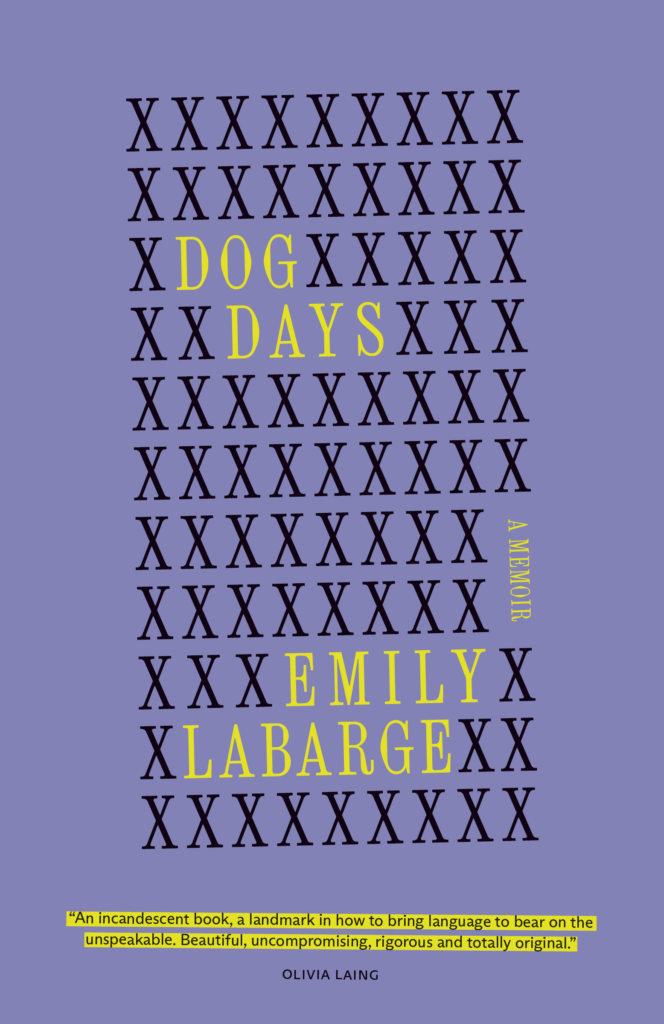
The memoir is divided into three sections that start, stop, restart, loop, and fragment as they grow restless against their own formal constraints. Structurally and syntactically, the book bears close resemblance to one of Carson’s essays or Maggie Nelson’s Bluets (indeed, LaBarge will engage with texts from both authors). We leap between anecdotes and analyses, finding footholds in books, films, and art—Vladimir Nabokov and Walter Benjamin, Virginia Woolf and Mary Barnes, William Carlos and Tennessee and Joy Williams—as LaBarge gathers splinters of experience that reflect her own, each helping her articulate something that resists being easily said. Throughout, we are immersed in the velocity of LaBarge’s mind. She’ll whirl into an analysis of Nelson’s The Red Parts and then whirl quickly away, only to off-handedly return to “Nelson” again, with no contextualizing handlebars, fifty pages later. Nothing is put down. And yet the book works, not only because of La Barge’s formidable intellect but also because of her talents as a stylist. It is a pleasure to watch her arrange her words.
The first section, “The Good Story,” is the most metatextual. Here, LaBarge works syntactically. She recounts the attack and the ways her family were asked to narrativize it to law enforcement, embassies, relatives, and friends. The local police take a sequential list of actions (“Sigh, sigh, and then what happened, yes, yes, and then what happened. Sigh. Then XXX then XXXXXX then XX then X and XXXX”). Back in Canada, the listing continues. LaBarge and her family must draft a Schedule of Loss, “the official title for what must be given to an insurance company or any kind of court or tribunal issued with loss compensation.” Frequently, the first section of Dog Days fragments into long lists—of actions, of losses, of the attack—during which LaBarge drops or censors words, allows phrases and clauses to be broken over and over again, subverting the list as a vessel for organization and clarity, highlighting its limitations.
LaBarge’s analyses are so clean and compelling that she is almost over my shoulder, directing my attention here and then there.
The second section, “It’s a Wonderful Life,” turns to depictions of sleep, of depression, of the moon. Anchored by her experiences in the weeks, months, and years after what she refers to as “the Event” (the parts of her life that were subsumed or lost or rendered incoherent), LaBarge pendulums between artistic renderings of these darker states and moods, and psychiatric literature. We move, here, from the fragmented sentence to the fragmented self. Of greatest concern is what happens to one’s subjectivity when one falls out of linear time and into a more oneiric state of being. It is a nocturnal-feeling chapter, a building arrangement of vespertine images that shade in the Event’s profound impact, estranging LaBarge from the person she was “before.”
“Dog Days,” the final third, is deceptively more straightforward. It achieves the most narrative coherence, opening with an invocation towards genre—a private investigation LaBarge launches against one of her attackers years later—to directly address what closure might look like and whether it is even possible, on and off the page. Will she know the right form when she finds it; if so, will she like it; if so, will it help her; if so, will it smooth out her life’s edges and return it to legibility? LaBarge probes whether there are answers to her questions or, if not, at least an end to the asking.
2.
Take notes! We are writing a review, after all. The witty hook, the robust synopsis, the laudatory adjectives, the incisive critique, the minor fall, the major lift, the analytical refrains that cohere all of this reading into meaning, the meaning that justifies the price of the book in both capital and consideration. LaBarge has done her part and written the book. I must do mine, and adjudicate value.
Take notes! And I do. The publisher has sent me a digital ARC, and one so secure that I cannot even highlight passages or scribble in the virtual margins without an elusive password. I compensate by documenting particularly significant and striking pages in the Notes app of my phone. I track themes, particularly impactful sentences, LaBarge’s citational patterns. I note the pages on which “trauma” is addressed directly: sparingly, it feels, in the first two sections, and then almost constantly in the last third, now that LaBarge has established its emotional contours through a steady series of references and metaphors. I record these details diligently, thinking any one of them could lead me to some useful thesis. In the end, my Notes document is 940 words long, with an annotation for almost every other page. It’s all electric. It all demands attention.
I’m particularly drawn to LaBarge’s analysis of David Lynch. Trying to find a narrative vessel vast enough for her topic and flexible enough for trauma’s incoherent aftershocks, LaBarge turns to Mulholland Drive (2001). One early scene mesmerizes her: a narrative tangent between two men, Dan (Patrick Fishcler) and Herb (Michael Cooke), who hold an uncanny meeting at Winkie’s diner and do not reappear in the film’s remaining two hours. “These men,” writes LaBarge, “are not quite right.” Dan, for one, is undeniably haunted. He dreamed about the diner and cannot forget the dream. In it, everyone inside Winkie’s, including him and Herb, was seized by terror. He explains: “Then I realize what it is. There’s a man in the back of this place, he’s the one doing it. I can see him through the wall, I can see his face. I hope that I never see that face ever outside of the dream.”
Already, the scene resonates with LaBarge. She knows the feeling of believing, against all reason, in the man around the corner, of being able to see his face through the wall. The man, says LaBarge, “is a darkness, a heavy feeling, a riptide, a terrible certainty” and this feeling can move not only through walls, but also through time and space. It can seize you at any moment.
Dan and Herb want to prove the dream was just a dream. They exit the diner. They walk toward the wall. But before Dan can turn the corner, the man appears. He exists, and his face is terrifying. Dan collapses to the ground. He dies on the spot, in Herb’s arms. This is, for La Barge, affirming: “Dan believes, perhaps, that he can assimilate the event he fears most by facing it and acknowledging its unreality, its non-power over him, but he cannot. It is, in the end, his undoing. Some things cannot be incorporated into the time in which we have been taught to live our lives, into the good stories we tell about them.”
I watch Mulholland Drive for the first time after reading Dog Days. I play the film on my laptop and justify this sacreligious decision with nostalgia: this is how I binged Twin Peaks in high school, minimizing the screen whenever the terror mounted, shrinking Bob’s face to a corner of my screen. Shrinking the screaming demon didn’t help then. Likewise, even LaBarge’s forewarnings don’t impede the dread now.
After a brief jitterbug, Mulholland Drive opens with inexplicable tragedy. There’s a brandished gun and then a car crash. A glamorous woman (Laura Harring) survives both, but loses her identity. Later, she will call herself Rita. But first we watch her run, nameless, through Los Angeles with the skittish gait of a feral coyote. She sleeps under a bush, wakes, sneaks into an open apartment, and cowers, wide-eyed and confused, underneath a table. We cut to Dan and Herb, we meet the man behind the wall, we watch Dan die.
She knows the feeling of believing, against all reason, in the man around the corner, of being able to see his face through the wall.
The movie has barely begun, but the episode behind Winkie’s proves instructive. Scenes of Dan and Herb approaching the wall, with Dan becoming progressively sweatier and overcome, are cut with what is presumably Dan’s point of view, the camera inching closer to the wall. This first-person camera trick will recur throughout the film. Later, when starry-eyed ingénue Betty (Naomi Watts) arrives at her aunt’s apartment, the same place Rita has taken refuge, the camera paces slowly, shakily, through the hallways. The effect is clear: it’s a jumpscare without a jumpscare. Lynch mobilizes the audience’s fear. The man—the danger, the dread, the riptide, the terrible certainty—could be around any corner, could appear anywhere, at any time. The terrible thing could be hunting the women, it could be inside them. Betty is oblivious, but whenever the perspective splinters and shifts, I know better. I can see him there—I can’t unsee him, his face through the wall. I know he’s watching.
LaBarge is watching too. On the screen, Betty and Rita are trying to uncover Rita’s previous identity. In my peripheries, I am trying to understand Dog Days. The incredible thing is that I can. LaBarge’s analyses are so clean and compelling that she is almost over my shoulder, directing my attention here and then there. Think of the perspective of trauma, what it can hold and what it can’t. Think of the dream state, what it means to live in its fractures. I do, I watch on.
3.
The Moore story ends with the Mother, the Father, and the Baby leaving the hospital. The Baby has recovered from his surgery and the parents have decided to forgo chemotherapy. “We’re doing watch and wait,” the Mother says, when pressed by nurses. In the elevator, she swears that she “never want[s] to see any of these people again.” Then, La Barge notes a curt shift “from third to first person, leaving us with an abrupt and direct demand… No, not a demand, a statement, as if the Mother has been exhausted of question marks.” The final two sentences of Moore’s story become this exhausted demand: “These are the notes. Now where is the money?”
Time to loop back, time to return to LaBarge’s question: what if the only way to pay for the grief is to sell the grief? What if it cannot be fully expressed or successfully overcome? This is one way to read Moore’s story, and it is a compelling one. Rereading “People Like That” alongside Dog Days, I cannot help but notice further parallels. Like LaBarge, the Mother shirks a definitive narrative. Chemotherapy would, perhaps, provide clear answers, but the ending might not be what the Mother and the Father want. Rather than relief, chemotherapy’s conclusion might open up new grief. It’s harder to find a way to live within the narrative, to not look for its edges, but perhaps it is more survivable that way. These are the notes, not the story. Are they still valuable, just as they are?
LaBarge is not, nor does she ever claim to be, the first to connect trauma to fragmentary expression. But Dog Days’ skillful experimentations are a welcome contrast to still-abundant non-fiction that positions trauma as something to be overcome or, at least, a chapter that can be closed. Each new tangent—syntactical, metaphorical, visual, or otherwise—offers a different way to move with rather than solely through the harm. Her memoir is in step with a burgeoning literary trend Vulture’s Gideon Leek identifies as “the post-trauma plot book,” which figures trauma not as a climatic, conquerable event but a continuous anticlimax that, nevertheless, doesn’t prevent its protagonists from turning to their futures: “in the post-trauma plot, we learn… that things happen despite the trauma.” LaBarge arrives at a similar place, not through “vice signalling, performative transgression” or raunchy satire, but through artistic experimentation and generous, wide-ranging reading.
Dog Days doesn’t come to definitive conclusions about trauma or its narrative shape, nor does LaBarge ever suggest there will be any, even just for herself. But by the end, one feels they know something of LaBarge, her life, her taste, her brilliance. It’s possible that a good, ironclad narrative can transform your life into something more solid, can imbue you with meaning. It’s possible. But LaBarge’s elliptical non-narrative leaves me transformed in another way, in the relational practice of getting to know someone, deeply and specifically. Their notes, their limits.
What if that’s enough?
Rebecca Peng’s fiction and criticism has appeared or is forthcoming in The Walrus, Room Magazine, and the Chicago Review of Books, among others. Her short story “The Department of Unjust Histories” is a finalist for the 2026 Writers’ Trust RBC Bronwen Wallace Award for Emerging Writers. She exists online at rebeccapeng.ca.