
Stories for the Surveillance Age
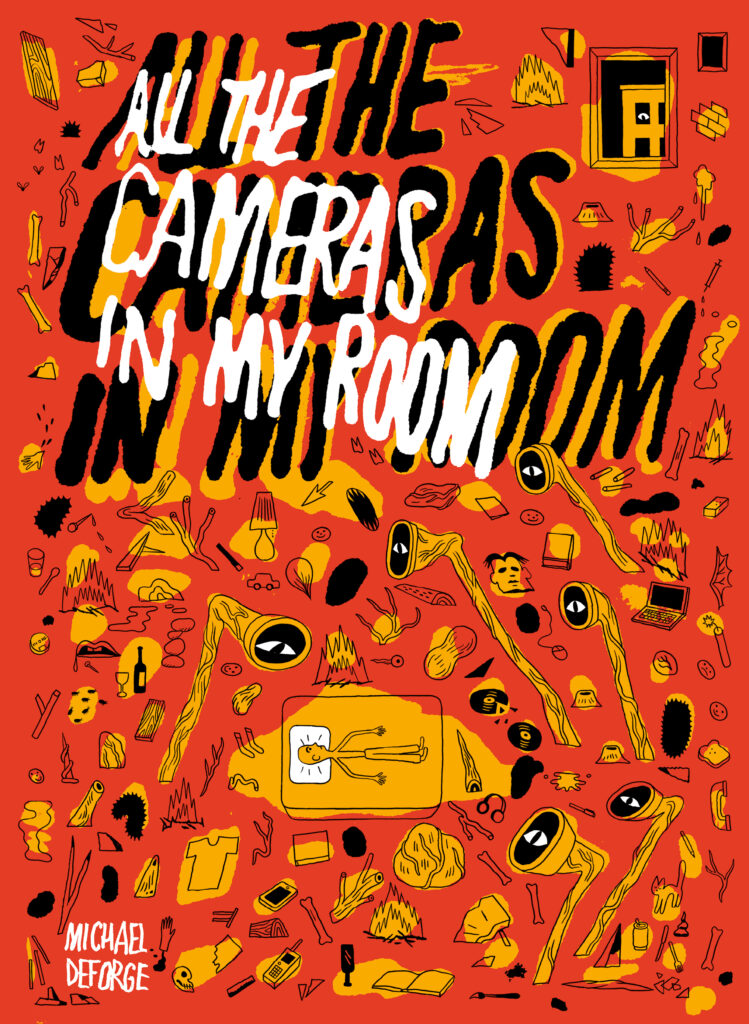
All the Cameras in My Room
By Michael DeForge
Drawn & Quarterly, 200 pp., $30 (hardcover, full-colour illustration)
April 21, 2026
Michael DeForge might be the patron cartoonist of the millennial laptop class. His comics are set in dreamy abstract landscapes and populated with gooey “corporate Memphis” characters. He riffs on his generation’s lingua franca of Redbubble stickers and Instagram carousels with a knowing wink. And yet, while DeForge’s work is almost always funny, there’s far more going on than mere quirky irreverence. His stories are equally likely to veer into raunchy sex, diatribes about late capitalism, moments of genuine emotional nuance,or, even all three at once. This makes sense given his resume. On top of his prolific solo comics work, DeForge has sharpened his pen working on Cartoon Network’s Adventure Time, illustrating covers for lefty magazines like Jacobin, and contributing countless posters for indie bands and book fairs. He wears his influences on his sleeve—children’s cartoons, corporate clients’ Adobe Illustrator vector art, absurdist short story writers like Thomas Bernhard and George Saunders, and anti-authoritarian politics—and mixes and matches them to great effect. While they’re certainly littered with visual gags and South Park-style satire, DeForge’s comics are elevated by their subtle intelligence and literary bent.
DeForge is startlingly productive. In the past fifteen years he’s published almost as many books, most of them with Montreal-based art comics publisher Drawn and Quarterly. He’s beloved in contemporary comics circles for how his books toe the line between playful and heady. But that same singularity can make his novel-length work daunting. 2022’s Birds of Maine, initially published as a webcomic, is nearly 500 pages of meandering conversations about utopianism and climate collapse, conveyed by spikily-rendered birds. Last year’s Holy Lacrimony is a psychedelic alien abduction story whose characters look more like hieroglyphs than humanoids. The comics could be thought of as Jack Kirby meets Franz Kafka—toying, as they do, with the visual language of adolescent, Adult Swim psychedelia while maintaining an unshowy sophistication in their plots and prose.
Far from connective and playful, tech has become synonymous with surveillance and corporate duplicity. DeForge isn’t just attuned to the shifting political tides but mines them for their complexity.
His graphic novels have gotten more attention, but DeForge’s short stories best exemplify what makes his kooky style special. They allow his antagonistic impulses to coexist: surreal, almost avant-garde page compositions that nonetheless treat their prose with a poet’s seriousness. All the Cameras in My Room, a new collection of original and previously serialized strips, hones in on his recent work’s preoccupations. The stories are playfully off-kilter. Every time you think you know where a DeForge comic is heading, he bobs in another direction. “Universal Studios Monsters” casts your favourite public domain villains in a talky, Bergman-ish relationship drama with the art of a smutty Dali napkin sketch. Frankenstein’s monster offers Dracula relationship advice while his bride licks the shaft of, uh, his screw. Meanwhile, the Wolfman vents to the Mummy, telling his side of the story: “There’s this condescending edge to the way [Frankenstein] responds to my interests […] We used to bicker about his habit of overexplaining things to me. I asked him to let me learn on my own and reach my own conclusions, but it’s like he responded to that by totally checking out instead.”
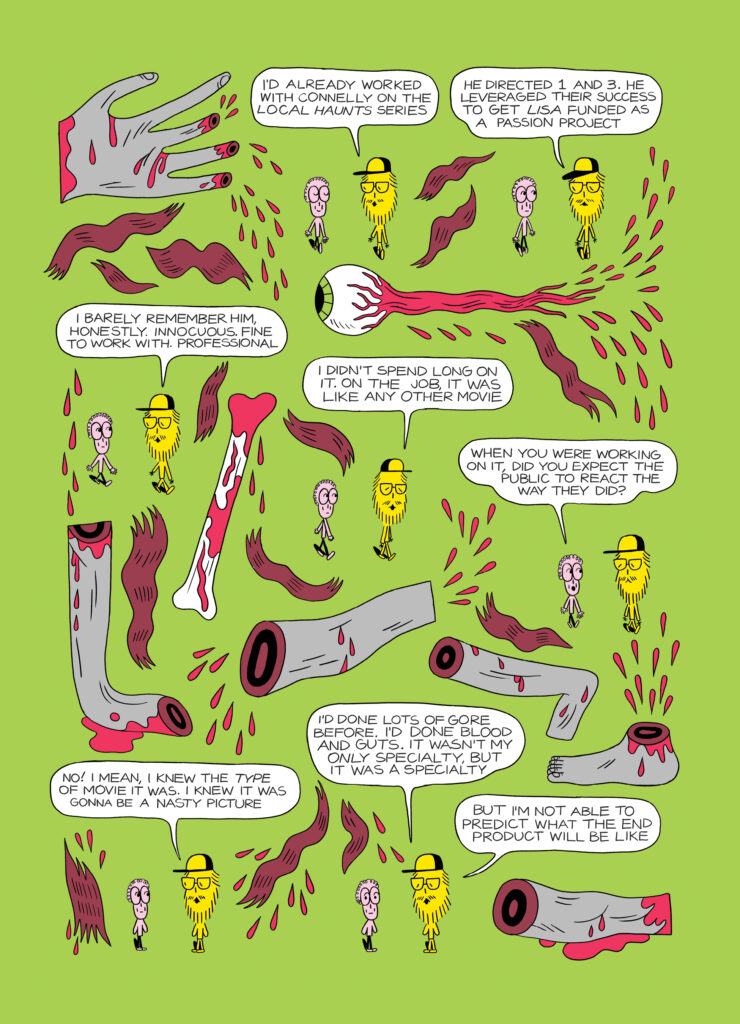
The flipside of “Monsters” is the deadpan, comparatively realistic “Gore,” a (fictional) interview between a reporter/fanboy and an aging Hollywood costume artist. The two talking heads are rendered as tiny thumbnail figures wandering a maze of blown-up horror movie iconography—severed limbs, monster masks, and bloody knives. Yet their conversation is grounded. Even when played for laughs, DeForge sneaks little insightful character moments into the conversation. “Are you at all heartened by the second life your work has had?” asks the reporter, referring to a Blu-Ray reissue of a cult, exploitation horror movie that comes bundled with a retrospective essay by a well-known feminist critic. The costume designer stares uncertainly into the middle distance, dwarfed by the gruesome visual language of schlocky horror that looms over him. “Second life?” he says. “No, I’m unfortunately still wading through my first one.”
DeForge’s last collection, Heaven No Hell (2021), pulses with the language and visual sensibility of millennial leftism. Its stories aren’t necessarily political but have a palpable anarchic streak. The comics are populated with polycules and precocious schoolchildren who refuse to comply with an FBI investigation. That neo-socialist bent is still present in All the Cameras, yet here it takes on a different register, less playful than paranoid. The collection’s title story is a two-pager with a classic DeForge Smiling Friends-ish protagonist privacy-proofing his apartment. This effort—which starts with masking tape over a laptop webcam and a Post-It on the front door’s peephole—quickly devolves into absurdity. He puts bowling balls in his bed to mask any body-shaped lumps in his mattress, and practices “good phone hygiene” by keeping it, batteries-out, in a jar of rice whenever he’s indoors. The story is farcical, yet unlike older DeForge stories which leaned into absurdism in a way that felt warm, the jokes here are darker, designed to draw something between a chuckle and a cringe. Political anxiety simmers palpably on the page.
The same energy is present in “Bugged,” a sort of illustrated, techno-apocalyptic prose poem in which all the world’s technology starts bleeding out and dying. With chunky linework and coloured with big swaths of melancholy blues and purples, DeForge’s illustrations here are some of the most straightforward and arresting of the collection—a smoke detector bleeding out from the speaker of its plastic case, or a drip of blood falling from a hearing aid in-ear, making it impossible to distinguish whether it came from man or machine. The prose here is assured in a way few comics are: “The motive,” explains the comic’s narrator, was obvious: “[the machines] had grown tired of us.” The story ends with a three-panel sequence that zooms in on a frayed wire and a lesser-rendered finger, dripping with blood. “Is this my blood or yours?” wonders the narrator. Tech-inflected melancholy is an unlikely step for DeForge, one which channels the anarchic satire of his older work into timely subject matter. A decade ago, DeForge might have smushed together lofty political ideals and slide-deck-ready vector art in an attempt at irreverence. Yet in today’s techno-pessimistic moment, DeForge’s go-to iconography has become saddled with a different sort of meaning; far from connective and playful, tech has become synonymous with surveillance and corporate duplicity. DeForge isn’t just attuned to the shifting political tides but mines them for their complexity.
This left-informed—but ultimately detached—atmosphere comes to a head in All the Camera’s final story, the novella-length “The Organizer.” From its first two pages, “The Organizer” announces itself as an even further departure from DeForge’s zany bread and butter. Gone are the wobbly linework and splashes of colour, replaced with a claustrophobic four-panel grid system, cut like a window pane, and the white-on-black imagery of a linoleum print à la Black Hole-era Charles Burns. “The agency I work for is an acronym you’ve heard of,” opens the story’s narrator, “but perhaps not the one you expect.” The narrator—unnamed and wearing a nondescript black hoodie and a V for Vendetta-cum-Occupy Wall Street mask—is an informant who has infiltrated a radical group with motives and an ideology that aren’t particularly clear. Her task is to live among her fellow vigilantes and write meticulous reports back to the agency. “At the debrief that night, I started an argument,” she explains, stoking egos with the couched language of academized revolution: ‘“Militancy.’ ‘Capacity.’ ‘Escalation.’ These words seemed to mean something at some point in time, and didn’t anymore. ‘We must escalate,’ I’d say at a meeting. ‘Now is the time to escalate.’ ‘The political moment is ripe for escalation.’ The group would nod accordingly. Later that week we’d spray paint a window.” These musings accompany panels showing the narrator, unmasked and bathed in sunlight, commuting to her nine-to-five.
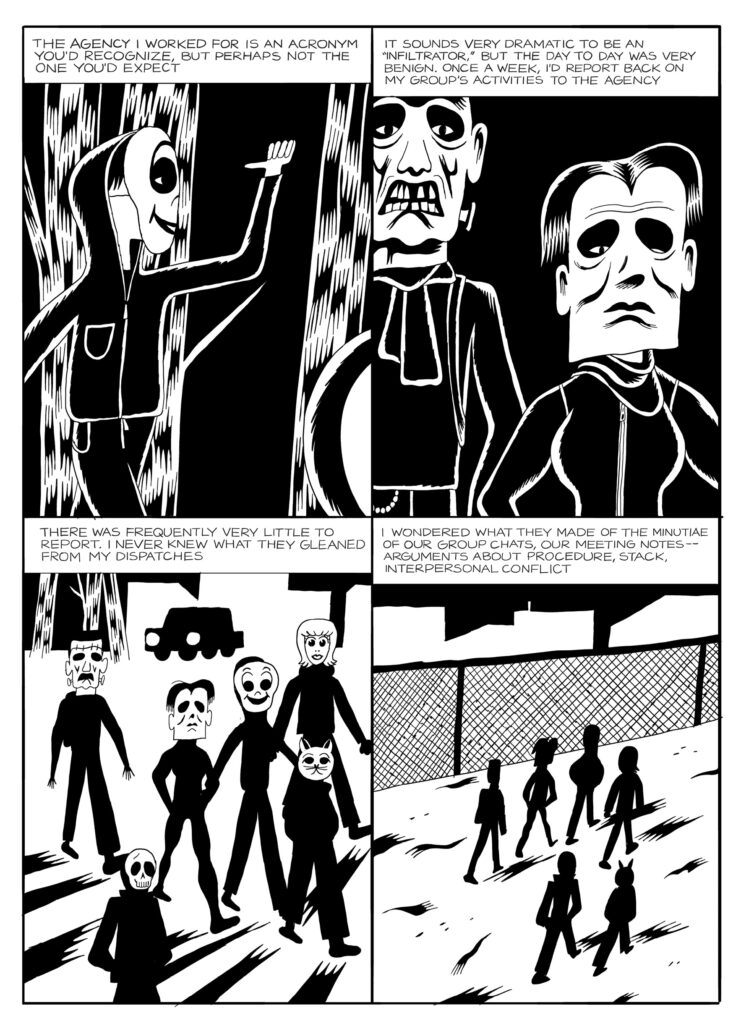
This day job at a Snapchat-esque company called Rile that operates a dating app, whose encryption tools are preferred by lefties and criminals, becomes the grounds for the group’s big action. Without her agency’s explicit approval or instruction, the narrator subliminally convinces her comrades to attack a data center. They drive three hours, break in, and torch the servers. The gasoline-doused flames are among the story’s few loose, organic lines. With the job done, the vigilante group temporarily disbands, paranoid about getting caught. The narrator reports back to her agency. Within days, three of the group are arrested. Then, so is the narrator. In jail, the agency reaches out with her next instructions. The agency briefs her on“how [their] cases could become a national sensation [but] public interest would start to wane as the legal process dragged on.” They explain how “interventions from the agency would allow [them] to be let out early—after three years—on good behavior.” They say that the narrator “would become a political celebrity [and] the iconography of [the group’s] masks would become appropriated by global movements of the left and right.” Everything unfolds exactly as the agency intends it to. Finally free, the narrator pivots to a fundraising job for a left-wing nonprofit, now a professional radical. The psyop is complete.
At this point in “The Organizer,” you’d be forgiven for thinking the comic is by anyone other than DeForge. From the tight art to the jaded, no-longer-radical politics, the story seems like DeForge grappling with his pessimism on the page. His signature absurdity is there, but something about the prose and linework seems beaten down, subdued. And yet in its third act, “The Organizer” takes another turn, one distinct from both the infectious optimistic energy of his early work and the embattled ex-radicalism of the novella’s beginning. Now in middle age, the narrator keeps reporting to the agency about her work in the left-wing charity world, though she gets the sense she’s no longer a prized intelligence asset. The double life has been wearing on her. Her life no longer feels real. And yet on a date (she’s still on Rile!) she reconnects with one of her ex-comrades from the vigilante group who’d been on “the action” with her. The woman reveals that she too was an asset of an intelligence agency. The narrator listens to her story, moved yet unsure if her date knows about her own double life, too. Was the entire movement made up of infiltrators? The narrator reports on the date to her handlers, but in a roundabout way she feels relieved by the responsibility lifted off her shoulders by the revelation of other spies and infiltrators. “I imagined [the date] writing her own report,” she concludes. “I assumed our correspondence went to the same place, the same readers. […] I made sure this one had a lot of detail. Every part of our date. Word for word. What we ate. What she smelled like. What sex with her was like. I hoped it felt real to whoever was reading it.” There’s a yearning in her cold, agency-instructed lack of humanity. And yet in a roundabout way, the narrator may have finally found a kindred spirit.
The loosely-defined left is on defense, maybe. Or at least battered. But DeForge, and his comics, don’t go full doomer.
This is a new register for DeForge. It’s pessimistic in the world-historical, political sense. The buoyancy of his old work is gone—a symptom, maybe, of a generation who were promised that technology was the future yet have woken up to a world where the only firms still hiring are the Palantirs and Anthropics. Yet despite the paranoia, the sense of helplessness, there’s still, in a roundabout way, a humanity to the stories. The jokes are sharper, darker, but they’re still punctuated by those unlikely moments of grace. The loosely-defined left is on defense, maybe. Or at least battered. But DeForge, and his comics, don’t go full doomer. If anything, All the Cameras is a call for the zany satires of DeForge’s older work to grow some teeth. Yet the real depth of these comics isn’t the bite of their snark. It’s the genuine emotional core that he manages to find even in technoapocalyptic hellscapes.
“The Organizer” punctuates All the Cameras stylistically and in terms of DeForge’s evolving interests. An easy read of the collection’s throughline is that the idealistic youth culture of the 2010s—think the visual language of stick-n-poke tattoos and screen-printed dad hats—has grown up. If not totally disillusioned, then at least these once quirked-up millennials are starting to get world-weary. This is reductive, but not wrong. As the 2020s wage on, and our cultural aesthetics evolve (or don’t) with it, DeForge’s comics—funny but knowing, irreverent in a way that only feels more and more real—are only going to become more relevant. After all, there are cameras in our rooms. And the first step towards resistance might just be having a sense of humour about it.
Martin Dolan is a writer from Albany, New York. His essays have appeared in The Baffler, The Drift, The Nation, and more. He’s online at dolanmartin.github.io.