
Poetry and Risk: An Interview with m. nourbeSe philip
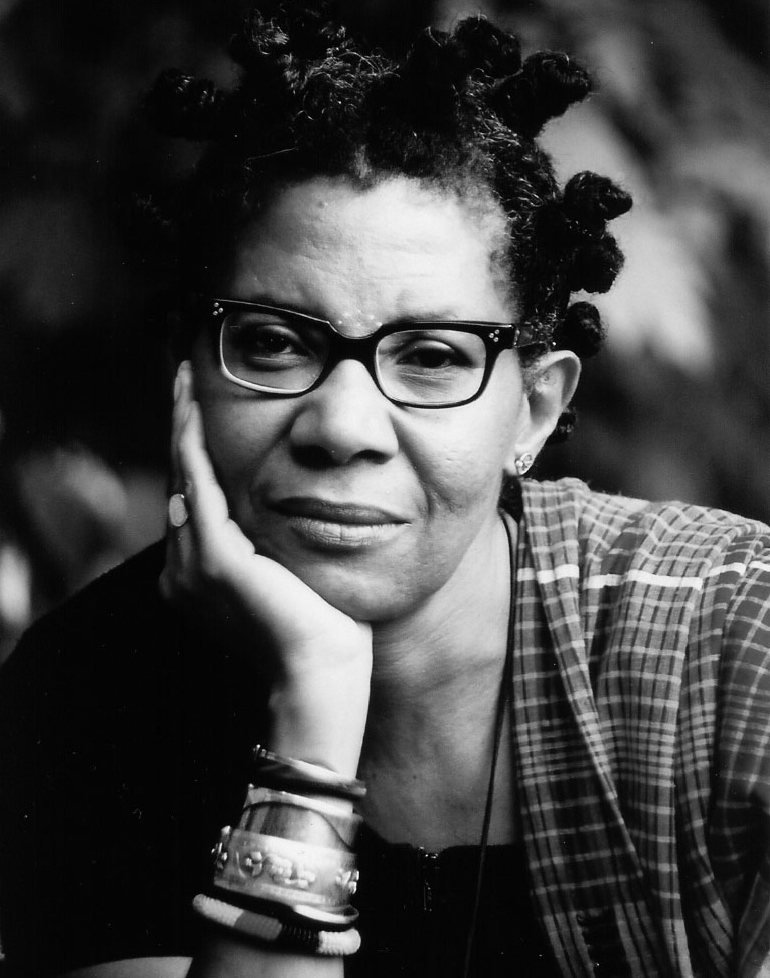
If history moves like a spiral rather than a straight line, then art and literature become records of our lived experiences, cultures, and political struggles that affix themselves along a curving temporal arc, explaining, as each new ring circles around the previous one, why works from the past remain relevant in new contexts. This recognition burned in me as I pored over m. nourbeSe philip’s collections She Tries Her Tongue; Her Silence Softly Breaks and Looking for Livingstone: An Odyssey of Silence, newly reissued this spring by Invisible Publishing. These two works seek to interrogate language and its role in colonialism, and though originally written in 1988 and 1991 respectively, their insights feel as urgent as ever.
In She Tries Her Tongue; Her Silence Softly Breaks, a foundational text that Katherine McKittrick aptly describes in a new foreword as a “textural-bibligographic rewriting of black femininity that cannot be explained,” philip positions creative writing as an image-making process complicated by the tensions of working as a marginalized artist: “The challenge, therefore, facing the African Caribbean writer who is at all sensitive to language and to the issues that language generates, is to use the language in such a way that the historical realities are not erased or obliterated, so that English is revealed as the tainted tongue it truly is. Only in doing so will English be redeemed.”
Throughout her oeuvre, philip confronts the historical, sociological, and etymological contexts which inform the way that we speak and image ourselves. In doing so, she not only brings our attention to the ubiquity of anti-blackness and white supremacy, but provides a model for art as a space of recovery. When working within a market highly influenced by colonial logics, there is always the risk of reproducing the same forms of loss instigated by systemic violence. At its best however, creative practices can help us reconnect with ancestral ways of knowing. Questions of reclamation, epistemicide, and the erasure of knowledge systems haunt her poetic novel Looking for Livingstone, which tells the story of a woman travelling through Africa in search of David Livingstone, a Scottish missionary who was miscredited as a “discoverer” of Africa. These works, along with her pivotal book-length poem Zong!: As Told to the Author by Setaey Adamu Boateng, an “anti-narrative lament” which gives an account of the Zong massacre, make up a triptych shaped by history, silence, power, exile, geography, and spirituality.
In March, philip and I met at a café to discuss some of the themes and questions guiding her prolific body of work. That morning, there was an air of openness and ease as the city awoke to what felt like the first glimpses of spring. As we placed our orders at the counter, I complimented the barista’s collection of antique rings, inherited from their grandmother and uncle. This blossomed into a brief conversation between the three of us about the talismanic function of jewelry. Writing this, I’ve come to recognize that philip’s books, which have gone in and out of print over the years, have a similar power and effect. Each is its own revelation, piercing the silence around the troubled histories of Africa and the Caribbean. These are collections that live with you, guiding you into the realm of the sacred.

Jessica Kasiama: Reading She Tries Her Tongue; Her Silence Softly Breaks and Looking for Livingstone were both transformative experiences for me. What was it like for you to revisit these works at this moment?
m. nourbeSe philip: Given my age, this is an extended moment in which everything I’ve written is being revisited. And as I went through the process of rereading them–it’s hard to say this without sounding boasie, as they say in patois–but I felt a sense of “well done, young woman,” because I was a lot younger then. Sometimes you look back at stuff you’ve written and think, “oh, I would have done that differently,” but I felt it was still relevant and that was what was unfortunate about it. So much has changed, but so little has changed as well. We have forces actively attempting to roll back all the developments in decolonization. This is history, and history has a recursiveness to it, so the books are still relevant today.
JK: Can you expand on that feeling? How would you name it?
mnp: How much time do you have? Abject despair. Grief. Anger. Rage that can paralyze you because there’s so little you feel you can do. I actually went into therapy a few months into the genocide in Palestine, partly because international law had always been dear to my heart. Even though I knew that there was still so much work to do in those organizations to make them more effective, I still felt like I had believed in something that no one in their right mind should have believed in. I actually began seeing it as a form of spiritual crisis. I’ve come out of that now and I’m not sure where I am. In times like this, poetry becomes even more necessary.
We have forces actively attempting to roll back all the developments in decolonization. This is history, and history has a recursiveness to it, so the books are still relevant today.
JK: In the introduction of Looking for Livingstone, you reflect on the text’s central questions, writing: “What did silence really mean; was it always negative; were there ever contexts in which silence could be a positive force?” You’ve written briefly about cultivating a silent meditation practice. I’m curious to hear about the rituals and habits in your life, outside of writing, that have helped shape your thinking around silence and the limitations of language.
mnp: I [meditated] for fifteen years quite religiously—pardon the pun. It was a form of silent meditation. I don’t have a religious practice, but I believe deeply in the spiritual aspect of life.
Coming out of that practice was a profound interest in silence. I have come to believe that the most important thing happening on the page in Zong!, for instance, is not the words but the silence—in its potentiality, in its promise, [and] in its calling out to us to try and fill those gaps with something meaningful.
Years ago, I did a residency in Paris with a colleague, Omar Berrada, who is of Moroccan background. I had got a grant to look at what I call Afrosporic communities, and I was particularly interested in the Gnawa of Morocco. The Gnawa are a group of West Africans from the Sahel region [and] who were taken as slaves by Arabs to what’s now Morocco.
There’s a huge music festival that happens in the town of Essaouira outside Marrakesh. I found myself there. But before that, Omar and I had been working in Paris on issues related to Moroccan culture, history, and particularly the presence of anti-Black racism. He had brought with him a series of poems, which are sung by the Gnawa during spiritual ceremonies. Now when you look at the poems, you’ll see words in brackets. But he explained that those words are never pronounced, which is fascinating to me because of my interest in silence and its manifestations. We were working towards a performance, so I started collecting [and shaping] those spoken silences, so to speak. They’re really beautiful.
Silence continues to haunt me, and I think it may be a metaphor for that larger historical silence that surrounds our cultures. When I think of [the creativity of] Caribbean and African people, I think that’s what they’re translating–the silence that was imposed on them. It has to find an outlet.
JK: You’ve worked with language at such a granular level, both artistically and legally in your past role as a lawyer. How has that intimacy changed the way that you move through the world?
mnp: For myself, I am always trying to deconstruct language. I’ve taken recently to making up words and I’m compiling my own dictionary. For instance, when we had the big snowstorm, I thought of the word snowly. The day was snowy and slow–snowly!
JK: I like that!
mnp: That’s the fun part of it. The painful part is being aware much of the time that I don’t have a mother tongue to retreat to.
I have this deep interest in language because I actually wanted to be a linguist or translator.The idea of speaking a number of languages attracted me. I’ll share this with you: there is a Twi word okyeame and translated into English, it means linguist. When I was in Ghana, a colleague of mine told me that the linguist plays a very important role. One of his friends, a medical doctor, had been asked to become the king’s linguist and gave up his practice. The linguist liaises because the governing royal personage never speaks to the people—the linguist is the one who is translating the words and the silences from the ancestors to the king, from the king to the people, and so on. I thought to myself: maybe I have become a linguist of sorts [with] Zong!.
I am always trying to deconstruct language. I’ve taken recently to making up words and I’m compiling my own dictionary.
JK: In your 2017 collection Blank: Essays and Interviews, you write: “…in such a world, to be indigestible—to have the ability to make consumption difficult—is a quality to be valued.” As a writer and teacher, why is this quality important to your work, and how might you respond to a reader’s desire for clear, interpretive rules which can often reproduce colonial logic?
mnp: That was in response to comments about [my] work being difficult. The assumption [is] that because I’m black and female, it’s not supposed to be difficult or that only a certain group has a claim on being complex.
I don’t set out to make it difficult–not at all–but I think what we’re dealing with is very difficult and complex. If someone has to work hard at [understanding] what I’m saying, then I think that is a good thing. I have an essay I wrote some years ago calling [it] the threat to cohesion. Because part of how the system works [is] everything has to be fitted in and it has to cohere. I think some of what Zong! does is threaten that cohesion: ‘what is actually happening here? My mind can’t make sense of this and so on.’ Because of the history of how our cultures have been taken and literally consumed, that idea of indigestibility is very important to me.
Like Sinners, you know? I don’t watch the Oscars, but my son and my partner decided to watch the other night. At first, I was a little disappointed that the film didn’t get Best Director or Picture [but then] the following morning, I thought, no, I’m glad. You know, who am I to speak for Ryan Coogler? He’s done the work. But I am happy that a film like Sinners is not fully compatible with the decrepit, pedophilic culture that we know Hollywood to be.
JK: Can you say more about the relationship between poetry and risk?
mnp: I can only speak for this black [and] African descended poet. Poets who belong to the dominant structure may have other things going on, but we have had poets from that culture–African and Black–who have taken great risks. My personal definition of poetry is risk-taking at the highest order. There’s a line in “Cyclamen Girl” — “she / swung / a skilled trapezist—/ no net / below / no one / to catch / her.”
When I think of Zong! and where I had to go with that, I think that’s the only way I could do it. There’s been a price to pay for speaking about racism in this culture but you know when the Traveler appropriates Livingstone’s words and says, “I will open a path to the interior or perish.” That is what poetry has been for me.
JK: Before we wrap up, I’d love to know what ideas have been haunting you lately? What feels like it’s asking to be written?
mnp: I have a lot of unpublished work, but I [also] love detective stories and mysteries. I think, for instance, the family is one of the greatest mysteries. You’re born into this group of people, you love them, but they can be so different. As you get older, the mystery is what actually happened—and all we have is memory.
Around thirty years ago, I wrote a novel called Queen Hat about Queen Hatshepsut, the first female pharaoh. A little boy dreams about Hatshepsut’s daughter. There’s another children’s story called Leo the Liberating Lion about those stone lions you see around the city. I’d like to see them published before I die. In terms of new stuff? I think I want to change my persona [laughs]. It’ll be a mystery.
Jessica Kasiama is a writer and arts facilitator based in Toronto.