
Fuel for a First Novel
“Her glazing eyes, staring out of death, to shake and bend my soul. On me alone. The ghostcandle to light her agony. Ghostly light on the tortured face. Her hoarse loud breath rattling in horror, while all prayed on their knees. Her eyes on me to strike me down.”
—James Joyce, Ulysses
“Why are you so angry, Zachary?”
She had read through the first draft of my novel, Fancy Gap, and hated it. That was it, really—all my mother could muster in terms of feedback on the artwork I had hoped would push me past a lifetime of anger and resentment to a place of righteousness in her eyes. In the world’s eyes, maybe. I was looking for my novel to stand as a final sacrament before becoming that man she so wanted me to be: a good writer, a good artist, a good son, a good brother, a good husband, a good father maybe. A good man.
What my mother had on her mind was The Big Talk, where she would get me alone for a couple hours to put to rest any lingering questions she had for me before she died. She had warned my brother and me that this was coming for each of us, separately. When the time for my talk came, she took me on a drive down from the top of the mountain on which she lived, directing me through the winding spur roads that lead into town. No preamble. Her seatbelt alarm chimed all the while until we arrived at a nicotinated breakfast café in Stuart, Virginia.
I recoil, even now, when I think of the place, and how it seemed to encompass so much of what drove my animosity to begin with: the Rebel flags, the out-of-work farmers congregating over coffee and bitching to one another about a world they no longer recognized, the dogs barking in the locked pickup trucks outside, the men staring at us as we entered. Goddamn them and goddamn it all.
I told her I wanted, when I was writing Fancy Gap, for people to finally look here, here where we are, and (what’s more!) I did it for her: I wrote it for her, for my mother, to finally see what I’ve seen.
What I wish I had known then was how this talk wasn’t really about me, and my brother’s talk wasn’t about him either. This was my mother’s last attempt to absolve herself of her concerns for her sons and, by doing so, to reassure herself of her honest and decent work on this earth, to die as a mother and as an artist, as a mother of an artist, at peace then with her tribulations and struggles. My role wasn’t to defend myself. It was to acknowledge her anguish and release her from the guilt sitting at the table across from her, scowling into his coffee mug.
Nevertheless, and to my great shame, I tried again: “What did you think of the book, Mama? I mean in terms of the story, the details?”
“Well, son, it made me feel sick,” she said.
And that was really saying something, of course, because she was already incredibly sick and dying from a second bout of breast cancer; the morphine and chemotherapy doing so much heavy lifting in nausea-inducement that it was startling to think that my writing could be so distinctly to blame. The medicine was making her feel sick to help her live; to go on living. And me?
I persisted and insisted we wouldn’t have any kind of Big Talk if she couldn’t talk to me about my book. “I wrote it because I thought that’s what you wanted me to do with my life, what I was supposed to do,” I said. She’d always insisted that I would be a writer. Her precocious, lying-ass boy. She almost insisted this fact right into reality. But now that the art was made, she couldn’t accept that I had betrayed her so. That I had betrayed us so profoundly for my work.
I’d committed the cardinal sin of writing out a life (or in the case of Fancy Gap, many lives) where the hurtful truth of our world was laid out unallayed, but the beauty and love behind the story didn’t shine through. I’d made the novel from the clay of our shared memory, but she couldn’t see herself there among the chaos and loneliness. Didn’t see my brother there either, she said, nor my beautiful, hero of a stepdaddy who loved us so. Not as they were and are. Where did they all go? It was as if they’d been burned up and used, their composition changed to something unrecognizable. Their lifetimes fuel for art. What an unfair trade.
And so, she asked, “Why are you so angry, Zachary?”
“I don’t know, Mama, there’s a lot to be angry about. Anger is energy,” I said. How incredibly foolish.

I wanted so badly to be a sweet man, but found it counterintuitive to the movement of my soul—my actions, my choices, my writing, my mistakes, my life—which had always been powered by a resentful energy generated deep inside me. It was inconstant, and throughout my three decades on the earth had resulted in brownouts and blackouts of production, of morality, of thought, and of feeling for myself and others. The shutdowns of consequent shame. And yet, it was still something I could depend on; this core of unstable reactivity, despite the catastrophic and looming risk of a conclusive meltdown. I wrote and read and wrote and read and delivered into that core more combustive fuel, then more and more and more and more. I memorized historical injustices and internalized them. I refined and enriched my own narrative of personal injury and sent it into the fire. I fell in love with hurt people and let them hurt me. I hurt them. I hurt myself. I wrote it all down and tore it up. I let it sit in my mind. I found new ways of looking at God so I could be angry at Him. I found my nervous system growing perceptibly thin. But the angrier I became, the more I could produce, the more I could write, and the more I could prove. I had never thought what the limit might be.
Why was I so angry? I didn’t think that question could be answered anymore. It was too strung-out, multitudinous. Which tree of a forest fire is most ablaze? Easier to answer where and when it began. To what end, I guess we’ll see.
I suppose I should have begun after my Mama ran away with us from Toronto. Our first landing there in Dobson, North Carolina—not too far from Stuart and not too far from Fancy Gap, Virginia—where we lived in a one-bedroom apartment with my mother’s parents. In Dobson the meals were light, the chickenshit smell from the processing plant was bright and acrid, and the towels smelled like mold. It was the first time I remember feeling anger, I think. Maybe I’d been used to or confused by the abuse from which she ran. But I was only five or six years old.
I should have begun there, maybe, with my mother’s violent arrest: the Sheriff’s Office making a visit about her missing court dates, for old speeding tickets, for God knows what; the drama exacerbated by her bad attitude. I remember the deputy’s threats of child protective services and foster care. Her screaming at him and clawing at him, her blouse tearing, the spitting and swearing. For sure the anger comes from there, exactly there. My hatred of Southern authority and the too-humid air. Her disappearance for the night, my brother and I breathing quickly back and forth, holding hands on the quilt-lain floor. The grey morning sunlight creeping cold through the plastic screen door, bowls of off-brand Cornflakes poured by my coughing Grandaddy Mike, cigarette ash floating in the milk. My eating it anyway. Yes. I was angry—but what could I say?
It was all energy; all fuel. In the café, she adjusted the blonde “Karen wig,” as she called it, and was crying in confusion at my consternation and what must have seemed—well, let’s be honest, what certainly was—my purposeful, palpable rage. At what now? My novel was written and it made her sick. What I’d hoped would make her proud had made her weep.
And I’m still there. I’ll always be there: the cigarette smoke curling in the air, her crying eyes, her sun-spotted face, watching me.
I can see her now: hysterical, beautiful, young, wine-drunk, and shirtless fighting, yes, fighting the police in the buzzing blue light of the TV screen’s static, there in the smoke-filled apartment. My grandparents’ retreat to their bedroom, my brother crying, wailing against the shouting and syrupy-accented exchange of threats. And I can see her now too: frail, flat-chested, the scars and radiation burn reaching up her décolletage to her throat, strangling her in the quiet diner, staring at me in grief and disbelief.
“Anger is energy, Mama,” I said. “Anger is energy.”
I have been so remarkably cruel and stupid.
We were there, my mother and I, among the rattling, agonal breaths of history, the country wheezing in time with out-of-work farmers’ moans about the world outside the diner closing in on them. Their jeers and cheers for the Republican administration. Oxygen tanks on wheels. Camel Wides. Me, inhaling the mutated simulacra of “America,” such as it was. Such that stale smoke in a country diner is all America is, now.
We’re here, in the interstitial pressure. This is what I tell myself I thought; still storytelling, still lying in a beautiful way. We’re here between time, between art and life where words don’t matter, the growing pressure to make everything right, collapsing in on ourselves on the unknowable ocean floor of the American psyche—the Deep South. And I told her I wanted, when I was writing Fancy Gap, for people to finally look here, here where we are. I did it for her: I wrote it for her, for my mother, to finally see what I’ve seen.
But she’d seen as I’d seen. She’d caroused with the honky-tonk demimonde while she sent us for sleepovers in the trailers of Bible-beating school friends where we shot pellet guns at one another, at stray cats with a .22. She in bars, drinking and driving not far from us, not far from the stifling statues to lost-cause colonels erected in Hank III town squares; us at birthday parties drinking warm cans of Mountain Dew, the looming mountains surrounding us huge and sad and illuminated blue. Those goddamn trailers of my youth, those static nightmares without wheels, the houses and spouses of the wretched of the red dirt earth. I watched a man throw his wife through a trailer home wall. Of course, we’d seen the ditches of the valley already, seen them all. It was just how we lived, then.
I read and wrote and read and wrote and wrought and reapt, almost biblically, what I sowed. Alienation, loneliness and spiritual hunger. I told her that I’ve been exposed to it like a Pripyatite baby: the radiation of all this misery coursing through the meltdown of the American experiment. It will always be inside me, eating up my insides and tearing years off my life. And hers?
And what a ridiculous man I am, to insist and insist and insist. Reading Fancy Gap, you might think that’s how life just is down there, with hordes of delinquent sufferers hiding in every crook and cranny, drinking polluted water from every brook downstream from the Elk River disaster, the whole earth shaking from the mountain-topping, the gas-seeking explosions and explorations shattering the striated natural wonder of that geography—that hallowed wall of wilderness between east and west—pill mills and chemical spills and welfare and all the miserable rest. And through the mountain wall comes flying a battered wife, comes all the dirtiness of my life; memory digging into the back of my knees. A pellet gun wound. And my mother asking why and what for. It overwhelms me still. Oh God, look at all the anger. She, of course, already knew.
But I held onto that smug grudge, that righteous resentment that artists feel when the world is peeling away from their strong-willed desire to shape it. Breaching containment. I was manic.
“I’m dying, son,” she reminded me.
My mother was an artist in her own right. Maybe a more prolific one than I will ever be. I am writing this while sitting in front of three huge bins of her collected, unpublished works: screenplays, poetry manuscripts, stories, plays, documentaries, aborted novels, letters, and ideas. She had protested through the sixties and seventies. She hated her abusive father her whole life. And she married a couple of men like him then suffered and suffered until she was happy and loved, until she had us and my stepdaddy Michael to love her. And that’s when the art stopped. Whatever residual energy was left sent all her artwork to desk drawers and plastic bins rather than out to the world. I’d made the novel, yes, through and from the difficulty, but I hadn’t found a less-destructive type of energy to make it real. She was warning me.
She was dying. Her heart would stop. She was speaking with me there in a stale diner in the Blue Ridge winter because time was running out. She was wearing a bleach-blonde wig that in no way suited her. It was cropped short and sporty. The locals around us were watching like maybe a bad movie was being surreptitiously filmed. I tugged at my beard and leaned into visible exasperation, performing the anger that was on trial. I ran my fingers through my thinning hair, wrung my hands.
What she wanted for me was to look at her. For me to see the me in her eyes; to know that this emotion was a trap. Her anger burning through all these lives she’d lived; burning up all her work. Threatening to burn up her son. The righteousness still in her eyes. She wanted me to see that it was a time bomb. She didn’t think I’d survive it. The readiness is all. One day the fuel runs out or overwhelms and the meltdown begins.
And so it did.
A few months later, I drove through the winding Appalachian roads heading south, downward, really, regardless of elevation, in the bleary and bleak return through the dreary poverty of my childhood. I remember being there and breathing there—King, North Carolina, Tobaccoville, North Carolina, Pilot Mountain, North Carolina, Dobson, North Carolina—these towns where we survived. Dobson, where, in hospice, my mother died, a Baptist chaplain with me at her bed.
My brother had called me from Central Asia where he was studying on a scholarship. It was late February 2020. I was in the Grand Canyon thinking I’d propose to my girlfriend. I’d been there for one day. The scar in the earth shimmering ice.
“Mom’s really sick,” he said. I told him that she had always been really sick. I felt the familiar injustice coming, swelling.
“She’s in hospice. You need to go home and see her.”
The insurance for the trip on which I had spent all my worldly money would only allow us to fly back to Toronto. We drove to the airport in silence, returned the rental car and went home. I got in my truck and drove from Toronto to Dobson.
Just as I passed Fancy Gap, Virginia, my brother called again. He had been on the phone with our stepfather, and all was bad news: pneumonia, a worsening condition. I said, “Well, I am going to be there in half an hour,” to silence on the other end of the line. “I guess I’ll see you there,” I said. “I’ll see you there.”
But of course, I wouldn’t. I have been so remarkably cruel. The anger in me had boiled over and it was spilling onto everyone I loved. I was glad to be alone in the cab of my truck, quarantined, somewhat, driving ninety miles an hour south on I-77. I wanted to die before I arrived.
All was quiet in the beige room when I arrived. Except the staccato TV news. A cruise ship had an outbreak of Covid-19 on board. They were building a hospital a week in China. Beige room. Drop ceiling, corrugated grey. The last thing on my mind was art. The last thing on my mind was the anger in my art. The rest is silence.
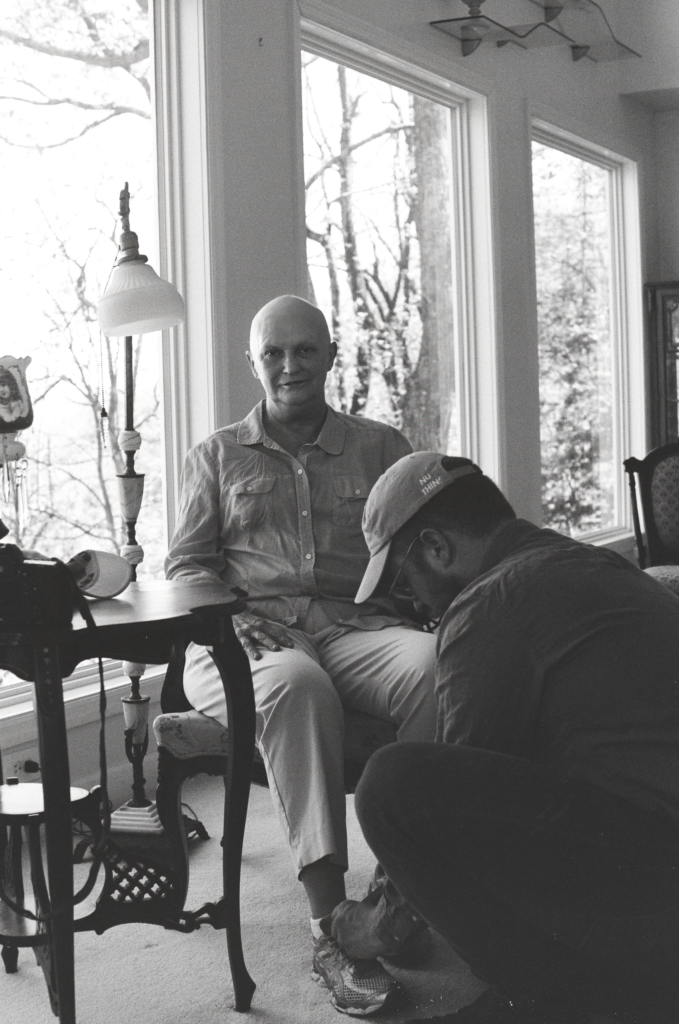
My mother lay on a comfortable hospital bed, connected to tubes. My stepdaddy wrung his hands, wept. No visitors, only nurses and the occasional doctor. I had been awake for 72 hours. Helpless and mad. I stared at the bed, at my mother’s face: her body like a cicada shell, an exuvia of the woman and artist to whom I owed my entire world. Morphine flooding into her. Her trying to ask for the bathroom in baby words. My stepdaddy on his knees. I touched her dry head, held her paper lantern hands and kissed them.
A doctor came in and examined her. He checked her pulse, then flipped up the covers by her feet. He held her toes.
“Cold,” he said. “Not long now. Her body is pulling the blood back up to her vital organs. Not much to do but wait. Say your prayers,” he said.
A Baptist chaplain came in to pray. God, how I hated him. I wanted to strangle him. Like it was his fault, like he was a conduit for the culprit, Himself.
Michael, my mother’s husband, hearing only, “cold,” opened her suitcase and pulled out a few pairs of her socks. He brought them to her bed and lifted the covers, held her feet in his hands, and blew his breath on her toes. He unraveled the rolled socks and slid them on her feet. One pair and another and another. He asked the nurse for more blankets for her feet. She was cold, he said.
And I knew then that I had seen real love. And something in me cooled.
Anger isn’t energy insofar as it didn’t propel me or move me, compel or improve me. It killed me.
I learned that no amount of indignance at the anguish I’ve caused, witnessed, or endured could take me back to innocence. Like that first tree ablaze in a forest fire, the first word I ever wrote as an artist is untraceable, lit by an impossible matrix of pain and hope, hate and love. It is true, too, that no testament to injury can overshadow the guilt constitutive to living. I think artists need to know that. But people can change and grow, and artists can choose to contain or wrestle their hurt rather than eject love from their work.
I am no longer wishing to exorcise only the nightmares. I might have tried to put that into words, there, in the diner in Stuart. But she already knew. She’d already seen.
The grief of her dying was like a barb in me that I’m not sure can be pulled out. But I am not angry anymore. I have quarantined it and tried to persevere. My brother, I think, will never forgive me.
But now to remember the good things. I try to call to mind the love and warmth, the Carolina sunshine and new moles on my back. Buck teeth smiles and Moon Pies eaten in the two miles from the gas station on the way home from school. Laughing and joking and my grandfather smoking as he combed my brother’s long, blond hair. The belly fat and biscuits and gravy, the preacher and hymns on the TV, my mother’s return from county jail, her blousy love, the smell of Pantene Pro-V, mid-April hail on the tin roof, mirepoix-steam midafternoons, my brother’s eating chicken pot pie with a baby spoon, the mini-VHS videos of me a goof, him a goof. How I love that beautiful, sweet boy—that serious man. Look at me, now: the sunshine breaking through while it can. Crow-footed eyes; the world, the memory of the world, so bright and fascinating new.
And so all this writing, all that writing—my novel, the poems, the stories, the essays, what now, already, in the middle of my life, is still my early work—has been what I hope to be an exorcism of that anger my mother so earnestly hoped for me to one day finally burn-through. Rather than the fuel that drove me, it was the myopia blinding my art to the truly beautiful, to the sublimity inherent to grace, inherent to forgiveness, and inherent to real love. I know that now. I’ve seen it.
And that sublimity is what I hope will be there in my future art, in all that I am, in everything I’m going to do. Everything for my mother and our life. Her art, my art, yours. Anger is a distraction from the course. Something else must compel me now, something else. A debt.
Many acts, I know, of penitence and repentance are left now before me, in art and in life, before I meet God, before I can apologize to my Mama.
Zak Jones is the author of the novel Fancy Gap (Hamish Hamilton, 2026). His short story, “So Much More to Say,” won the Writers’ Trust of Canada’s Bronwen Wallace Award for Emerging Writers, and his story, “Love Handles,” won the Norma Epstein National Award. He is at work on a doctoral dissertation at the University of Toronto and developing an archival documentary film project, Riding Six White Horses.